
NP STUDIO / JOURNAL / PROCESS
Handmade vs Cast Jewelry: What’s the Difference?
Handmade and cast jewelry are not absolute opposites. A cast piece can still involve substantial handwork. The more useful question is how and at what stage the primary form of the piece is created.
Short answer
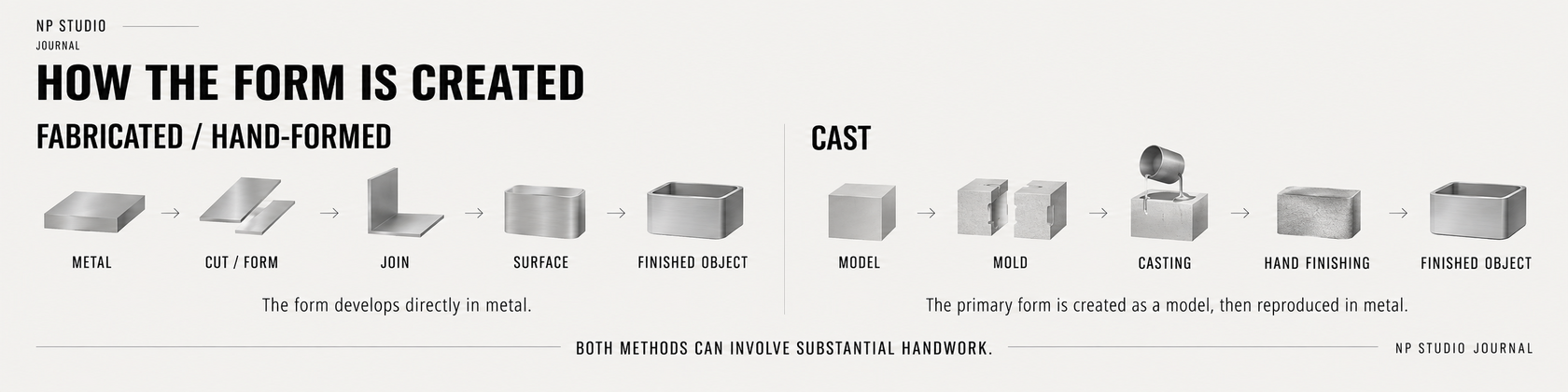
Fabrication can involve cutting, forming, bending, joining and finishing as the object is built. After casting, a piece may still require substantial handwork such as cleanup, soldering, stone setting, grinding, patination and final finishing.
What is fabricated / hand-formed jewelry?
In fabricated jewelry, the metal begins as sheet, wire, rod or separate components. The main form develops progressively in the metal itself through cutting, bending, forging, forming, soldering, assembly and finishing.
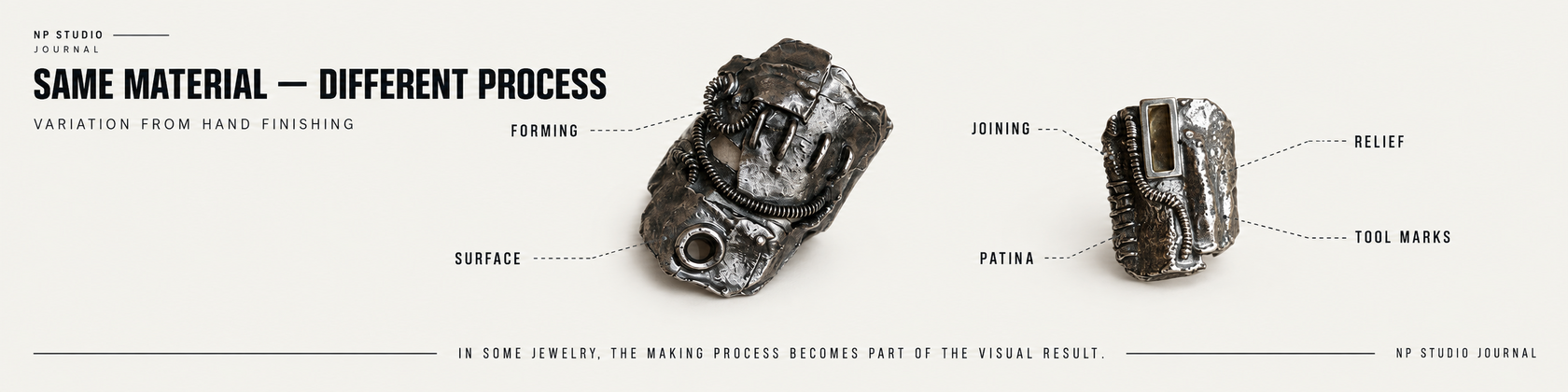
Surface can develop at the same time as the object. A fold, joint, deformation, relief or tool mark may become part of the final visual language rather than a decoration added at the end.
What is cast jewelry?
In cast jewelry, the primary form is first created as a model. That geometry is then reproduced in metal through casting. The casting is usually not the end of the process: cleanup, joining, stone setting, sanding, patination and finishing can all happen afterward by hand.
Casting is used in both artist-led and serial jewelry practice. The process itself does not automatically tell you the quality, scale of production or amount of handwork involved.
The main difference: where the form is created
The clearest distinction is not the word handmade but the stage at which the main plastic form comes into existence.
| Fabricated / hand-formed | Cast |
|---|---|
| The form develops directly in metal. | The primary form is first created as a model. |
| Cutting, deformation and joining happen in the material of the final piece. | Metal reproduces geometry that was defined in the model. |
| Process marks can become part of the surface and construction. | Surface detail may come from the model and then be modified by hand after casting. |
| Variation can arise while each individual piece is being built. | The main volume is easier to repeat, while hand finishing can still introduce differences. |
Can cast jewelry still be handmade?
Yes, in the broad sense. The model can be created by hand, and many operations after casting can also be done manually.
That is why handmade alone tells you relatively little about how the primary form was produced. It is more informative to ask whether the piece was fabricated, cast or made through a mixed process.
Why the surface can look different
In fabricated jewelry, visual character can emerge directly from forging, folding, stretching, soldering, grinding, reticulation, tool marks or hand-applied patina. These operations can change geometry and surface at the same time.
In casting, surface detail may be created in the model, reproduced in metal and then significantly changed by hand afterward.
Neither surface is automatically more “authentic.” The relevant question is how the process serves the intended result.
Repeatability and variation
Direct fabrication can produce more natural variation between pieces, especially when relief and surface are created during the hand-forming process. Even within one design, tool movement and degree of deformation may shift slightly.
Casting makes the main silhouette and relief easier to repeat when the same model is used. But cast pieces are not necessarily identical: cleanup, soldering, stone setting, patination and polishing can still create visible differences.
Does the making method affect the design?
Yes. Strong design usually takes process into account from the beginning. Some forms are more logical to model and cast, especially when their primary geometry would be difficult to build directly from sheet, wire or assembled elements.
Other objects make more sense when they are developed directly in metal, particularly when deformation, construction, layered surfaces or process-driven variation are part of the idea.
The technique does not simply execute an already finished concept; it often shapes what kind of concept is practical in the first place.
How this works at NP Studio
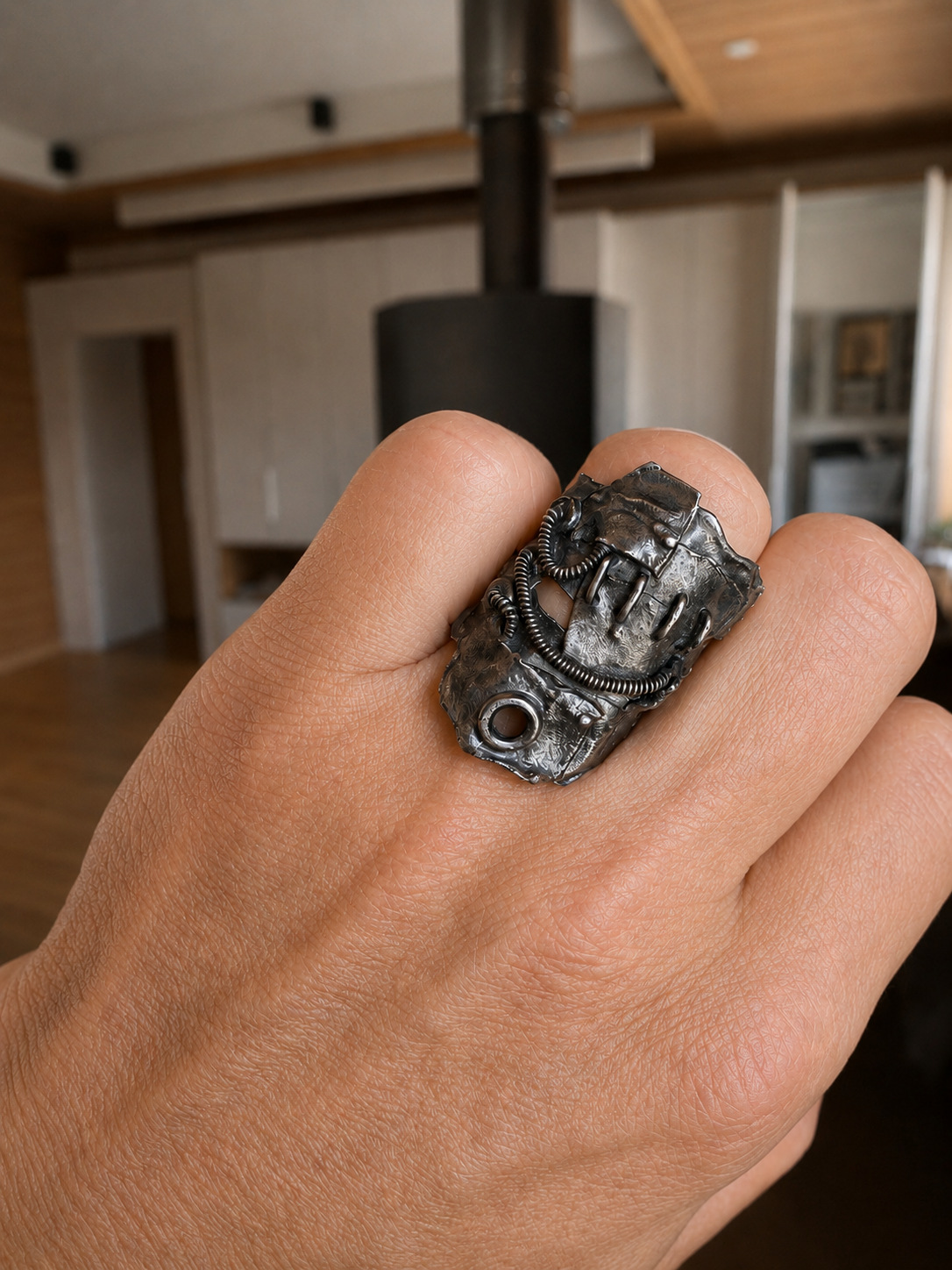
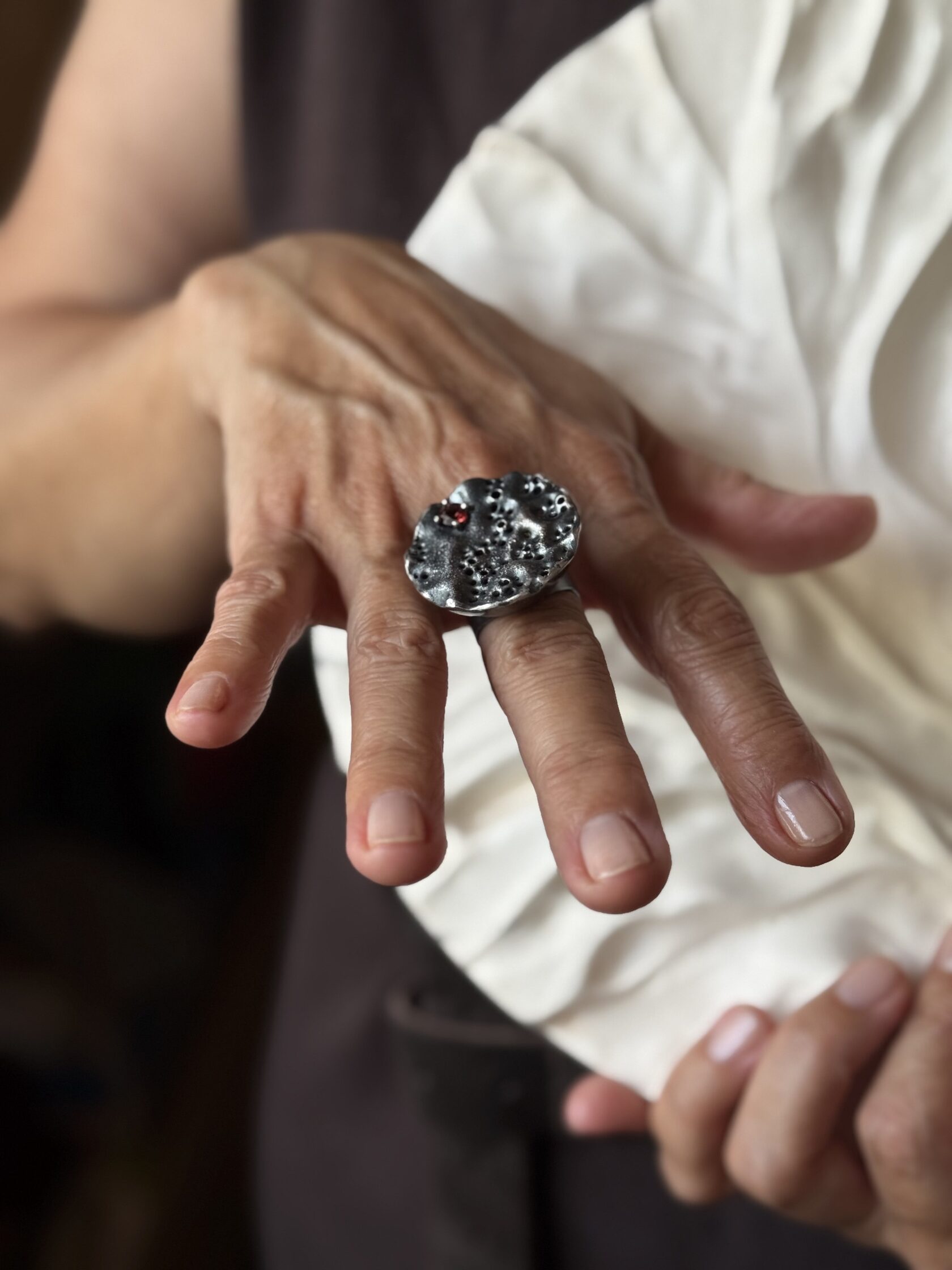
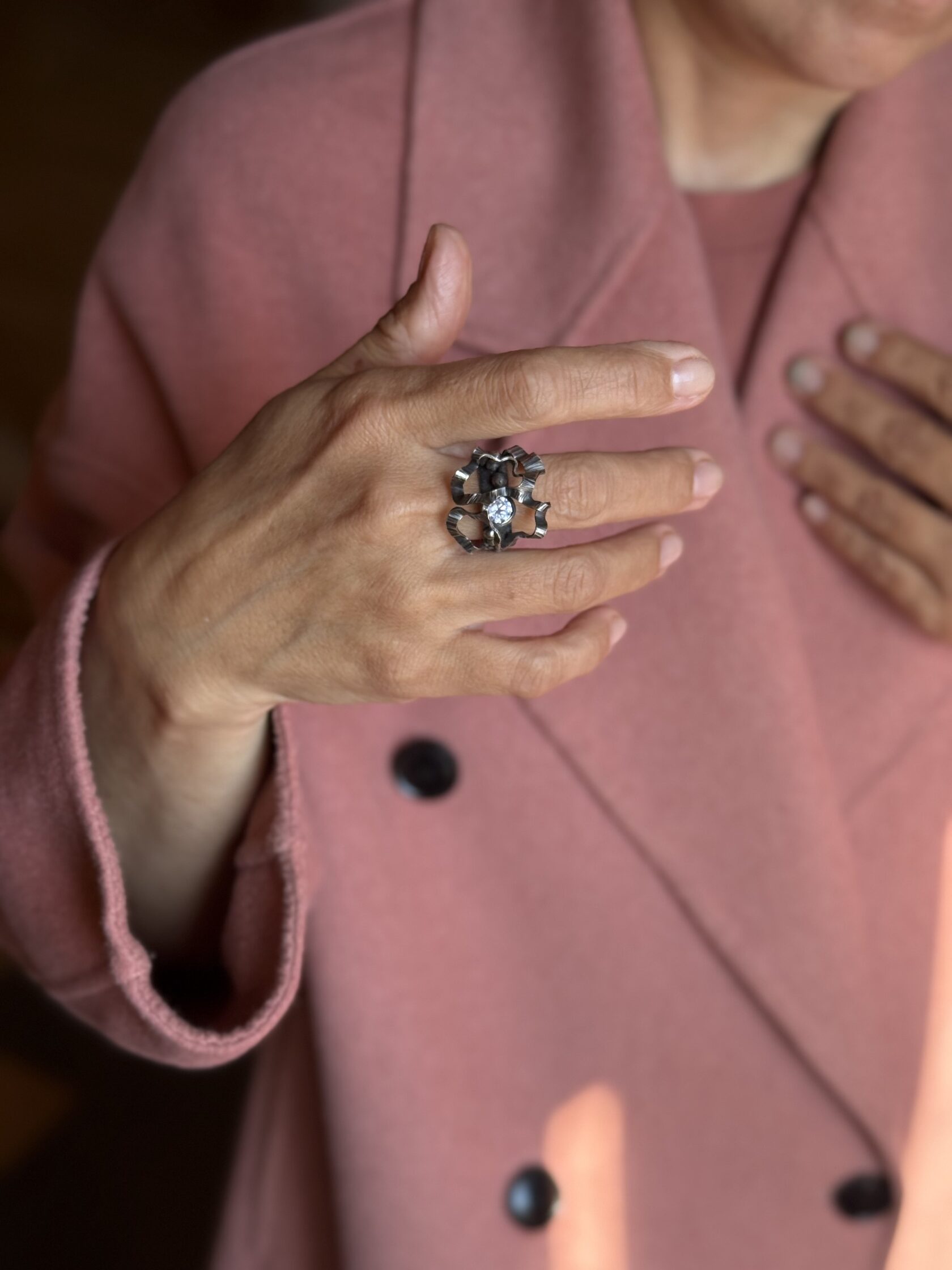
In many NP Studio works, the process of forming metal remains part of the visual result. Surface is not always applied after the form is complete; folds, relief, joining, forming, grinding and patina can develop together with the object.
This does not mean every NP Studio piece is made through one method. The relevant point here is that, in a number of works, the process remains visible and contributes to the final character.
Which is better: handmade fabrication or casting?
Neither method is automatically better. The appropriate process depends on the form, material, intended surface and desired result.
Strength, precision, smoothness and price are not determined by one process name. They depend on design, alloy, thickness, defects, joining, finishing and other variables.
How a buyer should read a jewelry description
The word handmade is useful, but broad. If you want to understand how a piece was actually made, more specific questions are better.
- How was the primary form created? Directly in metal, through casting, or through a mixed process.
- What hand finishing happened afterward? Soldering, stone setting, grinding, patination, polishing or other finishing.
- How individual is the surface? Is it created anew on each piece or largely reproduced from the model?
- Can the piece be repeated exactly? That helps clarify how much variation to expect between examples.
If you are considering a custom piece
For custom jewelry, it can be useful to discuss process as well as appearance. The making method affects what forms are practical, how repeatable they are and what kind of surface can be achieved.
Frequently asked questions
Author
Related NP Studio materials
For the broader idea of jewelry as an object, continue with Jewelry as Wearable Sculpture. For one specific visual language, see What Is Biomechanical Jewelry?. For the value question, see What Makes Handmade Jewelry Valuable?. For the base material, see What Is Sterling Silver?. Real pieces are available in NP Studio Works.
