Steampunk
Usually leans on recognizable retro-mechanical imagery: gears, clockwork, valves, pipes and Victorian engineering fantasy. Biomechanical form does not need literal machine parts.

NP STUDIO / JOURNAL / FORM
Biomechanical jewelry does not need to depict a functioning machine. More often, the term describes a visual language in which organic, bodily or biomorphic form is combined with a sense of artificial structure: rigid, segmented, repeated, layered or deliberately constructed. A metal object can therefore feel strangely alive without containing gears, pistons, hinges or moving mechanisms.
Biomechanical jewelry combines organic or biomorphic form with a sense of artificial, rigid or constructed structure. It does not have to depict a literal machine.
The term is most useful when a piece appears both grown and constructed at the same time.
The word “mechanical” is easy to read too literally. It can suggest gears, pistons, hinges or components that actually move. Yet a piece can feel mechanical before any functional mechanism enters the picture.
Rhythm, segmentation, repetition, hard edges, structural ribs, layered shells and artificial organization can all create that impression. The object may be completely static.
Biomorphic form tends to evoke growth, shell, bone, tissue, cellular structures, erosion or irregular natural development. Even when fully made by hand, it can look as if it emerged from a living process.
Biomechanical form often keeps that organic character but adds a stronger sense of artificial organization: ribs, segmentation, repeated elements, structural tension or a shell that feels simultaneously grown and assembled.
The boundary is not fixed. In real objects, these categories frequently overlap. For the neighboring language on its own, see What Is Biomorphic Jewelry?.
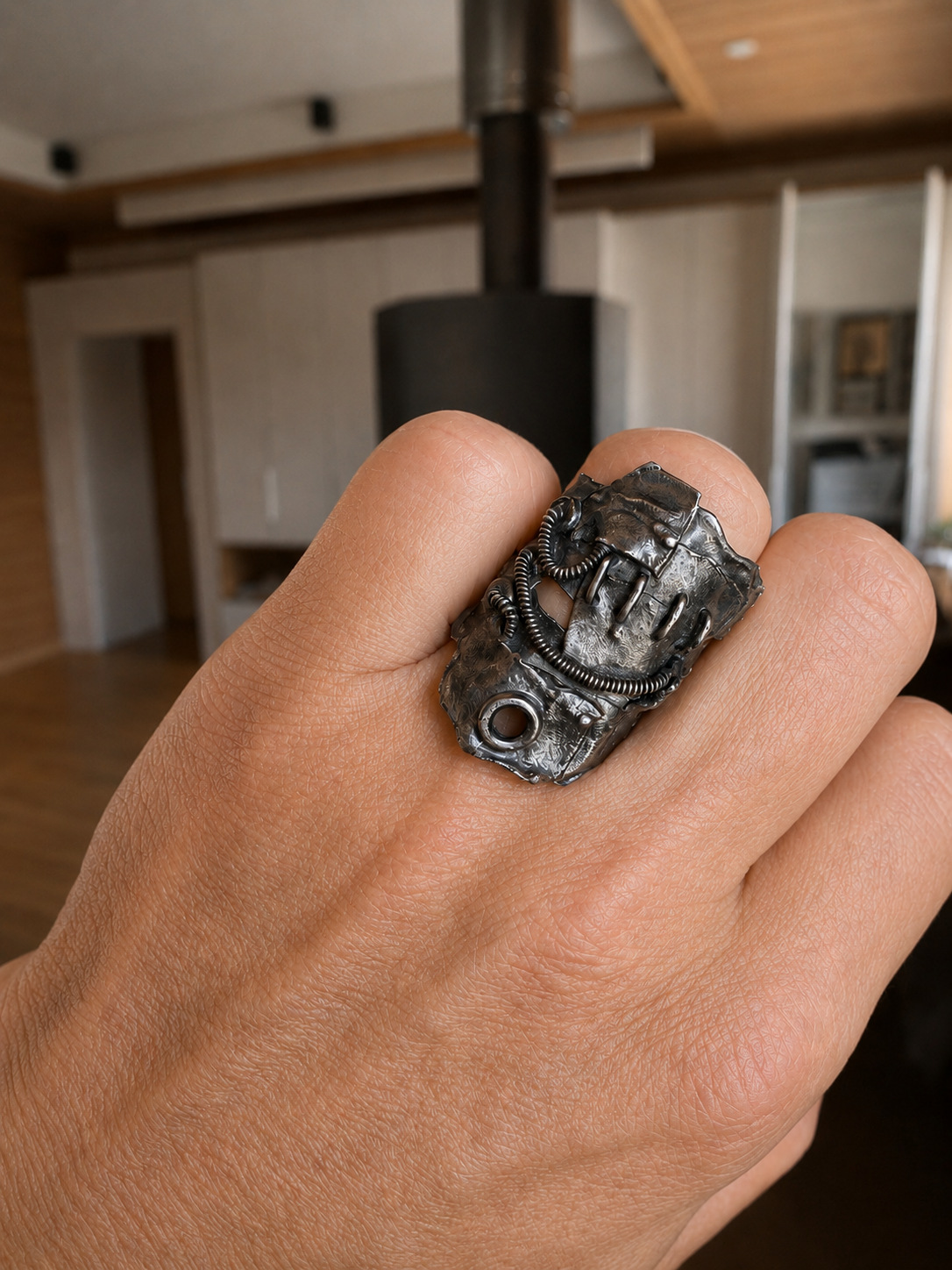
There is no mandatory checklist, but certain formal qualities appear frequently. A single piece may show only a few of them.
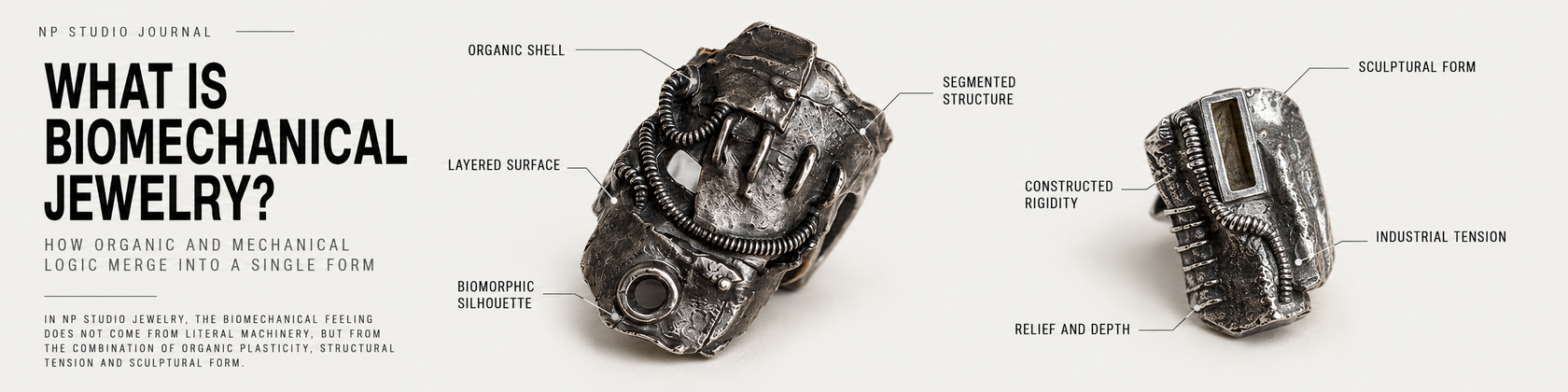
These visual languages can overlap, especially when dark metal and complex construction are involved, but their centers of gravity are different.
Usually leans on recognizable retro-mechanical imagery: gears, clockwork, valves, pipes and Victorian engineering fantasy. Biomechanical form does not need literal machine parts.
Belongs to a much wider technological, digital and urban culture. It can deal with bodies and technology without using biomorphic sculptural form at all.
Can be rigid, metallic and construction-driven while remaining completely non-organic. The biomechanical effect depends more on tension between the artificial and the living.
H. R. Giger made biomechanical imagery especially recognizable in modern visual culture. His work repeatedly fused bodily, organic and artificial structures so that a single form could feel anatomical, architectural and technically organized at once.
That historical association does not mean every piece of contemporary biomechanical jewelry comes directly from Giger or needs to quote his imagery. He is better understood as an important context for why the word carries such a specific visual charge today.
Some NP Studio forms can be read through that broader vocabulary — dark, biomorphic and artificially organized — without reproducing literal machinery or functioning as illustrations of someone else’s style.
At jewelry scale, formal density becomes intense. Relief, shadow, projection and segmentation are physically close together, so the eye reads them as one compact system. Metal sharpens the contradiction: something that looks organic becomes physically rigid.
The body also changes how the silhouette is perceived, but that is a separate, broader subject. A biomechanical ring can be wearable sculpture, yet wearable sculpture is a much wider category →.
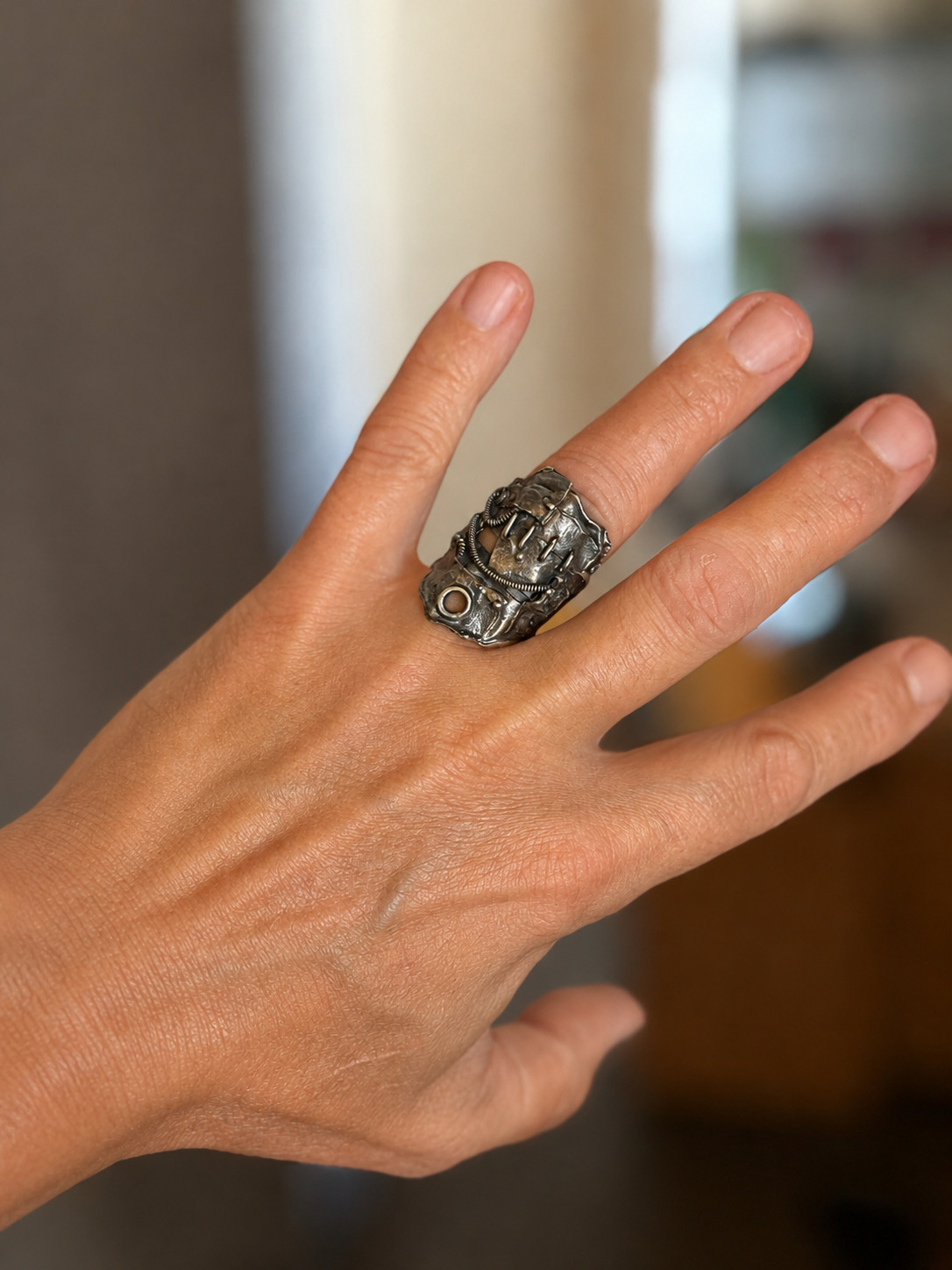
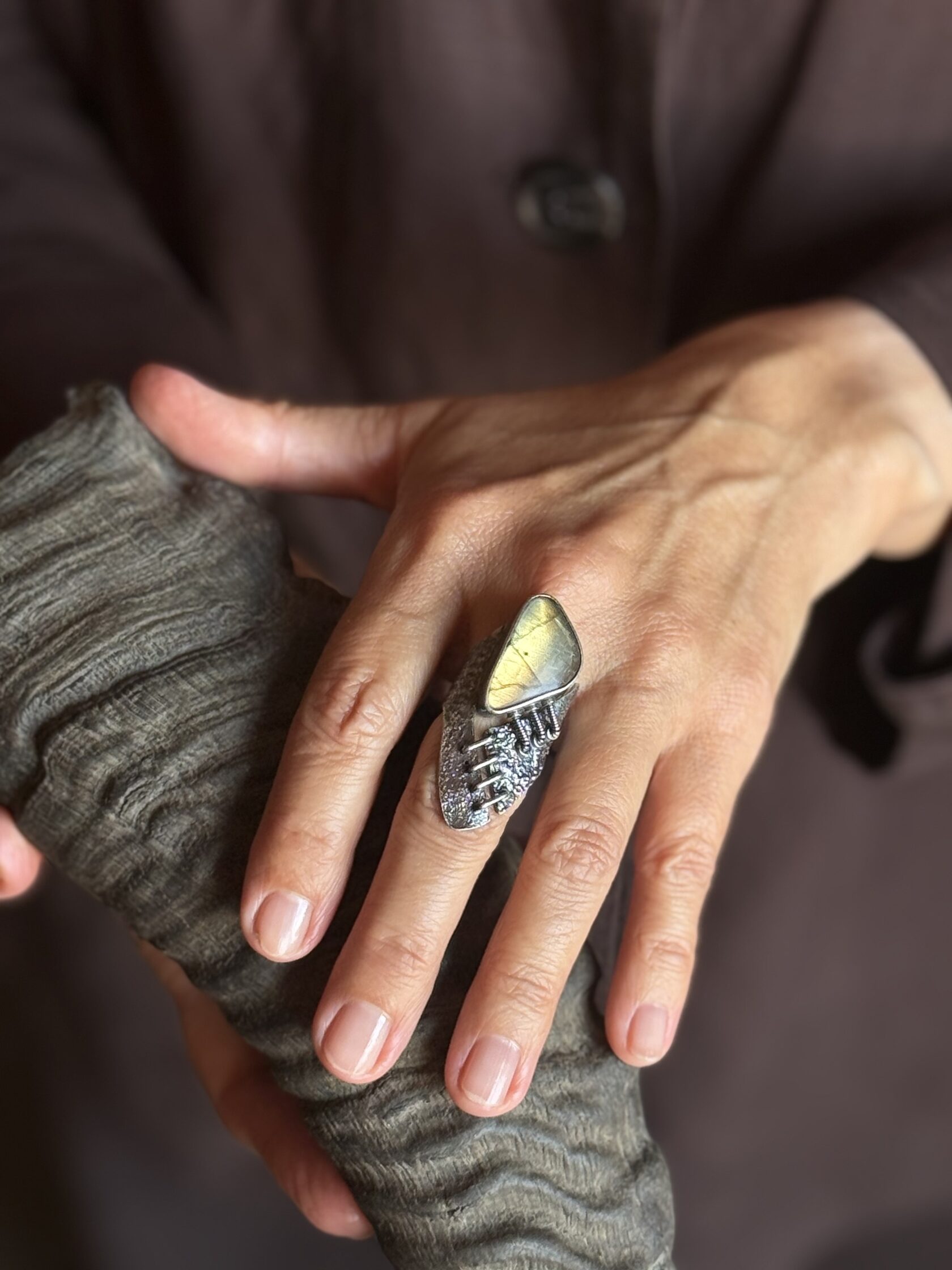
This ring is useful precisely because it shows why the term should not be interpreted literally. There is no need to search the image for a functioning mechanism. The more important qualities are the complex silhouette, deep relief, layered reading of the surface, repeated elements and the sense of an object that has been deliberately organized.
At the same time, the form does not become purely engineering-driven. Its edges, recesses and volumes retain an almost bodily tension. That combination — rather than hidden mechanical function — is what makes the piece legible through a biomechanical aesthetic.
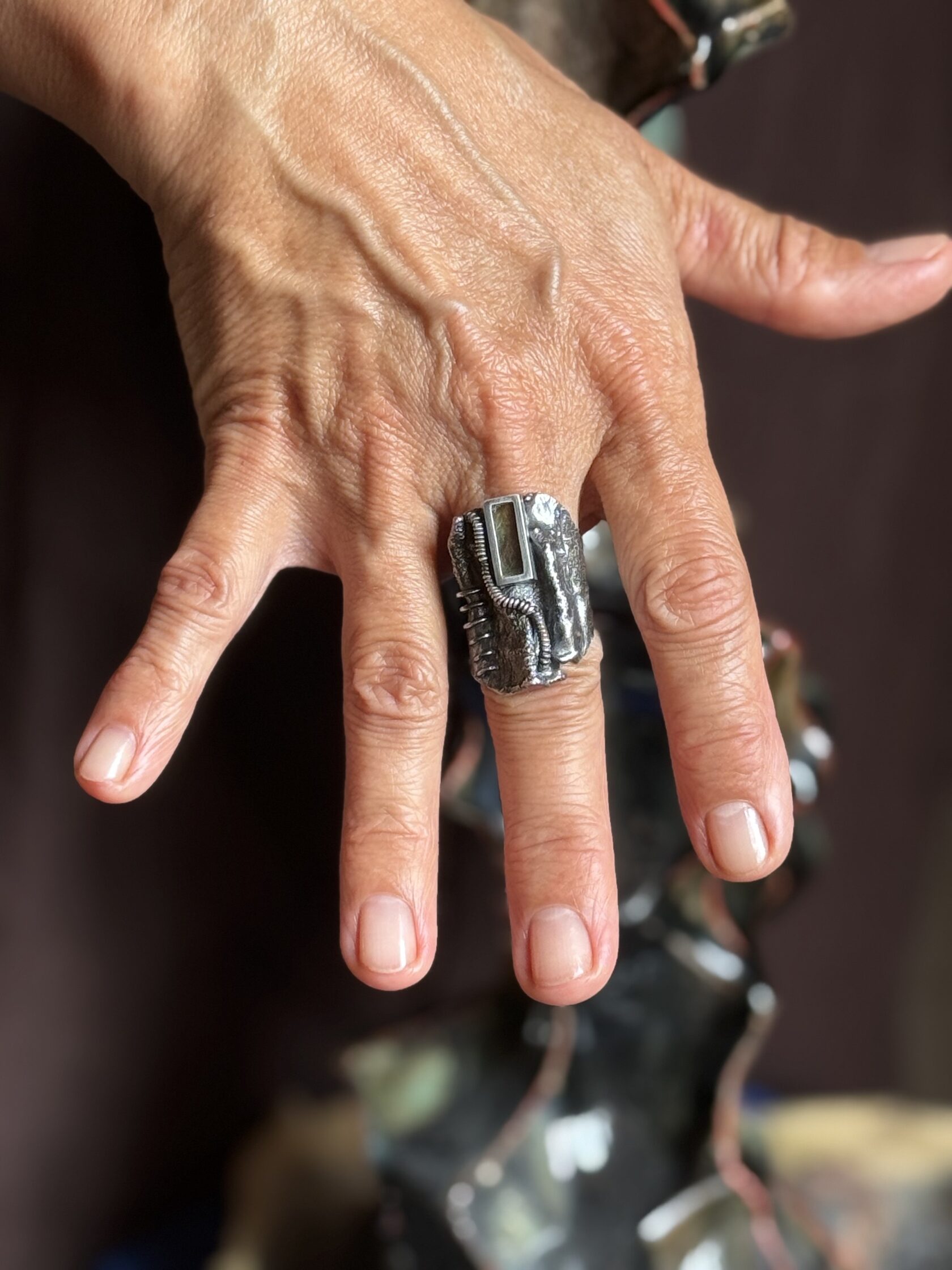
Bio with Labradorite makes the contrast between natural mineral and constructed silver especially clear. The stone remains recognizably geological, while the metal around it does not behave like a neutral frame.
The silver body has its own relief, segmentation and sculptural logic. Stone and metal therefore read as parts of one system in which the natural and the artificial are not separated by a clean border.
“Biomechanical” is useful because it quickly points toward a tension between organic and artificial form. But for many NP Studio works it is not a complete definition.
More precise terms would often be biomorphic, organic-industrial and sculptural. In some pieces the biomechanical aesthetic is strong; in others it almost disappears. Not every NP Studio work belongs to this direction.
Silver matters here not because the metal is inherently “biomechanical,” but because it can hold a rigid sculptural form and strong relief. Dark recesses make depth more legible, bright high points sharpen the structure, and matte, polished or oxidized areas can change how one silhouette is perceived.
Surface works with the form rather than sitting on top of it as decoration. For the material itself, see What Is Sterling Silver? →.
Not every unusual ring is biomechanical. A geometric, minimalist, purely architectural or botanical piece can be highly unconventional while using a completely different visual language.
The most useful test is not complexity or “strangeness.” It is the tension between an organic sensation and an artificially organized structure. If that tension is absent, the label probably adds little.
If your question is about choosing a particular artist-made ring rather than defining its style, use the separate guide: How to Choose a Unique Silver Ring →.
If you are interested in the broader idea of jewelry as an object, continue with Jewelry as Wearable Sculpture. If the question is how to choose a particular artist-made ring, see How to Choose a Unique Silver Ring. Real objects are available in NP Studio Works.
