
NP STUDIO / JOURNAL / BUYER'S GUIDE
How to Choose a Unique Silver Ring: Buyer's Guide
Choose a unique silver ring by looking beyond one dramatic feature. Consider how form, construction, surface, stone and fit work together. A strong artist-made ring should make sense not only in a product photo: you should understand its scale on the hand, material, weight, care needs, sizing limitations and whether it is a finished piece, prototype or direction for a custom commission.
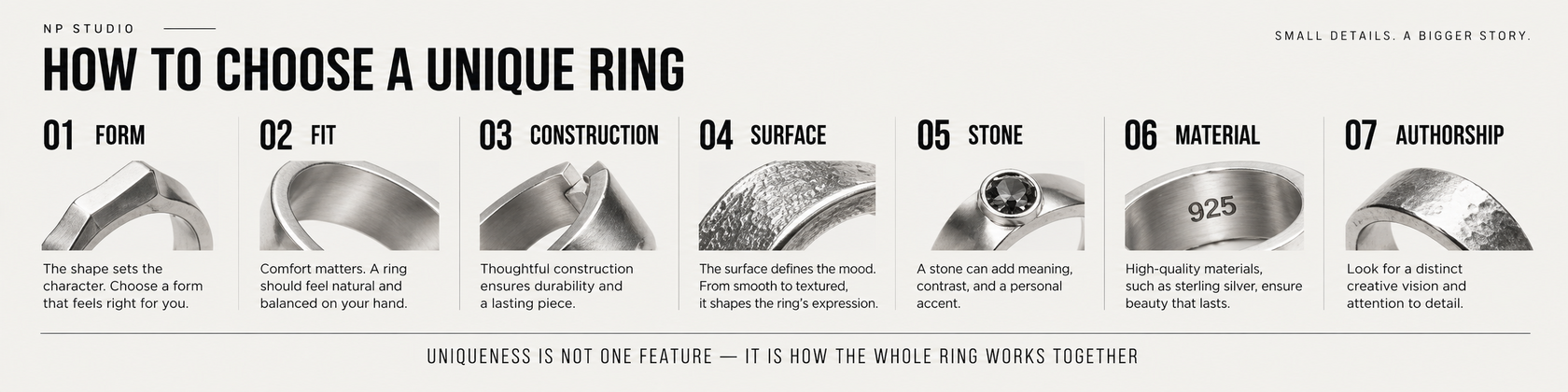
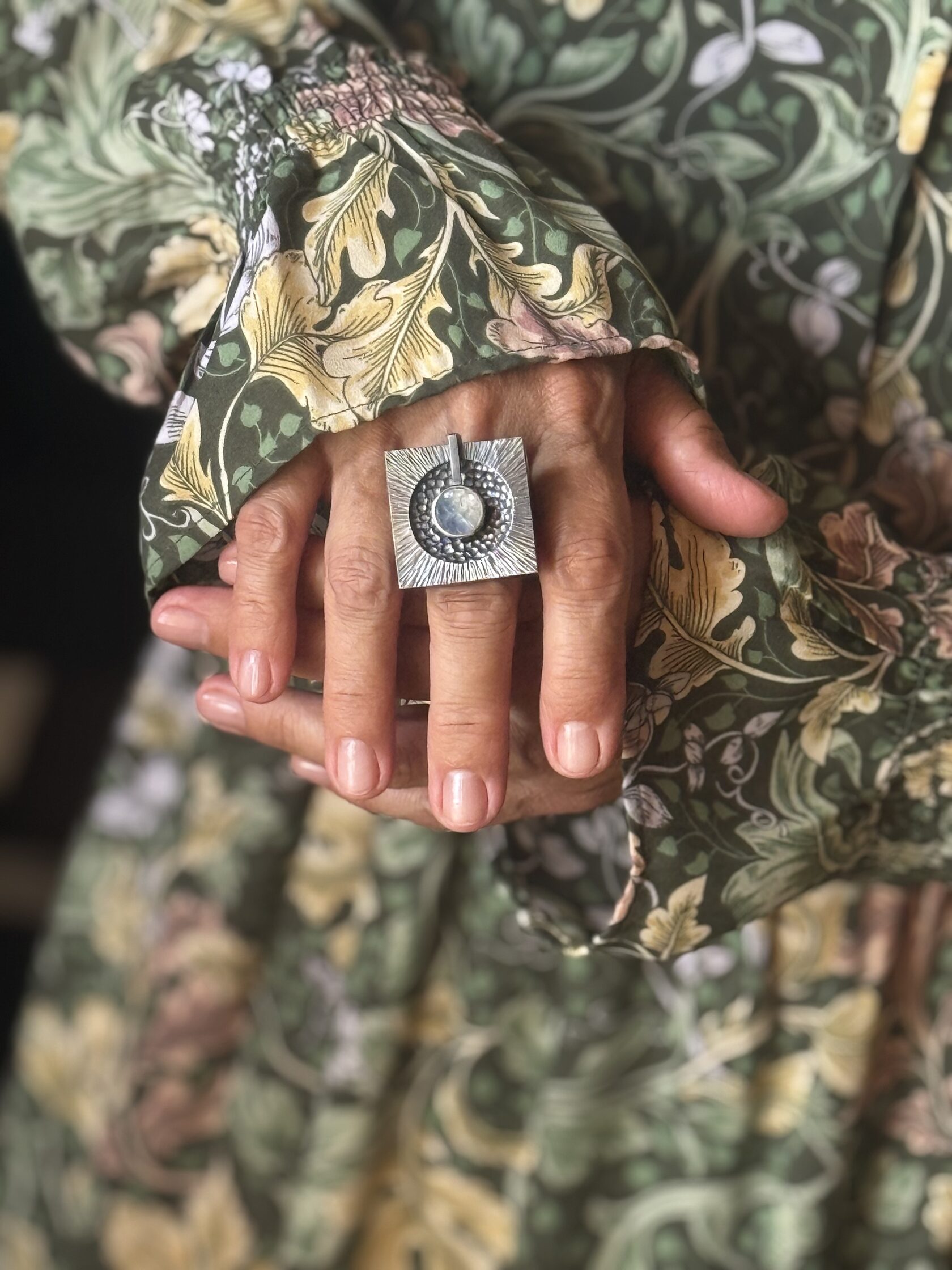
Short answer: what to look for in a unique ring
Evaluate the ring as a complete object. A dramatic shape does not make up for poor wearability, an expensive stone does not automatically create a strong composition, and handmade does not automatically mean high quality.
Look at silhouette, fit, construction, surface, stone, material and authorship, then understand whether the piece is finished work, archive, prototype or a direction for custom work.
What does “unique silver ring” actually mean?
There is no single standard for unique. A ring may stand apart because of silhouette, surface, stone, asymmetry, scale, construction, process or the fact that the exact result cannot be repeated.
A better question than “how strange is it?” is “what makes this a distinct object, and does the idea hold together?”
Uniqueness should have an internal logic
A strong artist-made ring usually does not feel like a random stack of special effects. Form, surface, material, stone and scale support one another.
1. Start with the silhouette
The silhouette is what reads first from a distance. Is the ring compact or a statement piece, vertical or wide, architectural, organic or sculptural?
Compare different directions in the NP Studio collections →.
2. Look at the ring on a hand, not only in a product photo
On a hand, you can understand scale, height, width, projecting elements, balance and how the form relates to the fingers.
For fit itself, use How Should a Ring Fit? →.
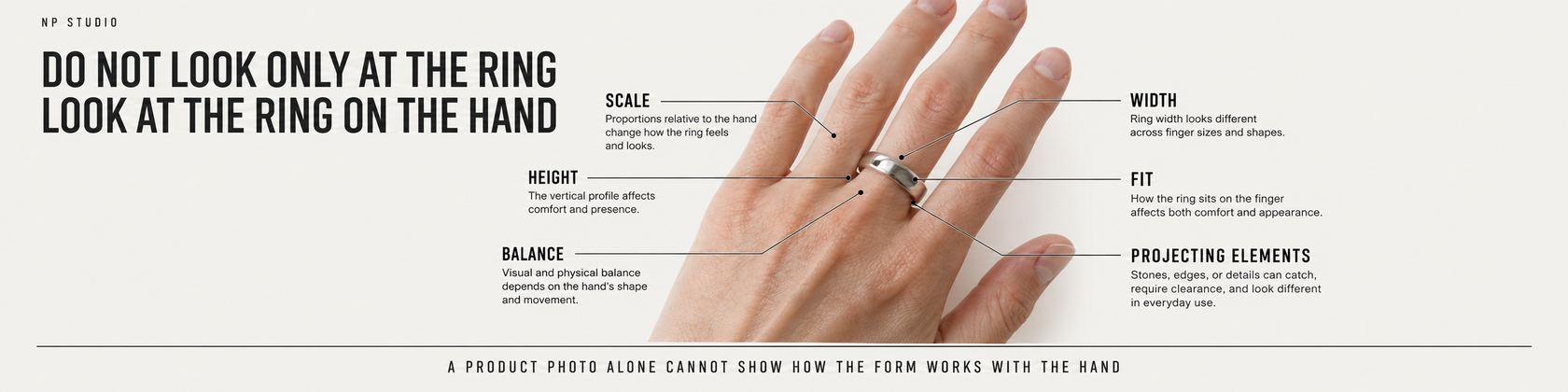
3. Check the construction
Look at the shank, inner surface, projections, stone setting and balance of a heavy top. If a photo does not answer a question, ask the maker about catches, setting, resizing and how the ring behaves in motion.
4. Width, weight and height matter
Two rings in the same size can feel completely different. A wide band often feels snugger than a narrow one, while a tall or top-heavy ring changes balance on the finger.
If fit is uncertain, see How Should a Ring Fit? →, How to Measure Ring Size → and the Ring Size Chart →.
5. Surface can matter more than decoration
Texture, forging, patina, tool marks, reticulation, matte, satin or polished finishes can be part of the idea itself.
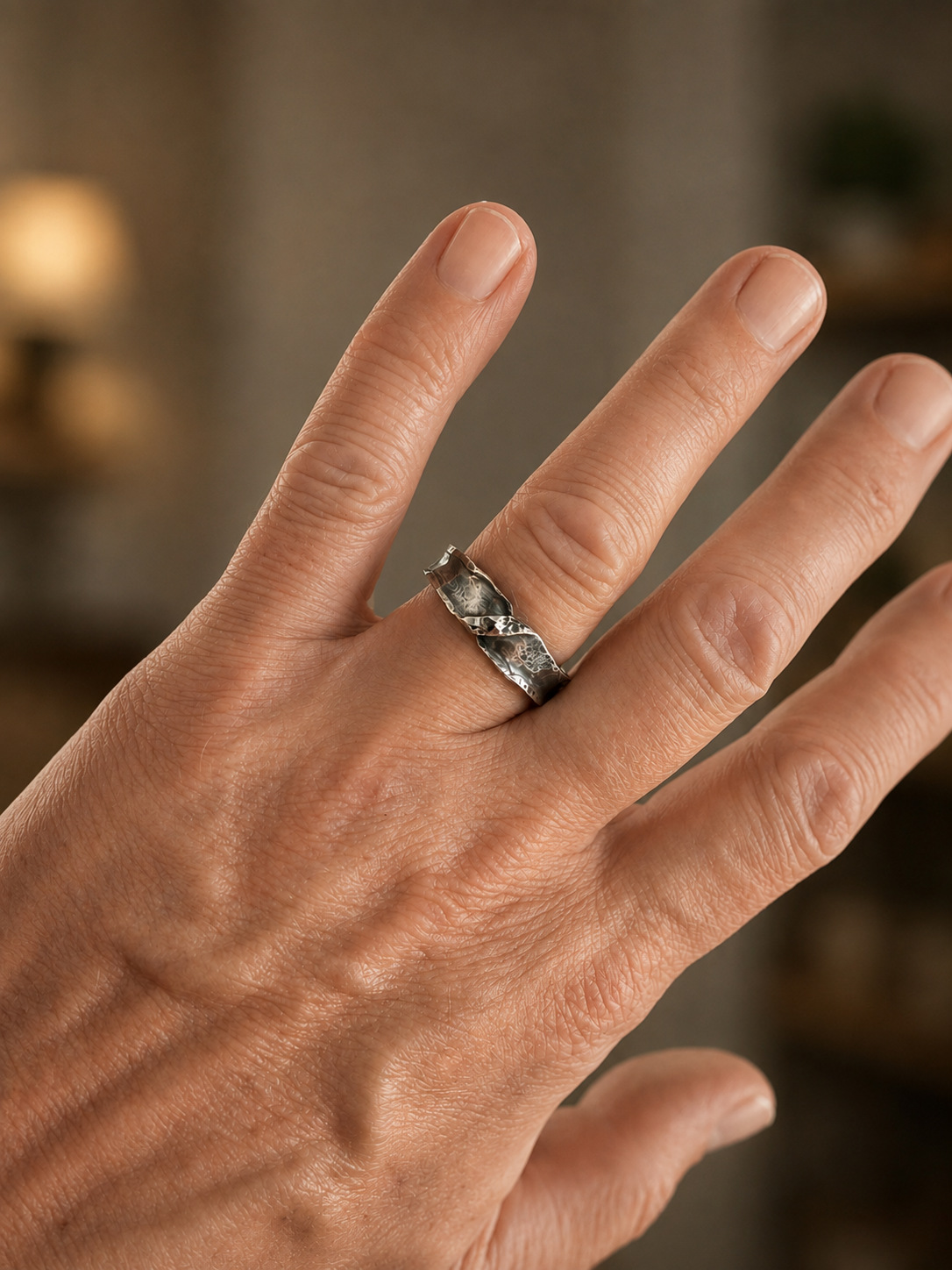
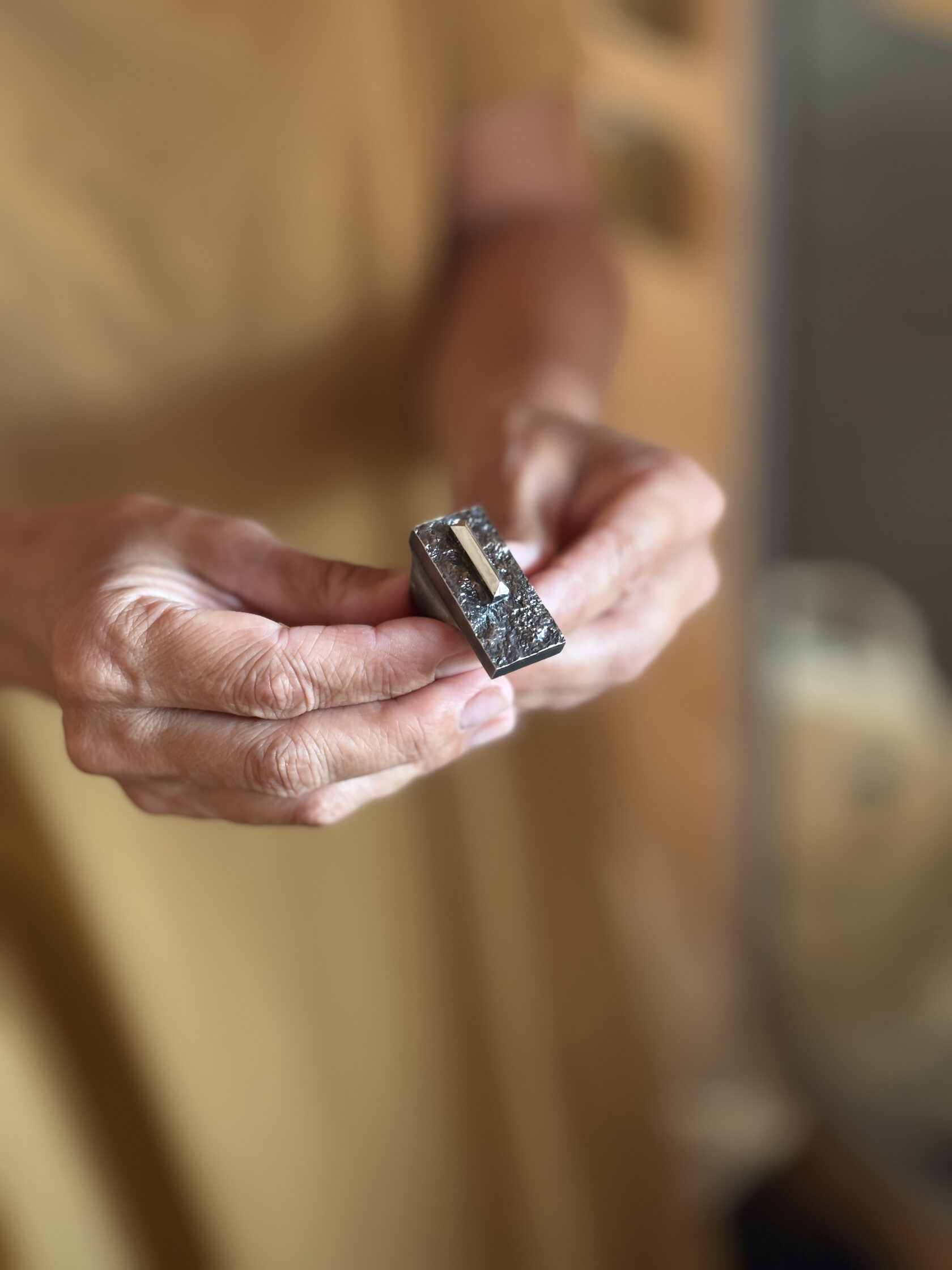
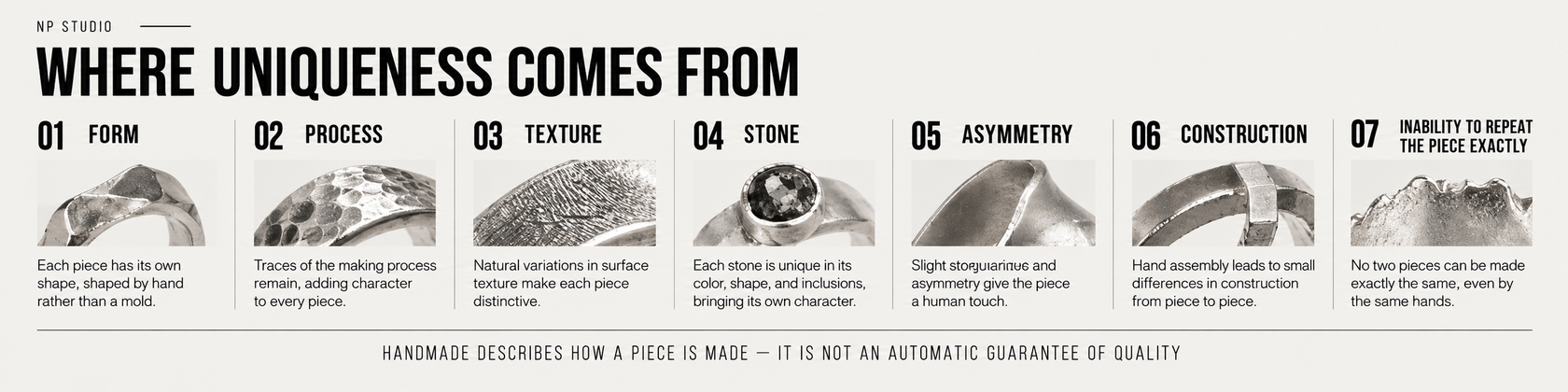
6. Understand where the uniqueness comes from
Uniqueness can come from form, process, a particular stone, asymmetry, material, construction or the impossibility of repeating the exact result. Handmade describes how something was made; it is not an automatic guarantee of one-of-a-kind status or quality.
7. The stone should belong to the form, not just add price
Judge scale, color, shape, setting and the way the stone relates to the metal. A natural stone is not automatically better than a synthetic material or glass in an artist-made ring.
8. Sterling silver 925 matters, but the hallmark does not answer everything
A 925 mark tells you about fineness and alloy composition. It does not tell you whether the design is resolved, comfortable or distinctive.
See What Is Sterling Silver? →, What Does 925 Mean on Silver? →, How to Tell If Silver Is Real →, and How Sterling Silver Is Made.
9. Look at authorship and consistency across the work
A named maker, a visible body of work, real on-hand photographs, understandable materials and a consistent visual language are useful signals. A large brand or art-school credential is not required.
10. Uniqueness and quality are not the same thing
A buyer still needs to understand material, construction, stone setting, surface, care and serviceability. An unusual form does not cancel practical questions.
11. Finished work, archive, prototype or custom commission?
At NP Studio, older work can be a starting point for something new. Explore works → or custom work →.
12. When a finished ring makes more sense
Choose finished work when you want that exact object and value knowing the precise stone, form and surface in advance.
13. When a custom commission makes sense
Custom work makes sense when you connect with the maker’s language but need a different size, stone, scale or a new version of the direction.
14. Questions to ask the maker before buying
- What silver alloy is the ring made from?
- What is the exact ring size?
- What are the width, height and approximate weight?
- Are there photos of the ring on a hand?
- How is the stone secured?
- Is there patina or another surface treatment?
- What care does the piece require?
- Can the ring be resized?
- Is it a finished work, prototype or custom commission?
- Can it be repaired or serviced if needed?
For care separately, see How to Care for Sterling Silver →, Can You Wear Sterling Silver Every Day? → and How to Store Sterling Silver Jewelry →.
15. Red flags — without turning this into a scam checklist
Clarify details if the material is described only as “silver” with no understandable fineness, there are no on-hand photos for a very unusual form, the size is unclear, the stone is unidentified, or the photos never show the construction.
It is also reasonable to ask what one-of-a-kind actually means and whether a promise of an exact copy is realistic when a handmade surface naturally varies.
16. How to tell whether the unusual ring is right for you
Ask whether you still like the form after the first surprise wears off. Are you comfortable with the scale, texture, patina and natural surface changes? Do you want a statement object or a quieter piece?
17. Price: what are you actually paying for?
Price can reflect silver and weight, stone, time, construction, surface complexity, development of the form, one-off production and custom work. There is no universal formula for a fair price, and expensive does not automatically mean better.
18. How I would choose an unusual ring
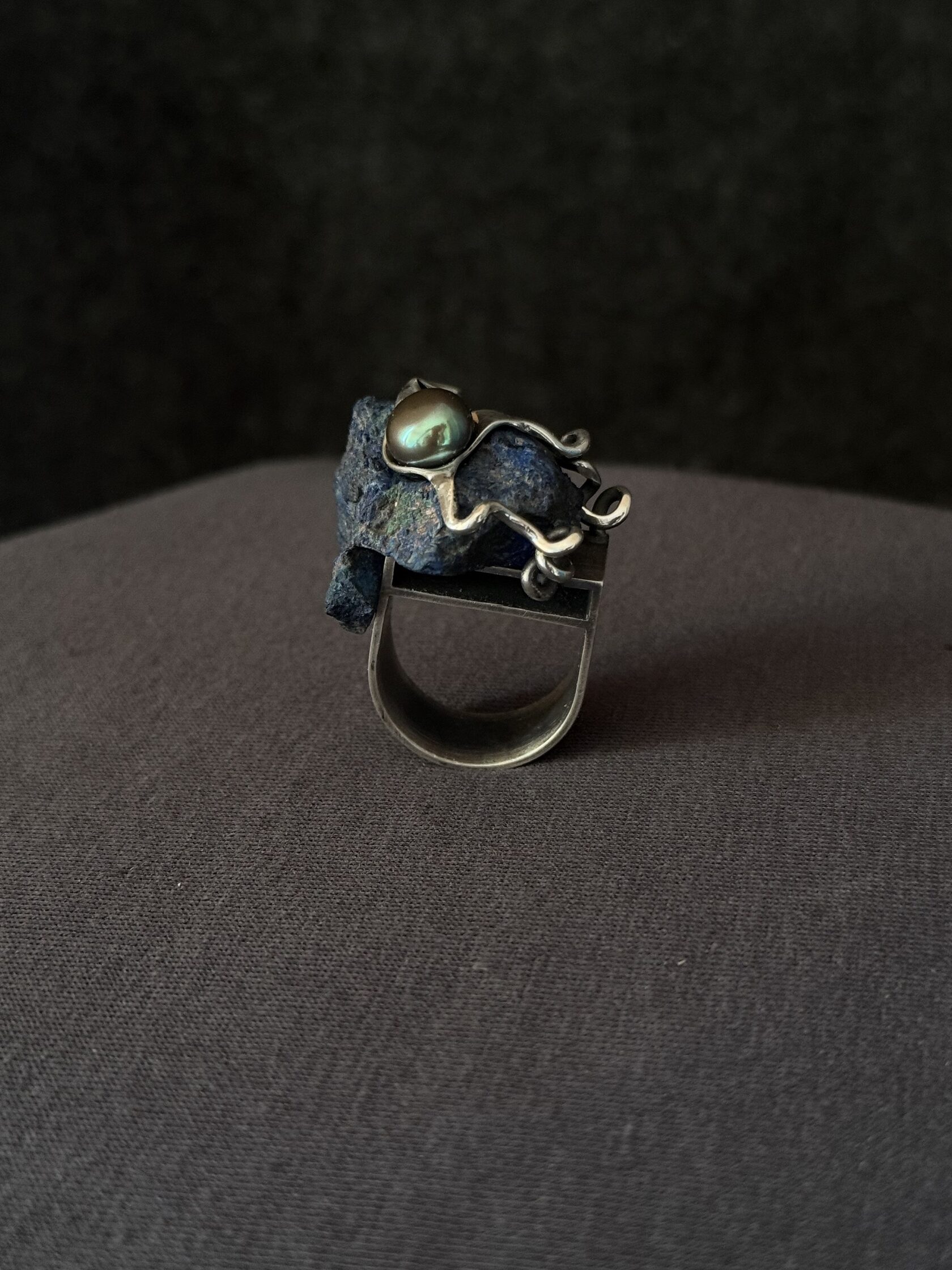
I would start by looking at whether the piece has its own logic, not at how many unusual details it contains. A good ring should still be interesting after the first surprise fades. I care about silhouette, surface, construction and how the ring exists on the hand.
I would always look for photos on a finger and ask about size, weight, stone and care.
19. How this works at NP Studio
Pieces on the site may be finished, sold, archival or prototypes. An older work can become a starting point, but exact repetition is not the goal.
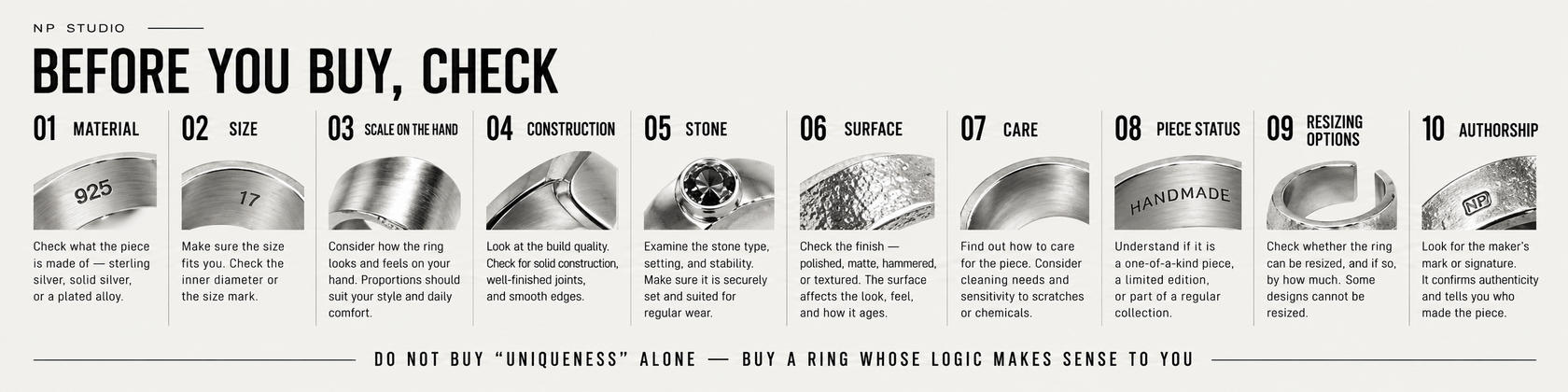
20. Quick checklist before you buy
- Material.
- Size and fit.
- Scale on the hand.
- Construction.
- Surface finish.
- Stone.
- Authorship.
- Piece status.
- Care requirements.
- Repair or resizing options.
- Whether you like the logic of the piece, not just the fact that it is unusual.
Frequently asked questions
Related NP Studio guides
Before buying an unusual ring, it helps to check how a ring should fit, understand what sterling silver is, and explore real NP Studio works. If you want a new piece developed from a direction you like, you can discuss a custom commission.
