
NP STUDIO / JOURNAL / CARE
How to Store Sterling Silver Jewelry
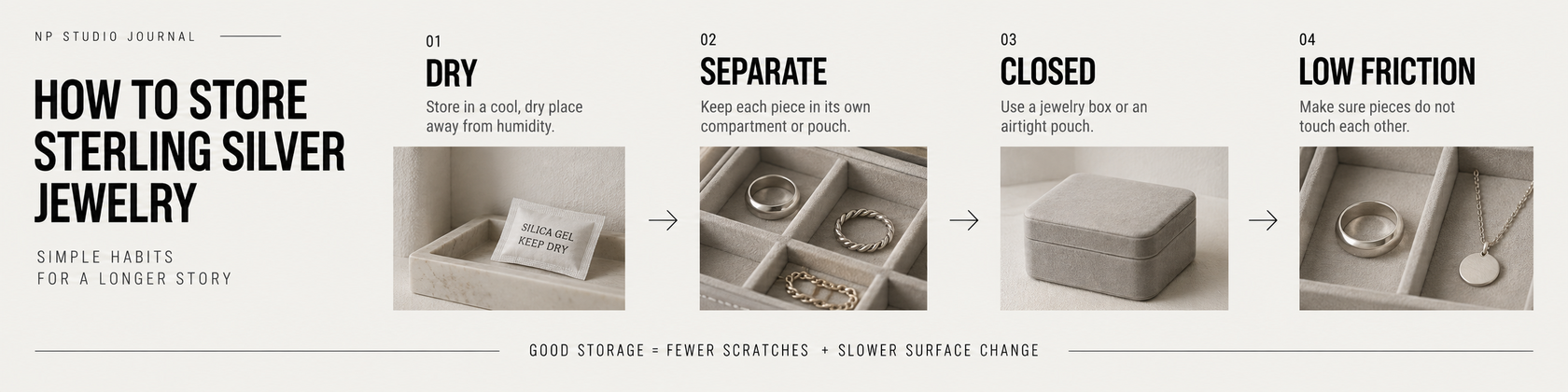
Store sterling silver jewelry in a dry, closed place and, whenever practical, keep pieces separate. Rings, chains, earrings and stone-set jewelry should be arranged so they do not rub, tangle or press against one another. For long-term storage, the piece should be completely dry before it is put away.
Where should sterling silver jewelry be stored?
A good everyday storage location is simply a dry, closed space in a living area: a jewelry box, drawer, compartmented case or similar container that protects pieces from persistent humidity and unnecessary contact.
You do not need laboratory conditions. Avoid persistently humid storage conditions, frequent steam and sharp temperature changes.
Direct sunlight is also unnecessary as a permanent storage environment. A closed box or drawer is usually more practical than leaving silver exposed on an open surface.
Why the bathroom is a poor storage location
Bathrooms repeatedly cycle through humidity, steam and temperature changes. They also contain aerosols, cosmetics and household products, so they are a less stable long-term storage environment than a dry room.
This does not mean a silver piece is damaged by simply being in a bathroom once. The point is choosing a sensible permanent storage location.
For tarnish prevention specifically, see How to Prevent Sterling Silver from Tarnishing →
Jewelry box, soft pouch or airtight bag?
Should each piece be stored separately?
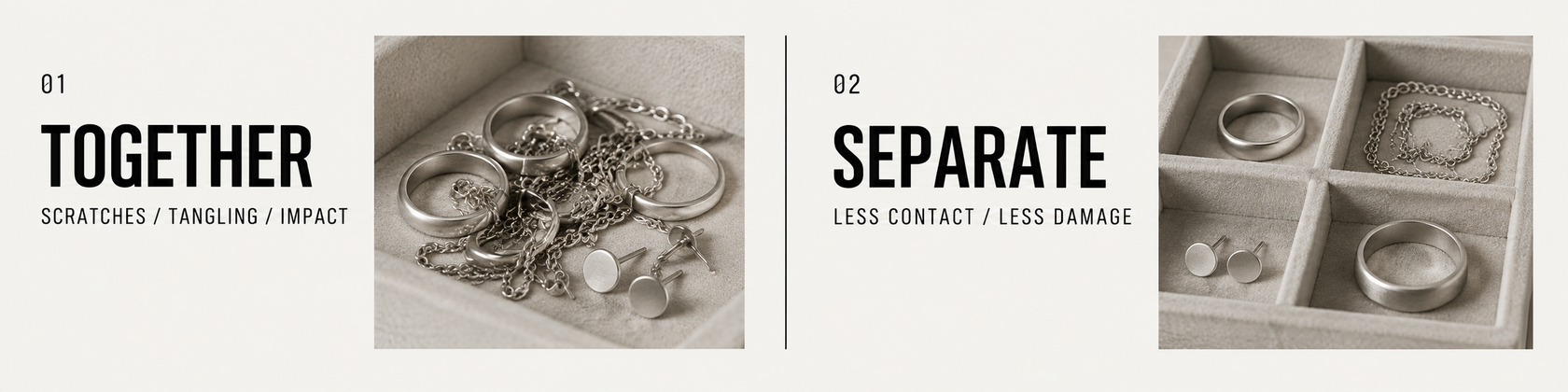
Preferably, yes. Separate storage is not only about tarnish. It reduces scratching, impact, friction, tangled chains and contact between stones and neighboring metal surfaces.
This matters especially when pieces differ in weight and shape: a heavy ring can press on a delicate earring, while a stone can scratch the silver surface of another piece.
How to store sterling silver rings
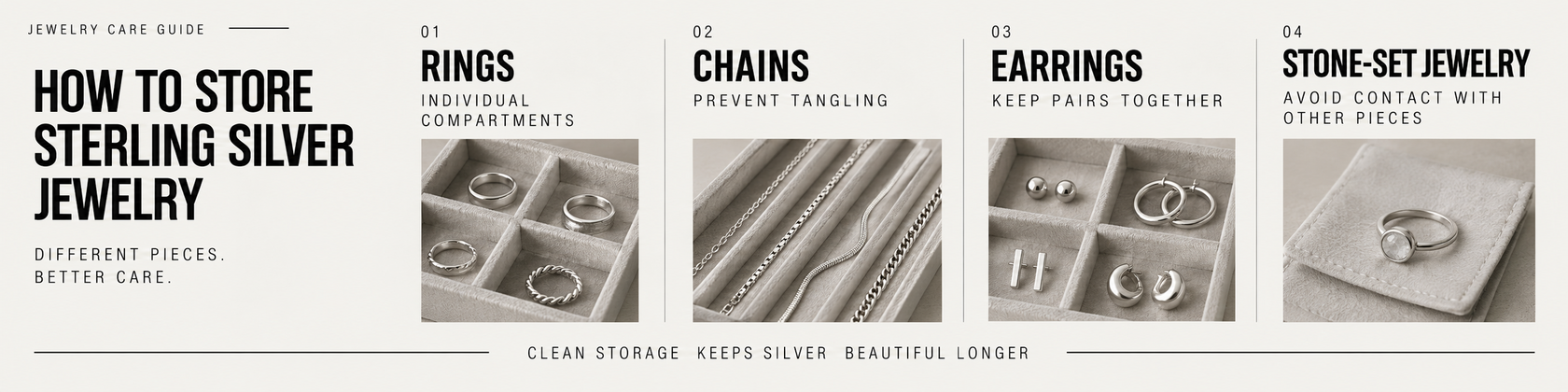
Rings work well in individual slots, small soft pouches or divided box compartments. The main goal is to prevent constant rubbing against other pieces.
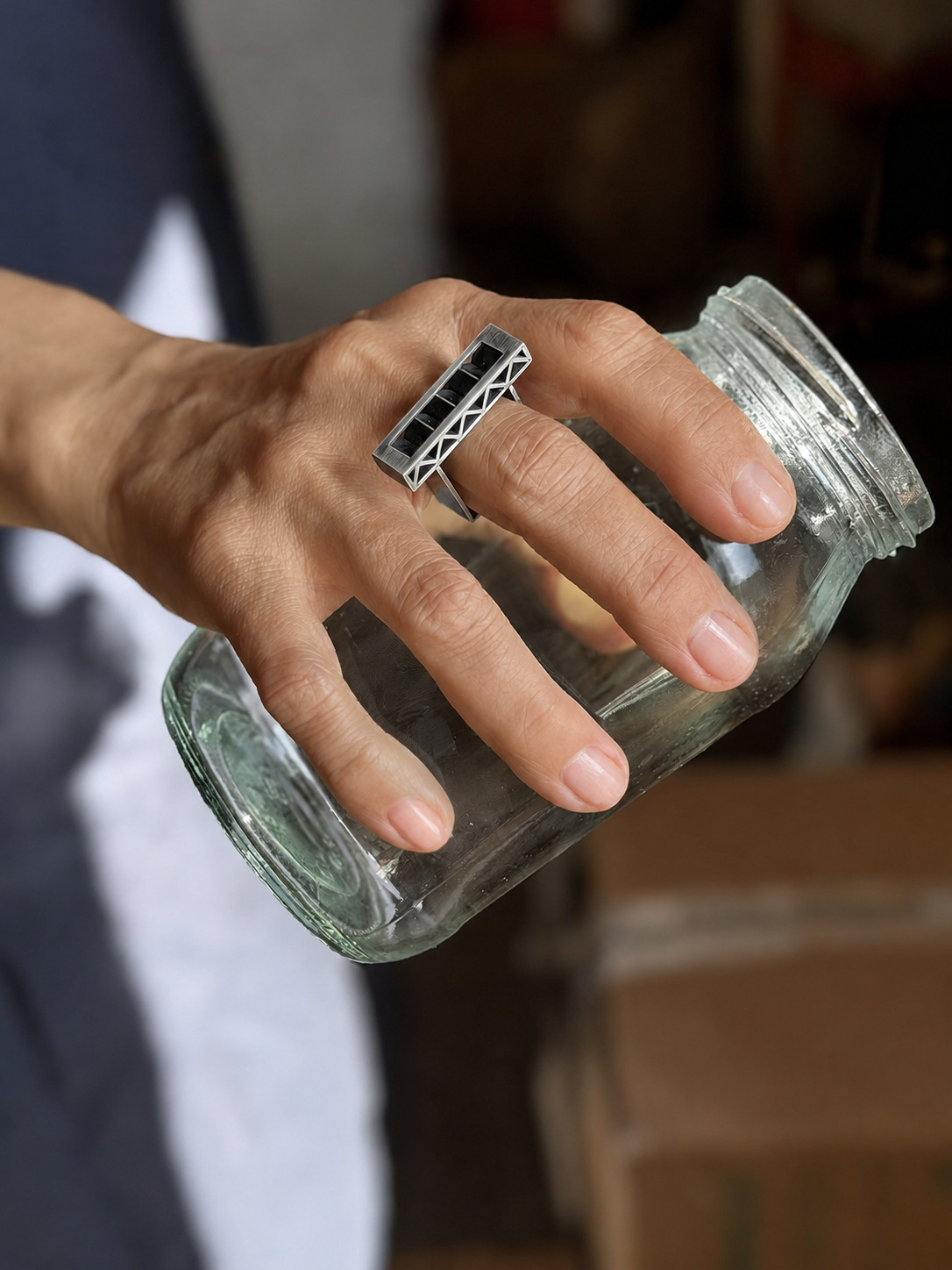
Take extra care with raised settings, large stones, sharp architectural details and thin projecting elements.
How to store silver chains
The main problem with chains is tangling. Keep them separate and fastened rather than putting several chains into one small pouch.
Longer chains can be stored laid out or hanging if the storage system prevents snagging and accidental falls.
How to store earrings
Keep earrings as pairs. Thin posts, long earrings and complex moving elements can deform more easily if heavier jewelry is placed on top of them.
A shared box is fine when it has dividers and the pieces are not pressing against one another.
How to store jewelry with stones
A stone may be harder than silver and can scratch a neighboring piece. At the same time, some stones themselves require more careful handling.
Large settings and jewelry with projecting stones are therefore better stored separately, without heavy objects placed on top and without repeated stone-to-metal contact.
Can sterling silver be stored in an airtight bag?
Yes, especially for long-term storage, provided the piece is completely dry. A closed environment reduces continuous exchange with the surrounding air and also isolates the piece from mechanical contact with other jewelry.
But it is not a mandatory rule. A well-designed jewelry box with individual compartments can also work very well.
Do you need a desiccant packet?
A small desiccant packet or a product designed for jewelry storage is sometimes used inside a closed container, particularly where humidity remains persistently high.
Follow the manufacturer's instructions and avoid placing unknown chemical materials directly against the jewelry surface. A desiccant is an extra tool, not a substitute for normal dry storage.
What are anti-tarnish strips?
Anti-tarnish strips are inserts designed for closed jewelry boxes and containers. They are intended to reduce exposure to certain environmental compounds around metal surfaces.
They are optional rather than essential, and they do not guarantee that a silver surface will never change.
What should not be inside the jewelry box?
Should silver be cleaned before storage?
Before storing it, make sure the piece is dry and does not have obvious moisture or visible residue on the surface.
There is no need for intensive cleaning every time a piece goes back into its box. If it actually needs cleaning, use the separate guide: How to Clean Sterling Silver Jewelry →
How to store matte sterling silver
A matte finish can gradually become smoother through repeated friction even inside a jewelry box. A separate soft compartment or individual pouch helps reduce that contact.
There is no benefit in vigorously polishing a matte surface before every period of storage; doing so can alter the finish itself.
How to store patinated sterling silver
A dark surface may be an intentional part of the design rather than dirt. There is no reason to polish a deliberately patinated piece back to bright white before storage.
Patina can wear on raised areas through repeated rubbing, so separation is particularly useful for these surfaces.

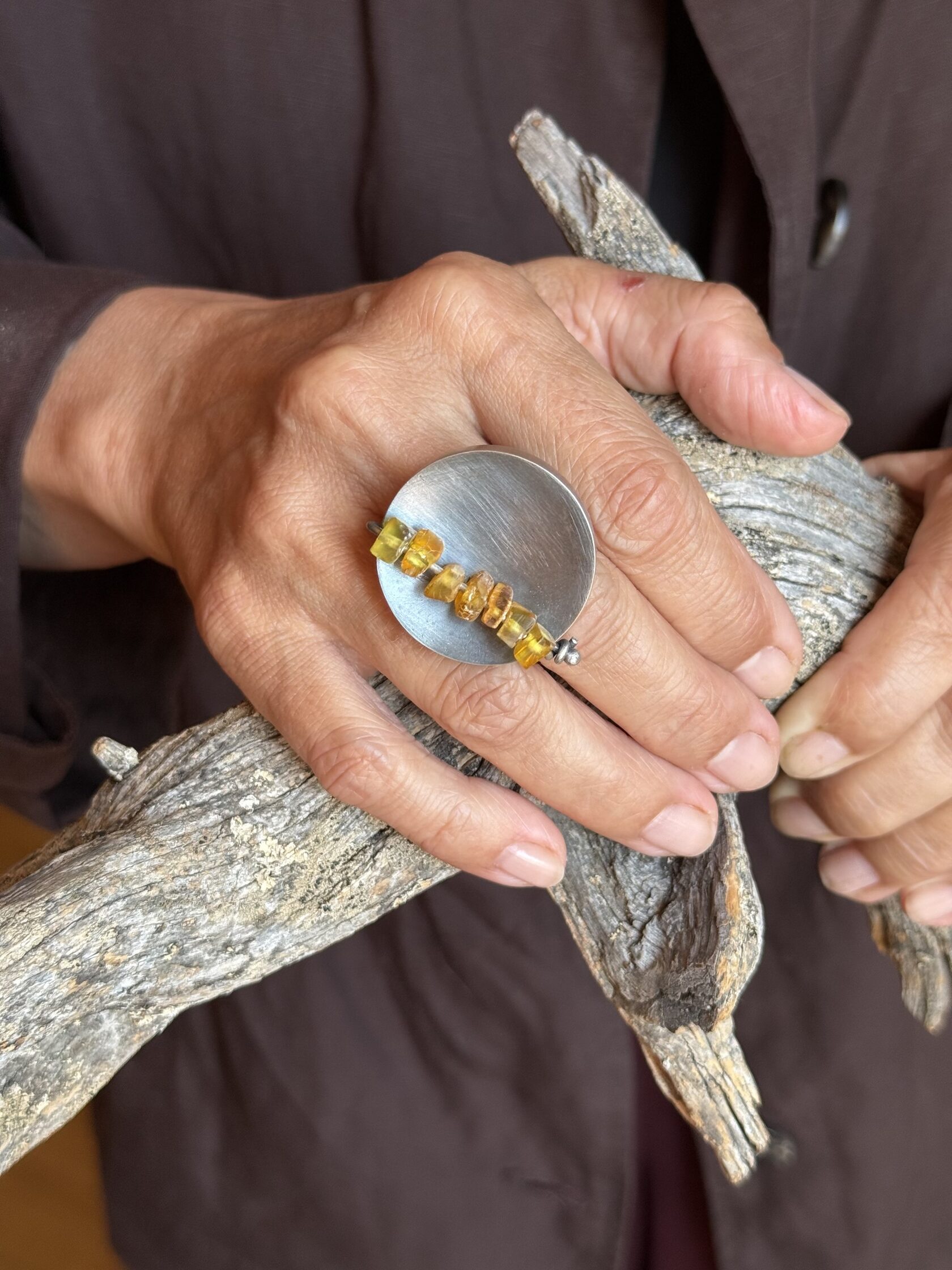
How to store sterling silver long term
For long-term storage, keep the jewelry completely dry, individually protected, enclosed and free from persistent humidity or pressure from other pieces.
There is no need to invent a rigid calendar such as checking every piece once a month. Choosing sensible storage conditions matters more.
How to store sterling silver while traveling
Travel makes separation even more important. Use small individual compartments or pouches, fasten chains, avoid stacking stones against one another, and do not allow heavy objects to press on delicate jewelry.
A large cosmetic pouch without dividers may be convenient for general items, but it often lets jewelry move, rub and tangle continuously.
How we store silver pieces at NP Studio
For me, silver storage starts with protecting the construction rather than fighting every change in surface color. That matters particularly with textured pieces, stones, projecting elements and patina.
A small scratch on a working surface can sometimes matter less than pressure on a thin setting or two objects rubbing against one another for months. So I first try to remove unnecessary mechanical load from the storage situation.
View NP Studio worksHow to store sterling silver jewelry — short answer
Frequently asked questions
READ NEXT / NP STUDIO JOURNAL
