
NP STUDIO / JOURNAL / MATERIAL
How Sterling Silver Is Made
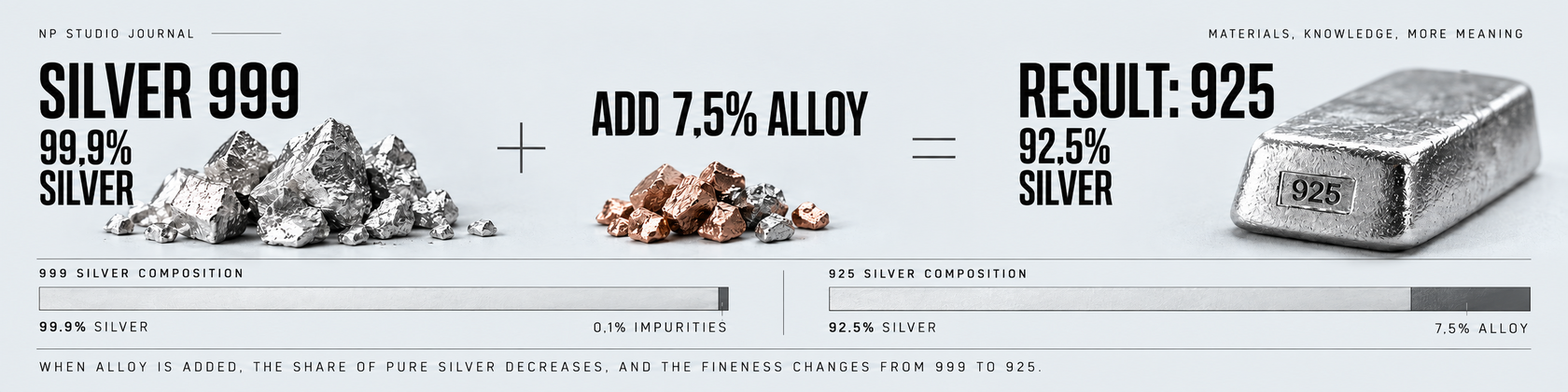
Sterling silver is not mined in its finished form. It is an alloy made by combining high-purity silver with a small proportion of other metals. In the traditional composition, the finished material contains 92.5% silver and 7.5% alloying metals.
What is sterling silver made from?
The base of the alloy is silver. The remaining part consists of alloying metals added to change the working properties of the material. In traditional sterling silver, copper is usually the principal addition.
The percentage is small, but it has a noticeable effect on how the metal behaves during rolling, forming, soldering and everyday wear.
For the meaning of the fineness mark itself, see What Does 925 Mean on Silver?
Why not use pure silver for everything?
High-purity silver is softer and more malleable. That can be useful in some metalworking techniques, but rings, stone settings, clasps and other structural elements often benefit from greater resistance to deformation.
Alloying keeps the silver content high while making the material more practical for most jewelry construction.
For a direct comparison, see Sterling Silver vs Pure Silver. For durability over time, see How Long Does Sterling Silver Last?.
How the 925 composition is calculated
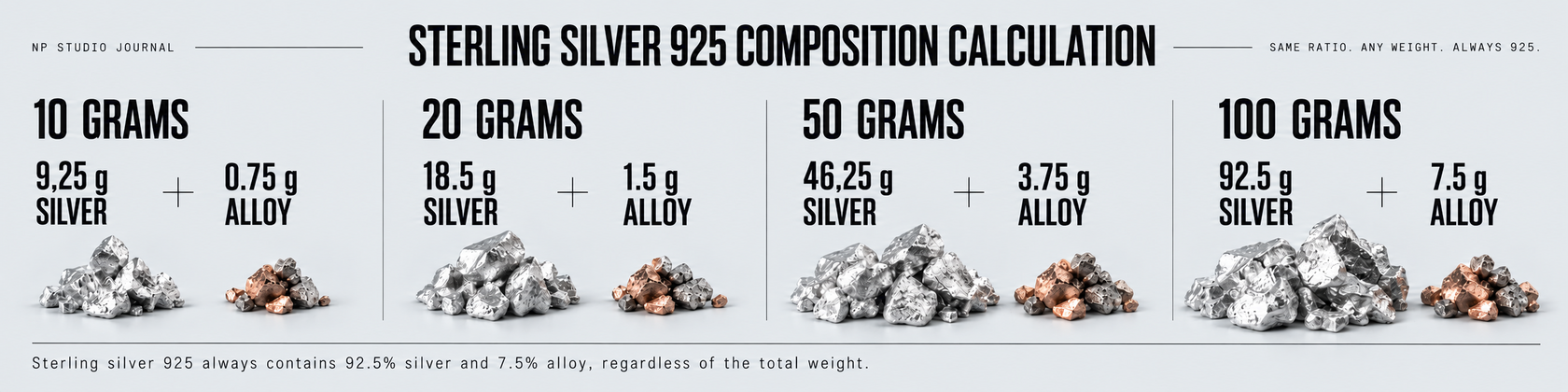
In the final alloy, 92.5% of the mass should be silver and 7.5% should be alloying metal. For 100 grams of sterling silver, that means 92.5 grams of silver and 7.5 grams of alloy.
| Final weight | Silver | Alloy |
|---|---|---|
| 10 g | 9.25 g | 0.75 g |
| 20 g | 18.5 g | 1.5 g |
| 50 g | 46.25 g | 3.75 g |
| 100 g | 92.5 g | 7.5 g |
Preparing the metal
Before melting, the composition of the starting material has to be known. With high-purity silver, the calculation is straightforward. If the starting metal is already an alloy of another fineness, simply adding 7.5% copper will not automatically produce 925 silver.
Accurate weighing, known starting material and control of contamination therefore matter.
Melting and combining the components
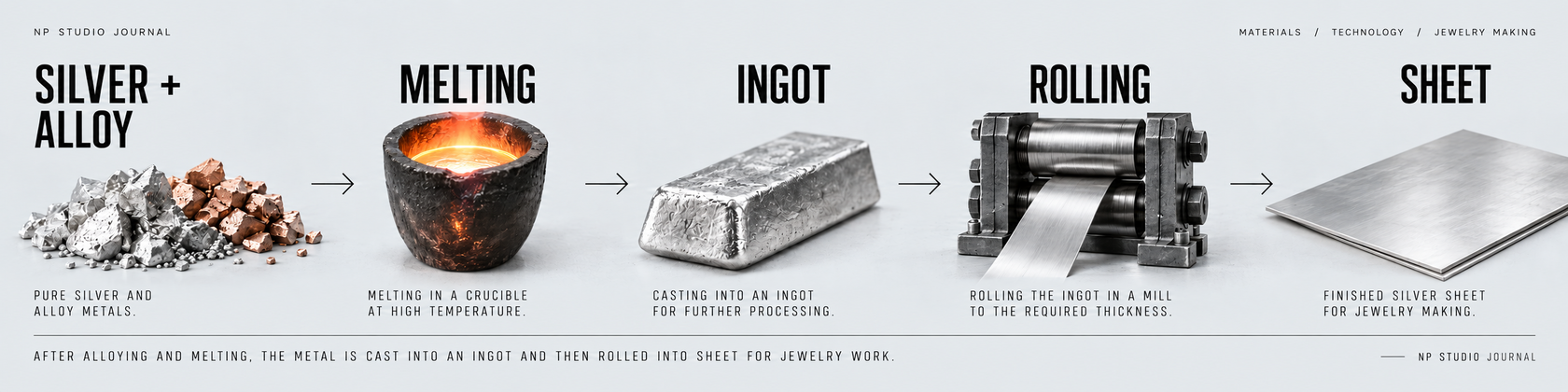
The silver and alloying metal are heated until they become liquid. The goal is not merely to melt two metals beside one another, but to form a homogeneous alloy in which the components are distributed throughout the melt.
The molten metal is then cast into a working form, often an ingot that can be mechanically processed.
Metal melting involves very high temperatures and requires suitable equipment, ventilation, protection and experience. This article explains the principle rather than providing a step-by-step melting procedure.
Why homogeneity matters
Correct proportions alone do not guarantee a good result. Silver and alloying metals need to be distributed evenly. Otherwise different areas of the billet may behave differently during rolling, soldering and forming.
The quality of sterling silver therefore depends not only on the number 925, but also on how the alloy itself was produced.
From molten metal to an ingot
After melting, the metal is converted into a compact billet. An ingot does not yet resemble the sheet used to make a ring; it is the starting form for further processing.
This is the point where the alloy begins to become practical workshop material.
From ingot to sheet and wire
The billet is rolled, formed and, when necessary, reheated until it becomes sheet, rod or wire of the required dimensions.
Deformation work-hardens silver. During processing it is therefore periodically annealed, restoring some malleability so forming can continue.

Why silver changes during working
The same 925 alloy can feel different at different stages of making. Rolling and hammering work-harden the metal, while annealing restores malleability. Heating and soldering alter its condition again.
For a jeweler, the processing history of a billet matters almost as much as its chemical composition.
Can old silver be turned into 925?
Yes, but only when the starting composition is known. If the old silver is already 925, adding another 7.5% of alloying metal would reduce the silver content. If the starting fineness is different, the calculation has to account for the metals already present.
Working with old or unknown silver is therefore a composition problem, not simply a matter of “silver plus copper.”
Can silver fineness be raised or lowered?
In principle, yes. To raise the silver content, higher-purity silver can be added to an existing alloy. To lower the silver content, the relationship between silver and alloying metals is changed.
Accurate results always depend on knowing the starting weight and fineness.
Industrial production vs a small workshop
Industrial production deals with larger batches, standardized raw materials, controlled equipment and laboratory verification of composition.
In a small jewelry workshop, the scale is different. Greater attention is paid to the behavior of an individual billet: how it rolls, how quickly it work-hardens, how it responds to heat and how well it holds the intended form.
How NP Studio uses sterling silver 925
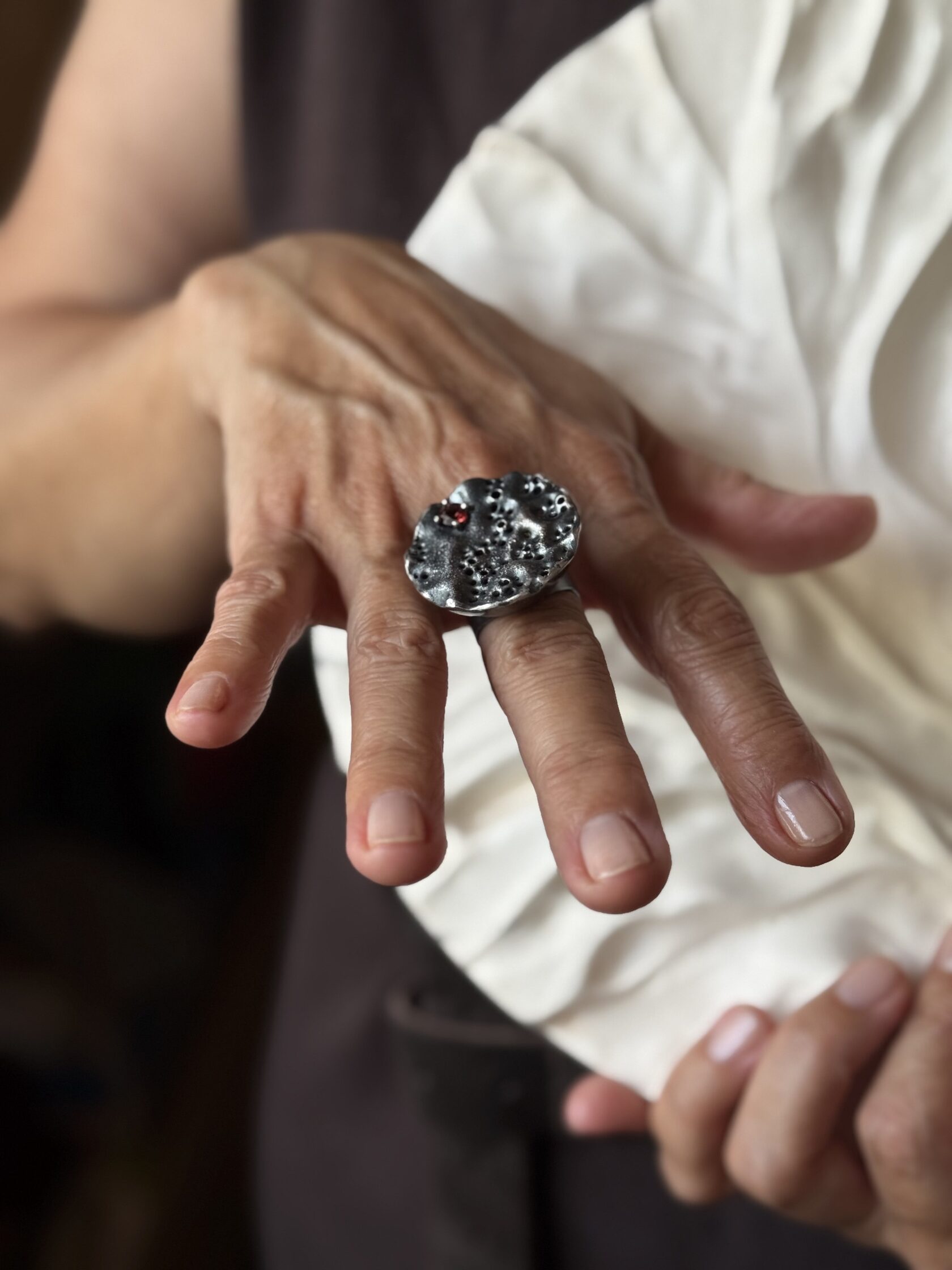
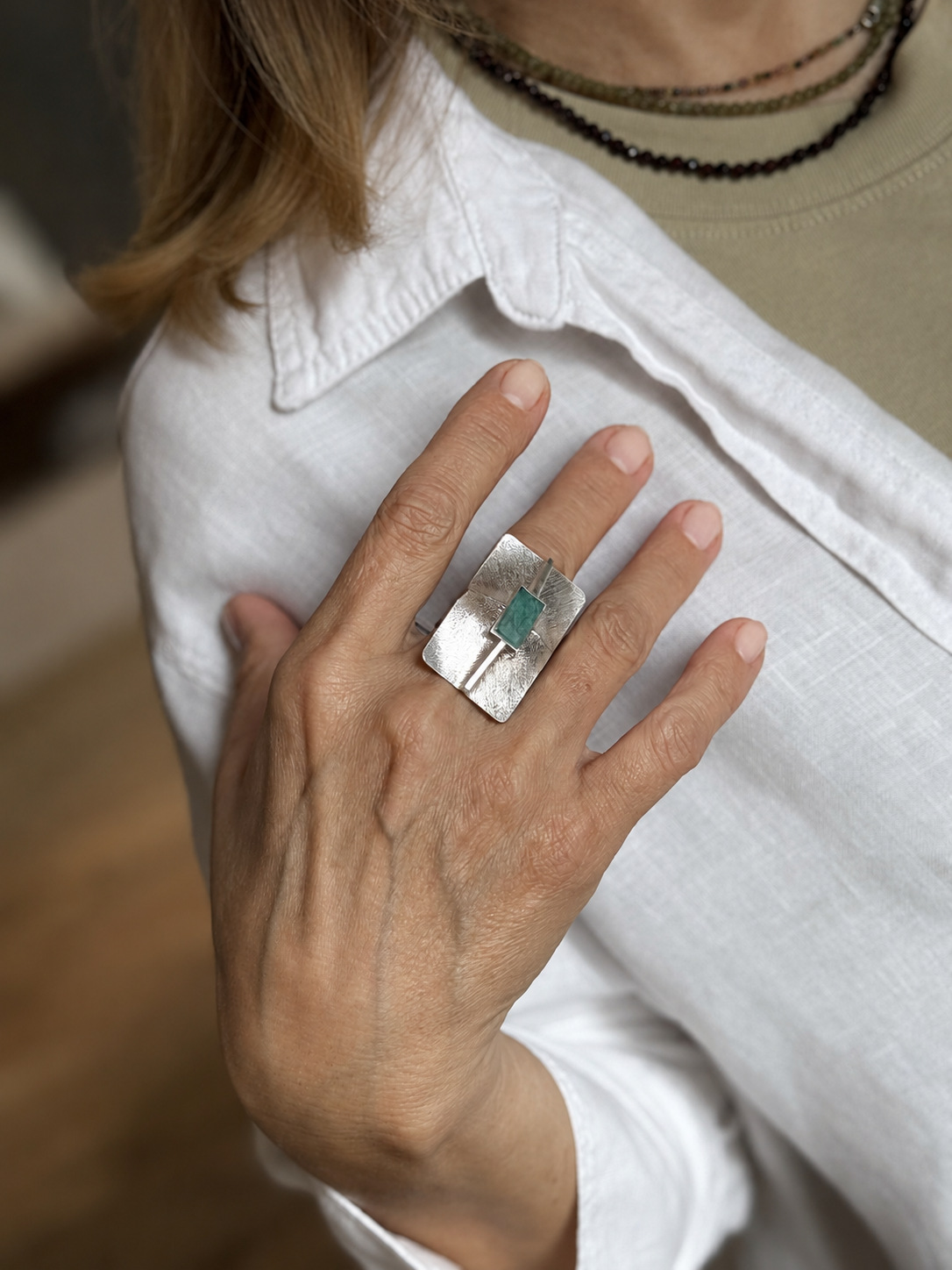
For NP Studio, producing sheet or another working form is only the beginning. The silver can then be rolled, bent, soldered, textured, ground, heated and patinated.
The same 925 alloy can therefore look completely different in finished objects: the surface is shaped not only by composition, but by process.
Frequently asked questions
In short
Sterling silver 925 is made by combining silver and alloying metals in a calculated proportion, forming a homogeneous alloy, casting it and then converting it into sheet, wire or another working form.
Silver → composition calculation → alloy → melting → ingot → rolling and annealing → working stock → jewelry.
READ NEXT / NP STUDIO JOURNAL
