
NP STUDIO / JOURNAL / SILVER AUTHENTICITY
How to Tell If Silver Is Real
Checking silver at home works better as a sequence of evidence than as one “magic” test. Marks, seller identity, surface, magnet response and tarnish can all provide clues, but professional analysis is the escalation path when composition really matters.
A 925 mark is an important first clue, but it is not proof by itself. Check the mark and provenance, examine the surface and metal behaviour, and use professional precious-metal analysis if certainty matters. Magnet response, tarnish and other home checks are screening clues only.
Start with the mark, but do not stop there
The number 925 states a fineness of 925 parts silver per thousand parts of the alloy, or 92.5%. In U.S. consumer guidance, the FTC says the words “silver,” “sterling” and “sterling silver” describe products containing 92.5% pure silver, and such products are sometimes marked 925.
This makes 925 a useful first clue, not a final verdict. A physical stamp can be applied to an object whose composition does not match it. The correct question is therefore not only “Is there a 925 mark?” but also “Who made or sold the piece, and what documentation supports the claim?”
For the mark itself, see What Does 925 Mean on Silver?. For the alloy definition, see What Is Sterling Silver?.
Check who stands behind the mark
Reliability begins with provenance rather than colour. Read the product page, identify the seller or manufacturer, and look for a clear material description and supporting documents when appropriate. For an expensive or unfamiliar object, knowing who is responsible for the stated fineness matters.
In the U.S., FTC consumer guidance says a silver item with a quality mark should also identify the company or person standing behind that mark. The UK uses a different hallmarking system: Sheffield Assay Office lists the sponsor's mark, fineness mark and assay-office mark as compulsory elements of a UK hallmark. That is UK context, not a global rule.
Do not generalize one country's marking system to every object. Jurisdictions, historical periods and exemptions differ, so the mark has to be read in context.
No hallmark does not automatically mean fake
The opposite shortcut is also unreliable. An unmarked piece is not automatically non-silver. Marking rules vary by jurisdiction and period, and an older, small, handmade or foreign-made object may have a different marking context.
In that situation, provenance becomes more important: who made it, what the listing says, what documents exist, and whether the object can be connected to a known maker or seller. If value is significant or provenance is unclear, professional analysis is more useful than guessing from appearance.
What a magnet can and cannot tell you
Strong attraction of the main metal body to an ordinary magnet is a reason to question a claim that the piece is solid sterling silver. But no strong attraction does not prove silver: many other metals and alloys are also not strongly magnetic.
Complex jewelry may also contain small components, springs or findings made from other materials. A magnet is therefore a screening tool, not a final PASS/FAIL test. Its value is in revealing an obvious mismatch, not identifying chemical composition.
Tarnish is a clue, not proof
Silver does tarnish when it reacts with sulfur-containing gases. The Canadian Conservation Institute describes tarnish on pure silver primarily as silver sulfide; tarnish on sterling silver also includes copper sulfide.
That does not make tarnish proof of solid sterling. Silver-plated objects also have real silver on the surface and can tarnish. CCI explicitly documents tarnish on silver-plated objects. The absence of tarnish is not proof of a fake either: environment, humidity, protective finishes, cleaning and storage all affect the rate.
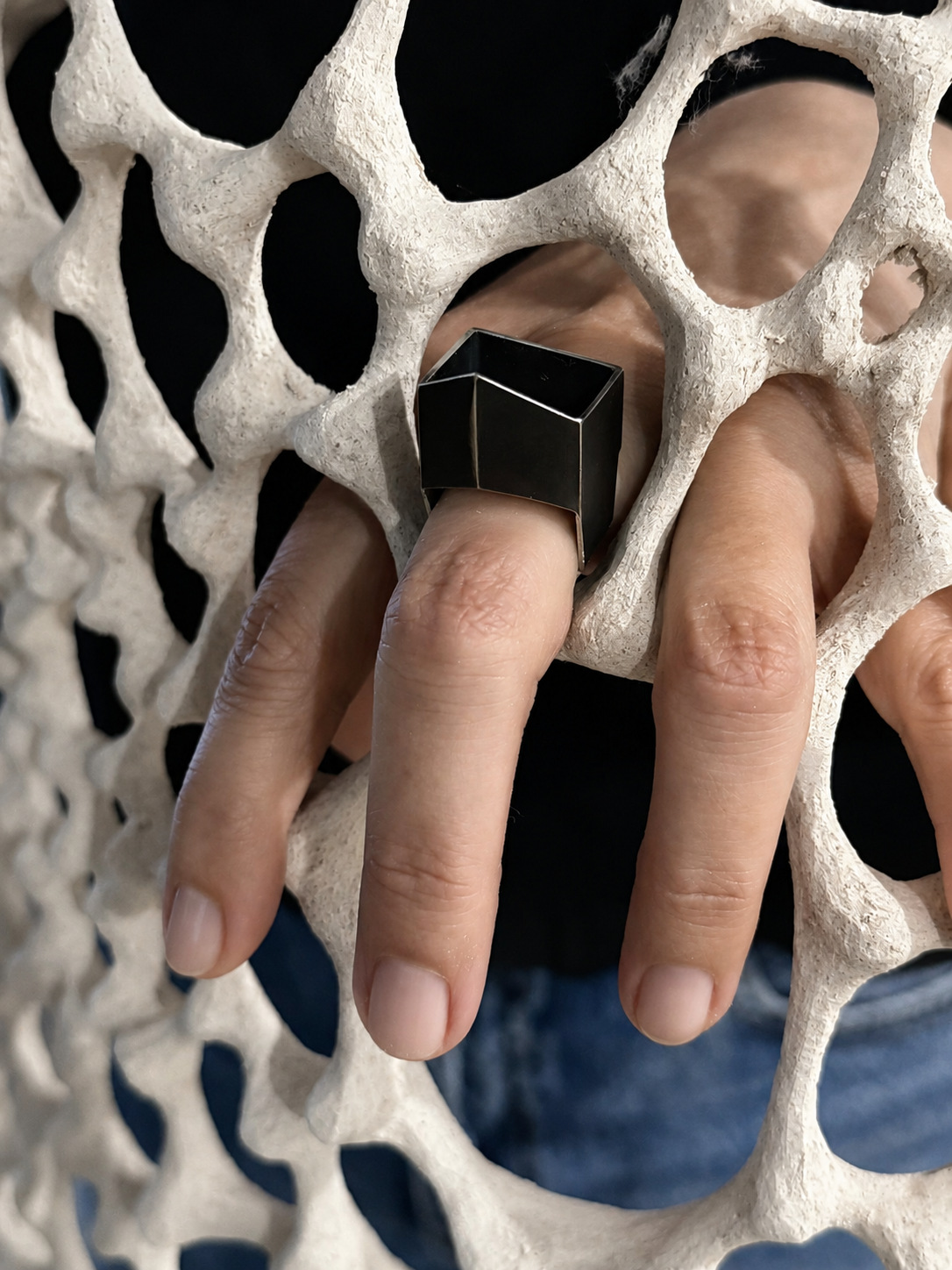
Dark colour can also be intentional. Black Cube is a sterling silver ring with a dark surface, while other NP Studio works use patina deliberately. For the chemistry of tarnish, see Why Does Sterling Silver Turn Black?.
Shine, colour and smell are weak indicators
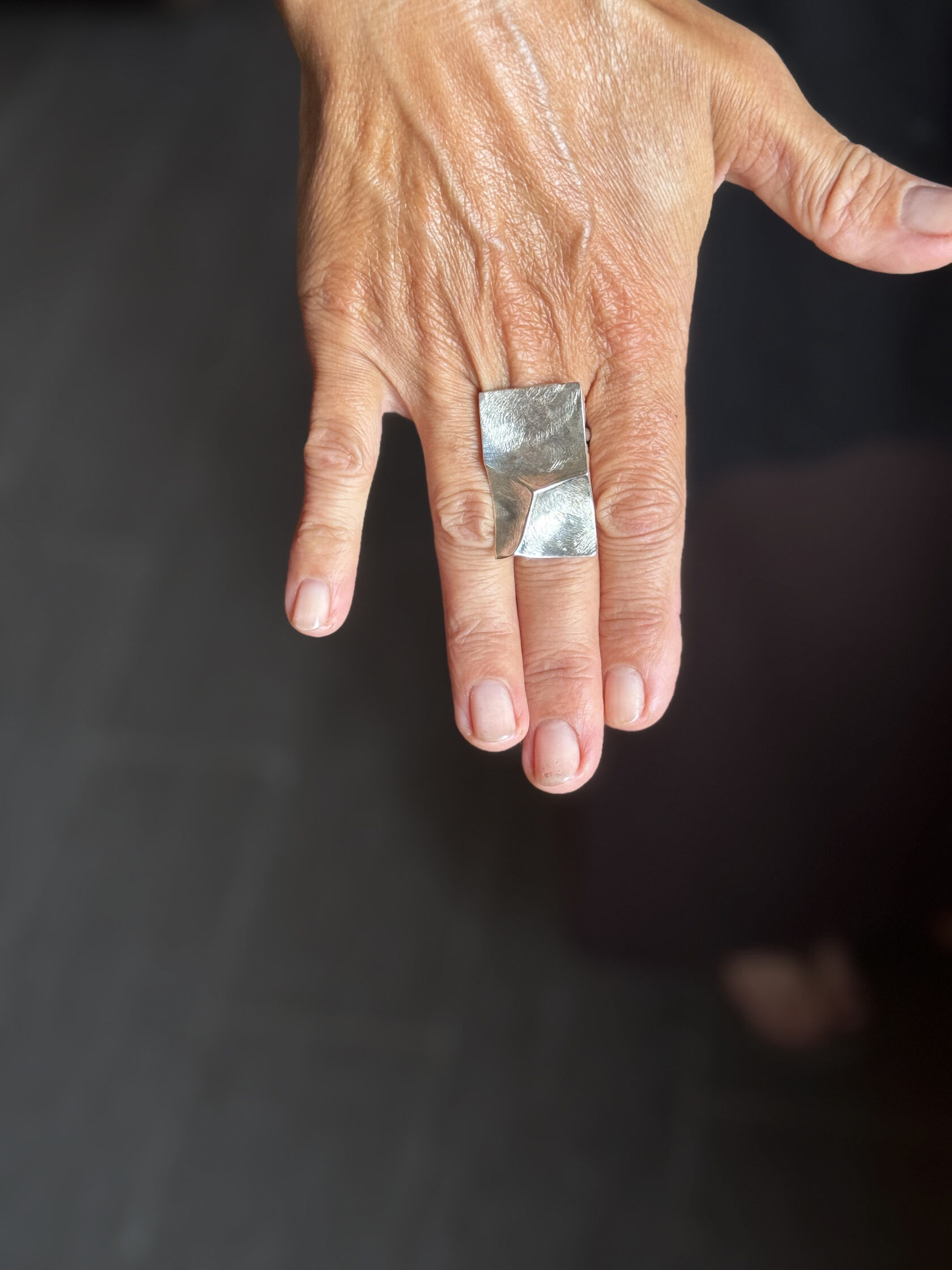
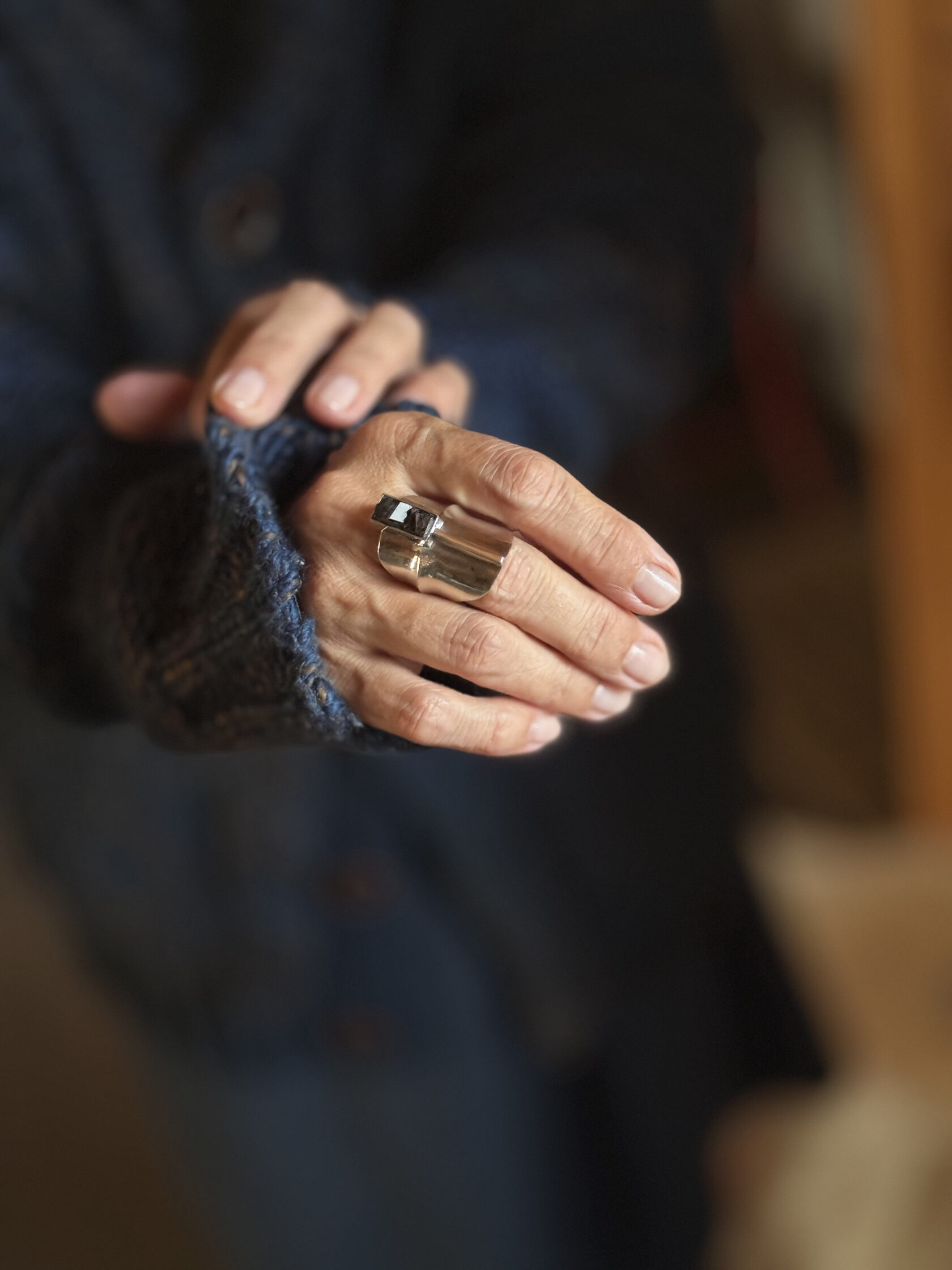
Silver does not have to look mirror-polished. Textured Plate has a matte abrasive surface, while Fold with Black Garnet has a polished surface. Both appearances are compatible with silver.
Polish, patina, oxidation, abrasion and other finishes change colour and reflection enough that appearance alone cannot identify alloy composition. An intact silver-plated object may also look almost identical at the surface.
The so-called smell test is weaker still. Odour is subjective and can come from skin, cosmetics, cleaners, storage or surface coatings. It should not be treated as an authoritative authenticity test.
Why the ice test is not proof
Silver has high thermal conductivity, which is why ice demonstrations can look persuasive. Real jewelry, however, is not a controlled laboratory specimen: mass, thickness, room temperature, contact area, stones and construction all change the result.
Fast melting can be an interesting demonstration of heat transfer, but it does not prove a 925 alloy. Another thermally conductive metal or simply different geometry can produce a similar impression.
Do not scratch or file jewelry just to test it
Any test that removes metal, creates a deep scratch or exposes an internal layer changes the object. This is especially undesirable with art jewelry because it can damage patina, polish, handmade texture, plating or collectible surfaces.
Home acid tests can also leave permanent marks and involve hazardous chemicals. This guide therefore does not include acid recipes, filing instructions or other destructive procedures. If composition matters, move to professional verification instead.
Silver-plated jewelry can pass some home checks
This is the central limitation of surface-only testing. In silver-plated jewelry, the outside layer is real silver. The surface can therefore look silver, tarnish and behave like silver in several quick observations even though the underlying body is another material.
The FTC describes silver plate as a layer of silver applied to a base metal. While that layer is intact, visual inspection may reveal little about what is below it. Tarnish, colour and weak magnet response therefore cannot be combined into a formula that says “definitely sterling.”
For the full material comparison, see Sterling Silver vs Silver-Plated Jewelry.
Professional analysis is the reliable next step
When composition matters — for example because the object is valuable, provenance is uncertain, or the result is needed for sale, insurance or expert assessment — the next step is a jeweler, assay office or precious-metal laboratory.
Sheffield Assay Office uses X-ray fluorescence, XRF, for precious-metal analysis. In professional settings XRF can provide non-destructive elemental information quickly, while laboratories may also use other analytical methods depending on the purpose.
XRF should not be turned into a myth of an infallible scanner. Surface coatings, heterogeneous objects and measurement depth can complicate interpretation, so equipment, calibration, operator experience and knowledge of the object's construction matter.
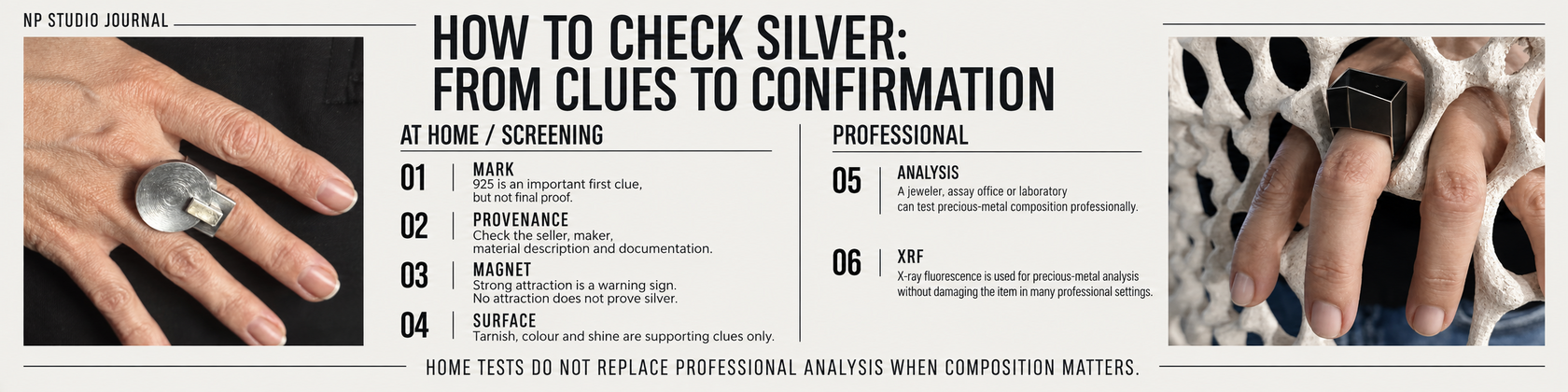
Five levels of confidence
Instead of relying on one test, build evidence. Confidence increases when independent forms of evidence agree, while professional analysis is the level that directly investigates metal composition.
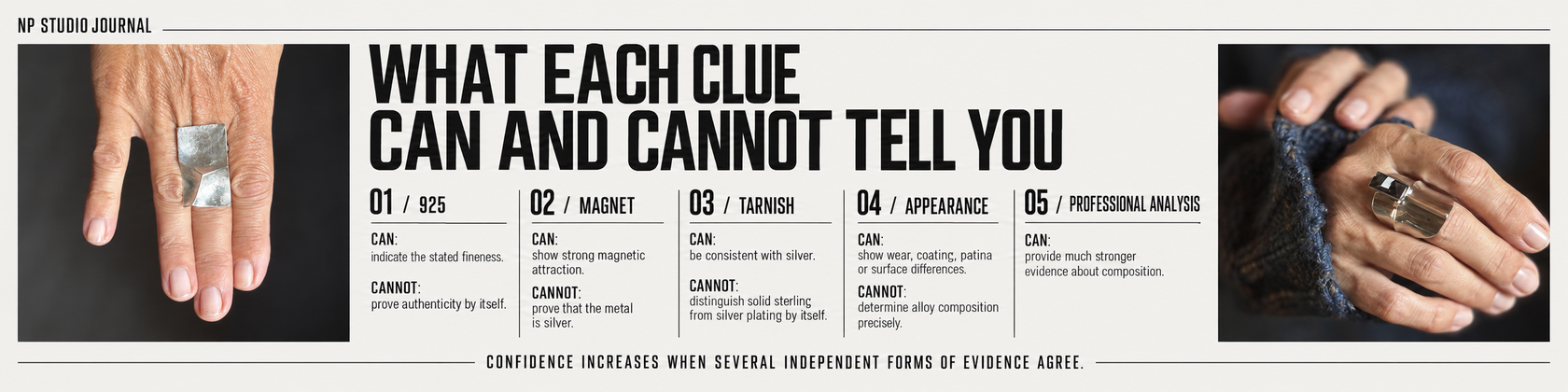
How to check silver jewelry before buying
You do not need to create a home laboratory before a purchase. Use a short consumer workflow and stop when the level of evidence matches the value and risk.
How NP Studio identifies material
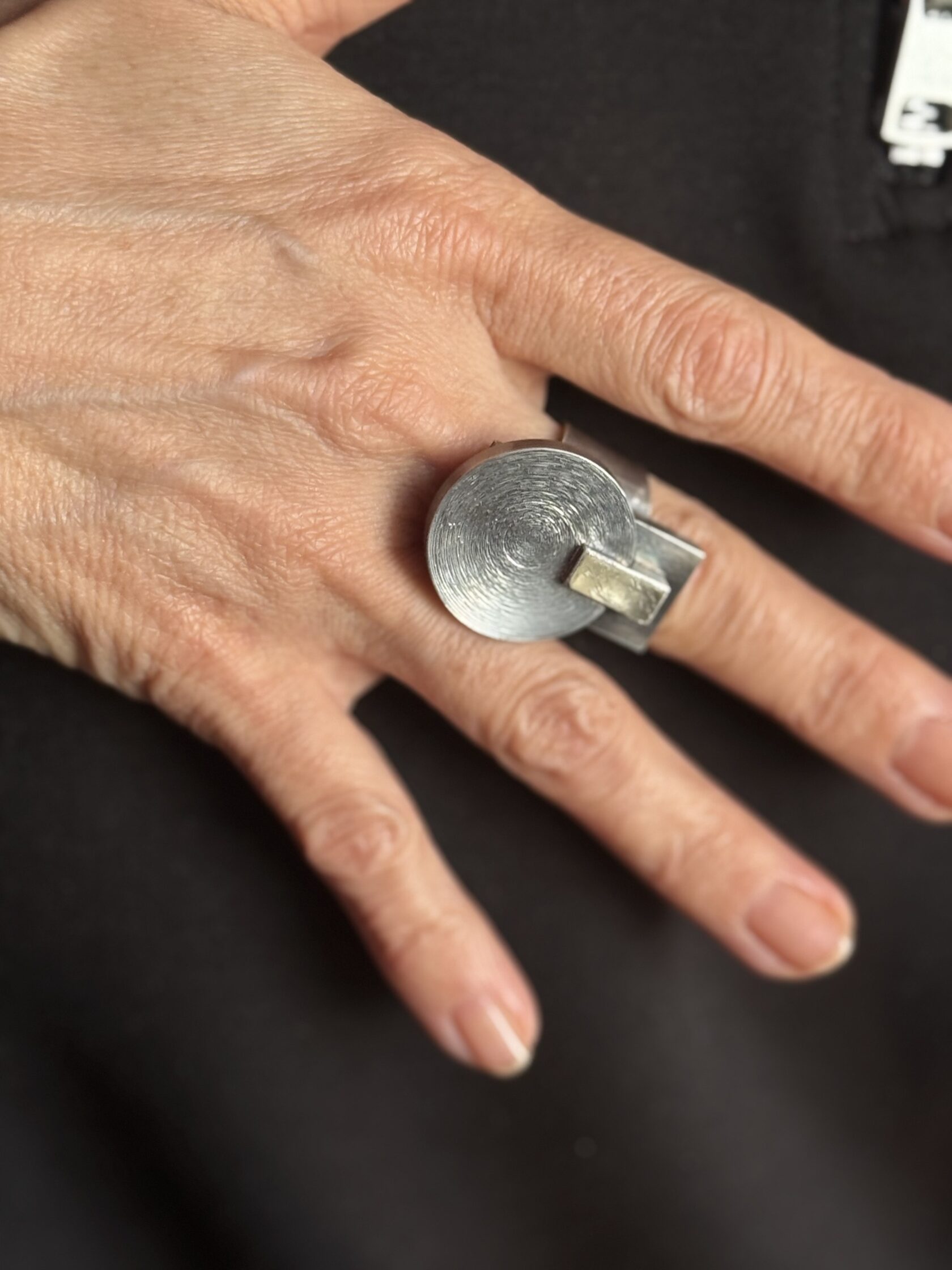
NP Studio work pages list the material for the specific object. Construction with a Disc lists sterling silver with Italian patina; Black Cube lists sterling silver; Fold with Black Garnet lists sterling silver.
The Legal Details page also states that material, fineness, stones, size, weight, price and other characteristics are recorded in the listing, order agreement, correspondence or accompanying documents.
This is a provenance and documentation layer, not laboratory proof by itself. Its value is that the material claim is attached to an identifiable maker and a specific object.
Conclusion: use multiple forms of evidence
A sensible checking sequence is mark and provenance first, then visual and physical clues, and professional analysis when needed. Magnet response, tarnish, shine and ice should not replace that sequence.
A 925 mark is useful evidence, not absolute proof. No 925 mark is not an automatic verdict either. Silver-plated surfaces can look and tarnish like silver because the surface really is silver. Professional analysis becomes appropriate when composition matters more than a reasonable consumer inference.
The higher the value, the weaker the provenance or the greater the consequence of being wrong, the less useful a “secret home test” becomes — and the more useful documentation and expert testing become.
Frequently asked questions
Does a 925 stamp prove that silver is real?
No. 925 states a fineness of 92.5% silver, but the stamp alone is not laboratory proof. Check provenance, seller identity and supporting information as well.
Can fake jewelry carry a 925 stamp?
Yes. A mark can physically be applied to an object whose composition does not match it, so the stamp is evidence rather than a final technical result.
Is sterling silver magnetic?
The main body of sterling silver should not show strong attraction to an ordinary magnet. But no attraction does not prove silver because many other materials are also non-magnetic.
Does real silver always tarnish?
Silver can tarnish through sulfur-containing gases, but the rate depends on environment and surface treatment. No tarnish does not mean fake, and tarnish does not prove solid sterling.
Can you distinguish sterling silver from silver plate at home?
Sometimes you can find suspicious clues, but surface-only checks often cannot distinguish solid sterling from intact silver plating. Professional testing is needed when certainty matters.
Is the ice test reliable?
Not as proof of authenticity. It demonstrates heat transfer, but results depend heavily on mass, geometry, temperature and contact area.
Should you acid-test silver jewelry at home?
No. Acid testing can damage the surface and involves hazardous chemicals. Valuable or artist-made jewelry is better checked professionally.
Where can silver jewelry be professionally tested?
A precious-metal specialist, assay office or laboratory can select an appropriate analytical method, including professional XRF and other methods when required.
