
NP STUDIO / JOURNAL / MATERIALS
Sterling Silver vs Silver-Plated Jewelry: What's the Difference?
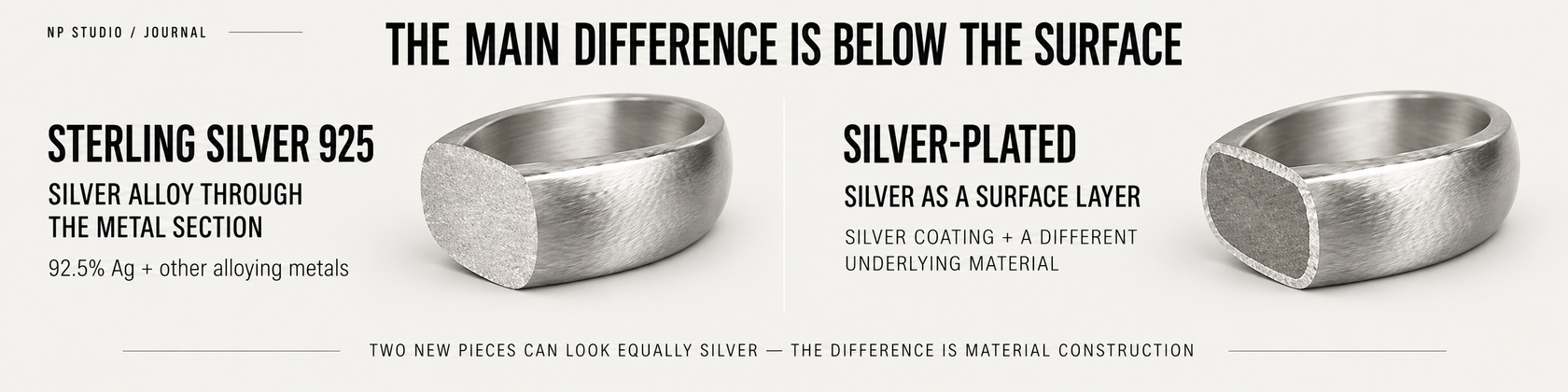
Sterling silver and silver-plated jewelry differ primarily in material construction, not color. In sterling silver jewelry, the metal body itself is a silver alloy containing 92.5% silver. In silver-plated jewelry, silver is a surface coating applied over another material. That structural difference affects how the piece wears, can be polished, repaired and maintained over time.
| Criterion | Sterling silver | Silver-plated |
|---|---|---|
| Material construction | Silver alloy runs through the metal body of the part. | Silver is a surface coating applied over another material. |
| Silver content | Under the U.S. FTC Jewelry Guides, Sterling/Sterling Silver corresponds to at least 925/1000 pure silver. | Silver is present in the coating; total silver content depends on the object and plating construction. |
| Appearance when new | Can look nearly identical to well-made silver plating. | Can look nearly identical to sterling silver. |
| Scratches / wear | A scratch reveals the same class of silver alloy beneath the surface. | With enough wear, the coating may thin and eventually expose the underlying material. |
| Polishing | The surface can often be refinished within the limits of the design and construction. | Abrasive polishing removes some of the finite surface coating, so more caution is needed. |
| Repair | Traditional jewelry repair is often more straightforward, but stones, wall thickness, patina and construction still matter. | Repair depends on the base material and may require restoring plating or surface finish afterward. |
| Marking | 925 / Sterling may indicate a fineness claim, but a stamp alone is not absolute proof. | The product description should make the coating clear; abbreviations and terminology vary by market. |
| Cost | There is usually more precious-metal value in the body because the silver alloy runs through the section. | Less silver may be used, but final price still depends on design, brand, labor and construction. |
| Best fit | Long-term wear, refinishing, substantial rings and pieces where the metal body is part of the structure. | Situations where a silver appearance matters more than using silver alloy throughout the body. |
Short answer: the main difference
In sterling silver, silver is part of the alloy that makes up the metal body. In silver-plated jewelry, silver is present as a surface coating. That difference may be invisible when a piece is new, but it matters for wear, refinishing, soldering, resizing and repair.
Why they are easy to confuse in photos
Both can have a silver-colored surface, similar reflectivity and an equally polished finish. A normal product photo shows the surface, not a cross-section of the metal.
Appearance alone is therefore a poor way to identify material construction. The product description, markings, history and, when necessary, professional testing matter more.
What sterling silver means in this comparison
Sterling silver is a silver alloy that makes up the metal body of the part. Under the U.S. FTC Jewelry Guides, the terms Sterling and Sterling Silver correspond to a fineness of at least 925/1000 pure silver.
For the full material guide, see What Is Sterling Silver? →.
What silver-plated jewelry means
Silver-plated jewelry is built differently: silver is applied as a surface layer over another material. The base material can vary, and so can underlayers, plating processes and coating thickness.
There is no universal plating thickness or universal lifespan that applies to every silver-plated piece.
The main difference is below the surface
Compare by criterion
Why the same color proves nothing
Color and shine are surface observations. They do not tell you what is underneath. A new sterling silver piece and a well-made plated piece can therefore look extremely similar.
How scratches and long-term wear differ
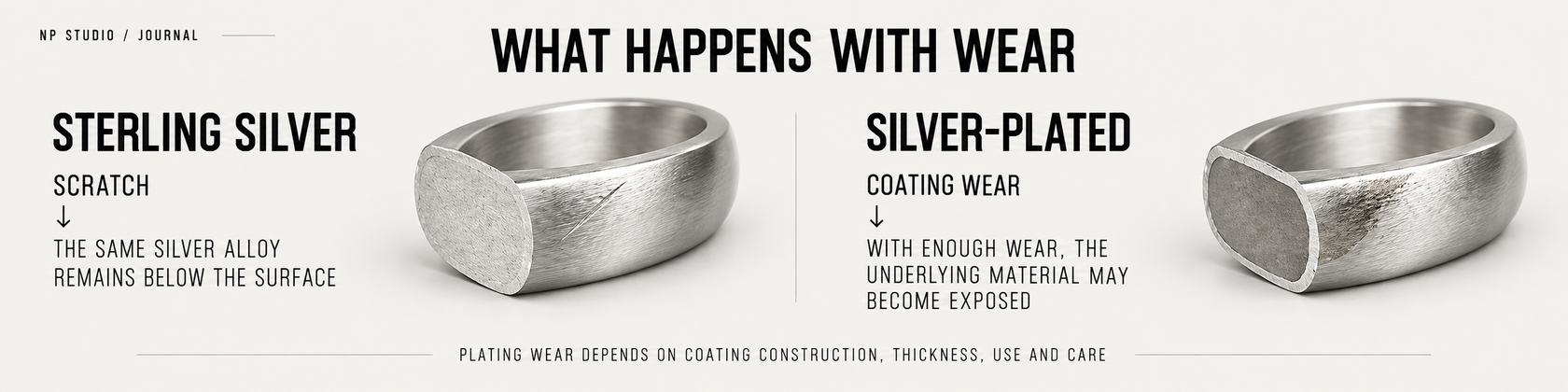
On sterling silver, a scratch changes the surface, but the same class of silver alloy remains beneath it. The piece can still develop scratches, patina and normal wear; it simply does not reveal a different base metal under an ordinary surface scratch.
On a plated piece, wear reduces the silver coating. With enough wear, the material beneath it may become visible. The rate depends on coating construction, thickness, use and care.
Can both materials be polished the same way?
No. Every abrasive polishing action removes a small amount of surface material. With plating, that matters more because the silver exists as a finite coating.
For actual cleaning instructions, use the separate guides: How to Care for Sterling Silver → and How to Clean Silver Jewelry →.
What happens when silver plating wears
With enough wear, the underlying material may become visible and the local color, texture or reflectivity may change. Re-plating can be possible in some cases, but it depends on the base material, construction and available service.
Repair and resizing
With sterling silver, traditional operations such as soldering, forming and refinishing are often more straightforward, but stones, wall thickness, patina and the design still matter.
With plated jewelry, the base material becomes an additional variable. Heat and mechanical work can affect the coating, and repair may require finish restoration or re-plating afterward. Not every repairer accepts every type of plated piece.
This article is not a promise to repair third-party jewelry; Custom → and Works → show how NP Studio approaches its own constructions.
What 925 means — and what it does not prove
925 is a fineness claim: 925 parts per thousand silver. A stamp is useful information, but it is not laboratory proof of the composition or origin of a specific object.
See What Does 925 Mean on Silver? → and How to Tell If Silver Is Real →.
Markings you may see on silver-plated items
Descriptions can include Silver Plated or Silver Plate, and some markets and product categories use abbreviations such as EP or EPNS. Terminology varies by region, so these should not be treated as one universal international hallmark system.
Can a magnet identify the material?
A magnet is, at best, a screening clue. Sterling silver is not strongly magnetic, but many base materials used in plated jewelry can also be nonmagnetic. Strong attraction can rule out an all-sterling metal body in many ordinary cases, but no attraction proves nothing.
For a fuller authenticity discussion, see How to Tell If Silver Is Real →.
Can weight identify sterling versus plate?
Not reliably without identical geometry and a known reference. Hollow construction, wall thickness, stones and dimensions can overwhelm any simple density comparison.
Can tarnish identify the material?
No. A silver surface can tarnish whether that surface belongs to bulk sterling silver or to a silver coating. Tarnish is surface chemistry, not proof of bulk construction.
Why green skin is not proof either
A green mark on skin is not a reliable diagnostic test for plating. Metal composition, perspiration, cosmetics and the environment can all affect what happens at the skin surface.
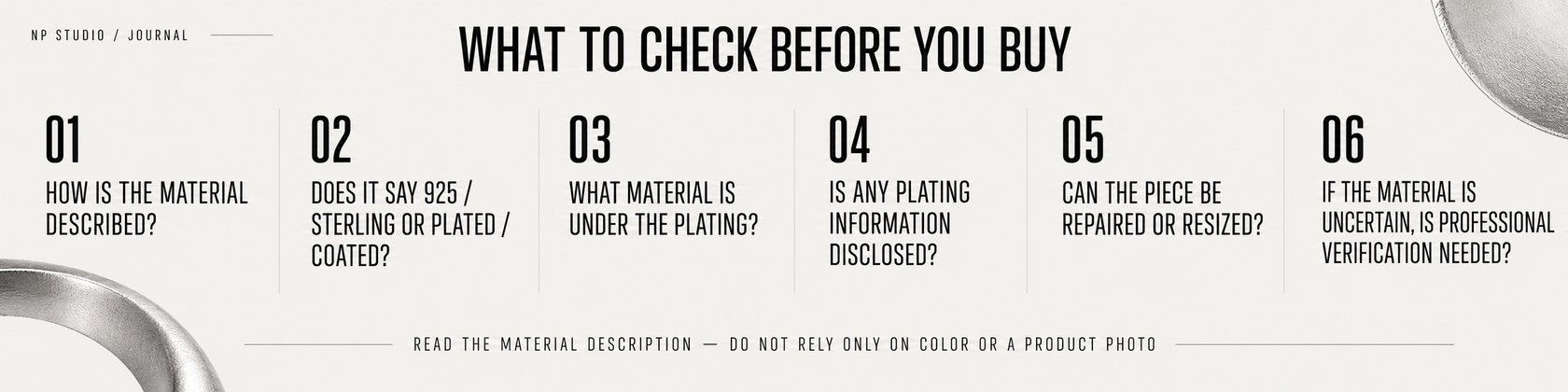
What to check before you buy
- 1. Read the exact material description.
- 2. Look for sterling / 925 versus plated / coated language.
- 3. If it is plated, ask what material is underneath.
- 4. Ask whether plating process or thickness information is disclosed.
- 5. Ask whether the specific piece can be resized or repaired.
- 6. For second-hand jewelry, inspect high-contact wear areas in the photos.
- 7. For high-value uncertain objects, use professional verification.
Which is better: sterling silver or silver-plated jewelry?
There is no absolute winner. Sterling often makes more sense for long-term wear, refinishing, substantial rings and objects where the metal body is part of the structure. Plated jewelry can make sense when the visual silver surface matters more than using precious metal throughout the body or when the piece is intended for lighter use.
Good or bad design can exist in either material category. For comparisons with other metals, see Sterling Silver vs Stainless Steel Jewelry: What’s the Difference? and Sterling Silver vs White Gold: What’s the Difference?.
Why NP Studio works with sterling silver
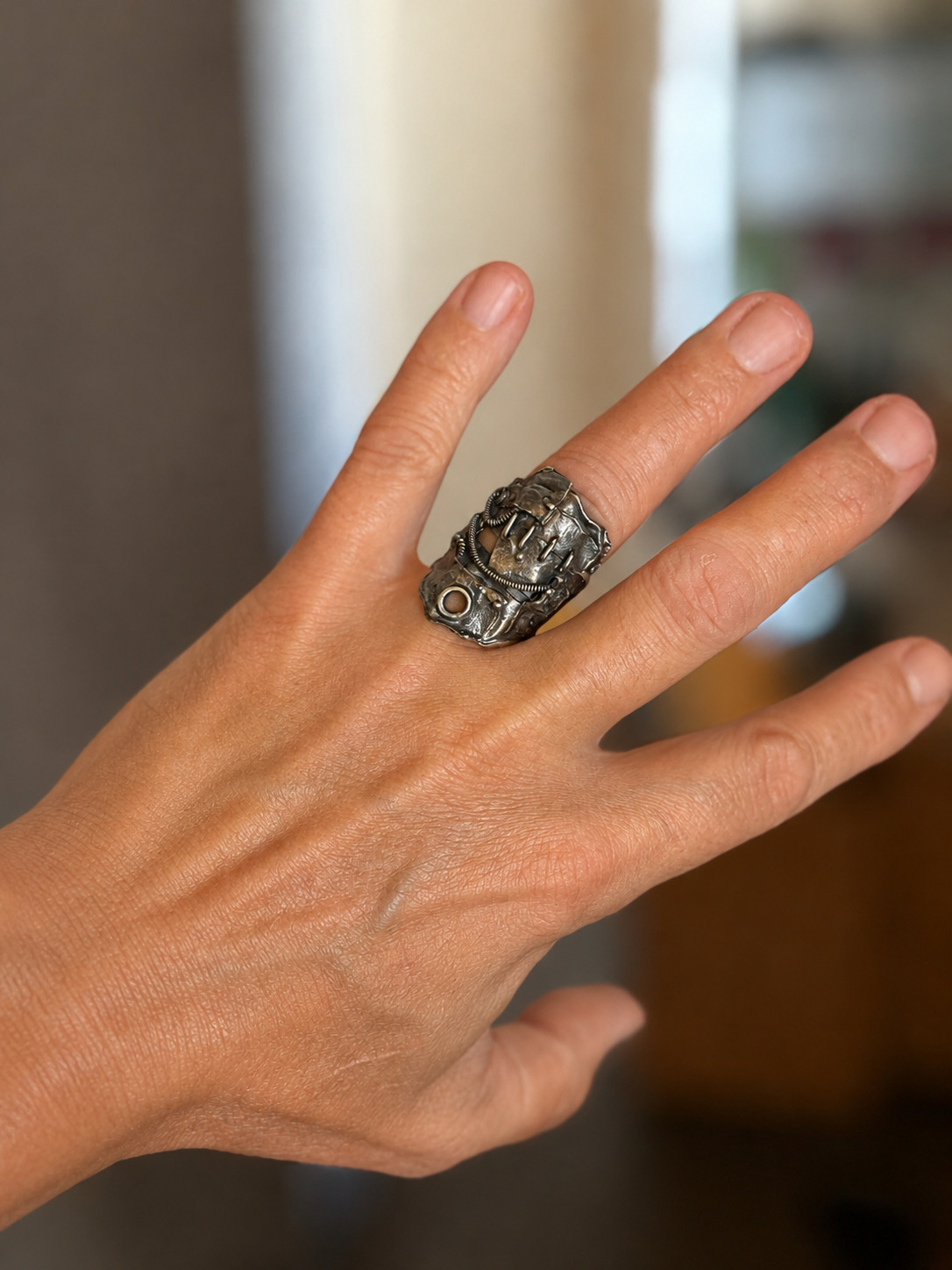
For my practice, it matters that the metal can be formed, soldered, textured, patinated and structurally developed. In substantial and sculptural rings, silver is not only the visual surface; it is the material of the form itself.
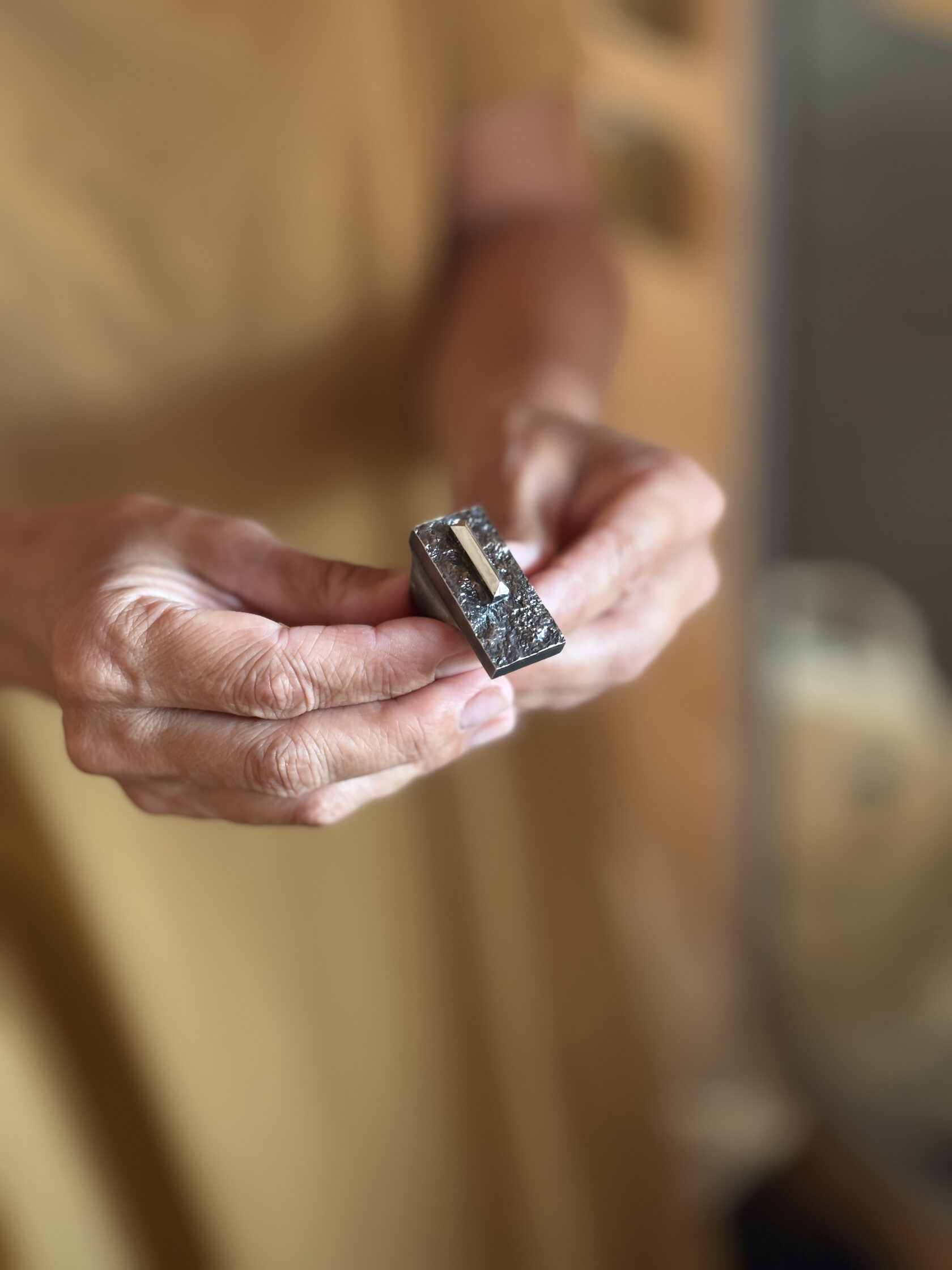
What changes in a substantial or sculptural ring
When the metal itself becomes the wall, body, solder joint, stone setting and carrier of relief, bulk material matters more directly. That does not make plating bad; it simply solves a different problem.
For the sculptural context, see Jewelry as Wearable Sculpture →.
Short summary
- Sterling silver means silver alloy through the metal body.
- Silver-plated means a silver surface over another material.
- New pieces can look nearly identical.
- Marks help, but do not prove authenticity by themselves.
- Wear, polishing and repair behave differently.
- Neither category automatically guarantees good design.
- Read the exact material description before buying.
Frequently asked questions
Related NP Studio materials
To go deeper into the material itself, see what sterling silver is and what the 925 mark means. If your question is about choosing the object rather than the metal, read how to choose a unique silver ring or explore real NP Studio works.
