Solo
The statement ring remains the only active object on the hand. Extra space lets silhouette, stone or texture read without competition. This is not the correct option; it is simply the cleanest way to isolate the ring.

NP STUDIO / JOURNAL / STATEMENT RING STYLING
A statement ring does not require one correct setting around it. It can remain the only active object on the hand, receive quiet support from other jewelry, or become part of an intentionally dense composition. Start with the ring itself — its scale, projection, silhouette, colour and texture — rather than with a list of restrictions.
A statement ring can be worn as a single focal point, paired with quieter rings or built into an intentionally layered composition. Start with the ring’s scale, position on the hand, colour, texture and how much visual space you want to leave around it.
The separate article What Is a Statement Ring? defines the term through visual role: the ring becomes a noticeable focal point on the hand. That effect may come from scale, silhouette, height, colour, surface or construction rather than from a mandatory size.
For styling, this matters because the rest of the hand does not automatically have to become quiet. First identify what makes the ring active. A broad plane creates a different problem from a tall asymmetric object; a strong coloured stone behaves differently from a dark textured surface with almost no colour.
Before adding another ring, watch or bracelet, consider how much space the main object occupies. Width, height, projection and direction shape both visual presence and available room.
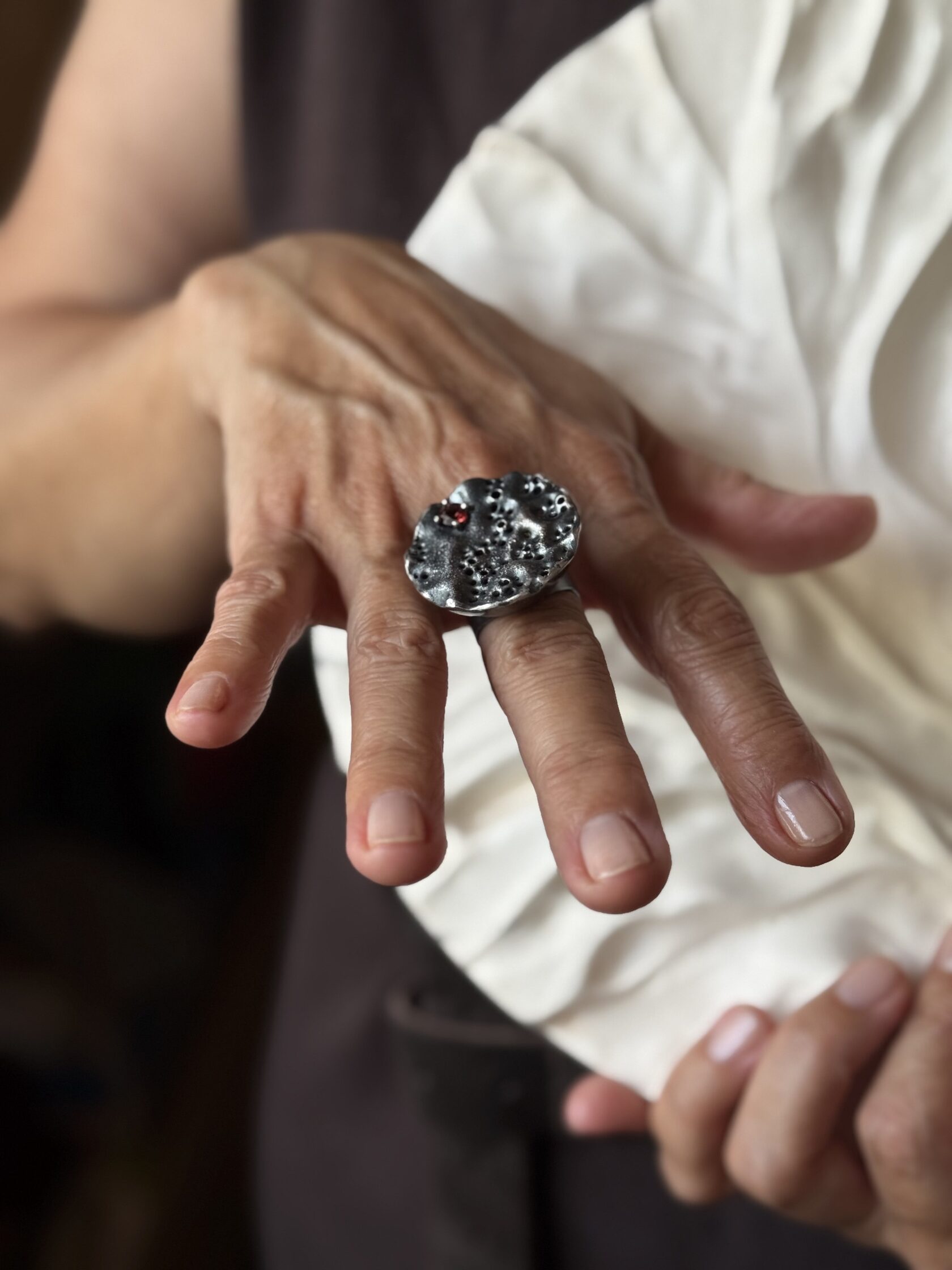
Surface with Garnet is built around a projecting hemisphere, dark rough surface and a small coloured centre. It does not need to cover the entire hand to feel dominant; height and texture already make it visually dense. Leaving space around it makes that effect especially clear.
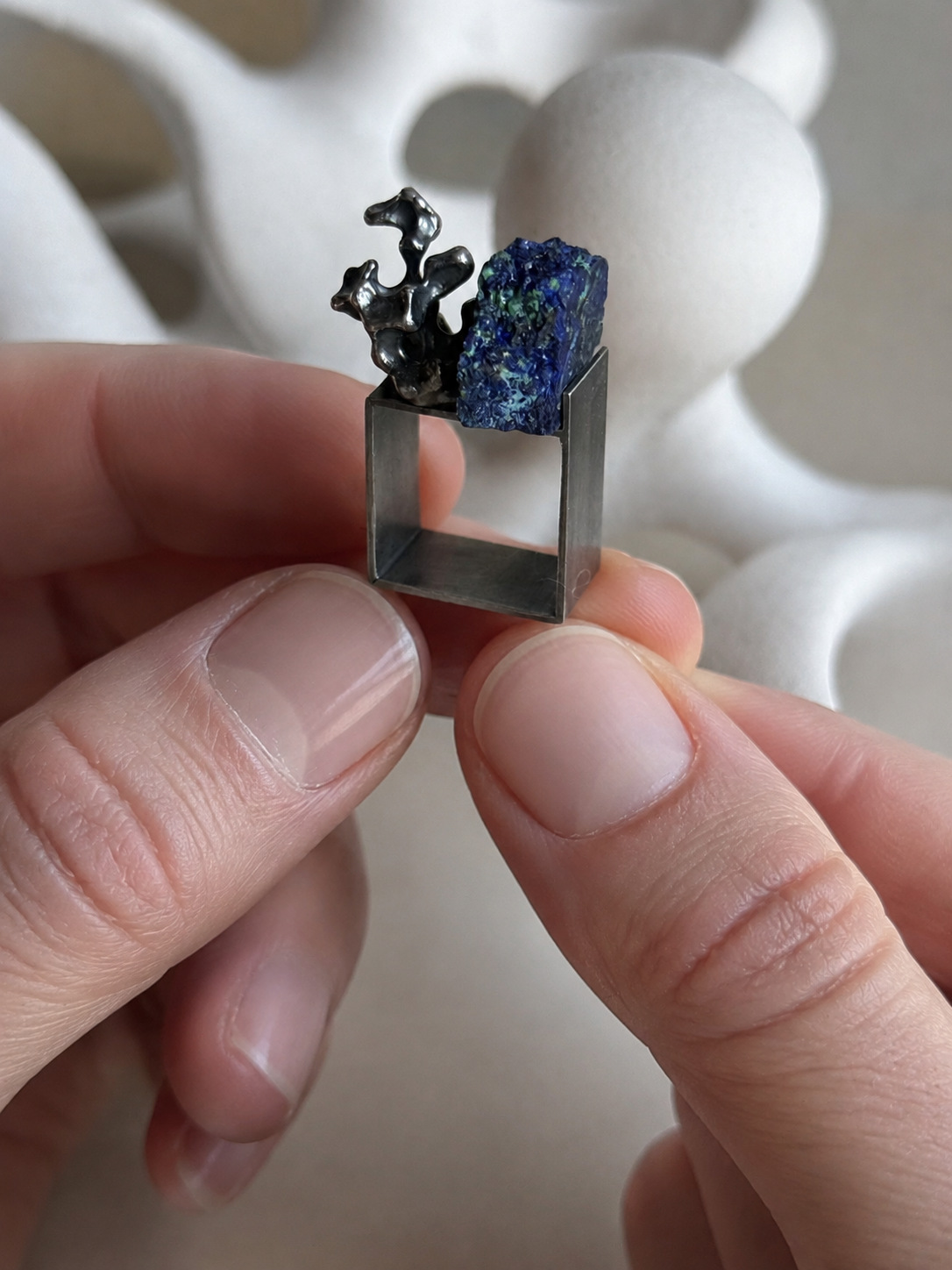
Sculpture has a different presence. Large azur-malachite, a rectangular shank and a coral-like silver element form a tall asymmetric object. It visually extends beyond the usual boundary of one finger. The question “What should sit next to it?” is easier to answer once you see where the volume points and how much room it needs during normal hand movement.
Look at the ring from above, from the side and while moving the hand normally. Styling begins with the real object in space, not only with a frontal photograph.
There is no universally best finger. Index, middle and ring fingers create different amounts of space around the object. The practical question is how the particular form interacts with neighbouring fingers.
On the middle finger, a large ring sits near the centre and may meet both neighbours. The index finger can give a projecting form more open space, while the ring finger shifts the object away from the centre.
An asymmetric top can be turned toward the side with more room. Test tall forms while bending the fingers. Dominant versus non-dominant hand is practical too: a projecting ring may be easier on the hand used less for handling objects.
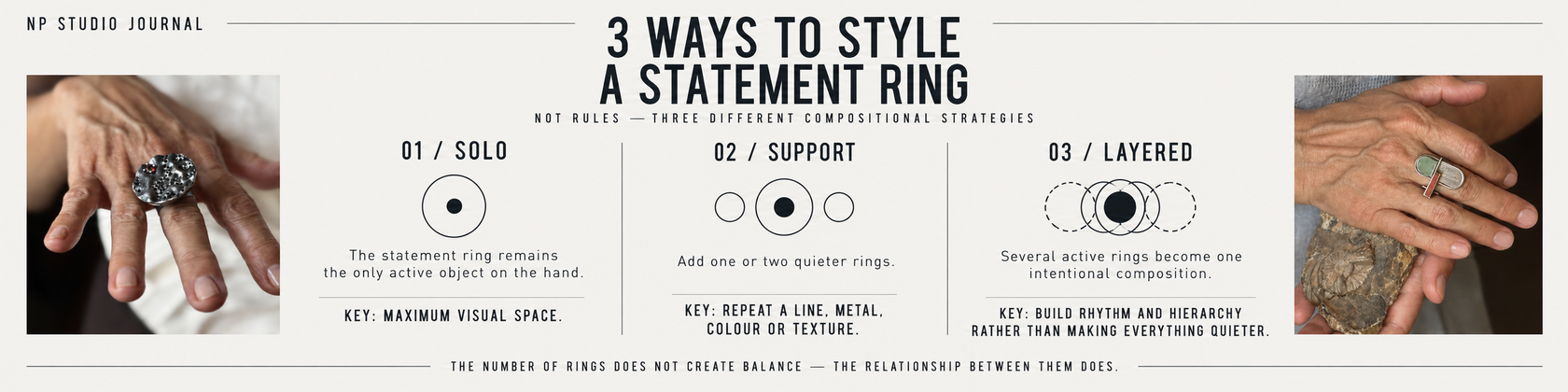
There are at least three equally valid strategies. The difference is not the number of rings by itself but how hierarchy and rhythm are built.
The statement ring remains the only active object on the hand. Extra space lets silhouette, stone or texture read without competition. This is not the correct option; it is simply the cleanest way to isolate the ring.
Add one or two quieter rings. They can repeat a line, metal tone, colour or texture, or simply create rhythm across the fingers. They do not need to disappear completely — the composition only needs a clear centre.
Several active rings become one intentional composition. Balance comes from rhythm, repetition, contrast and spacing rather than from making every surrounding object quieter.
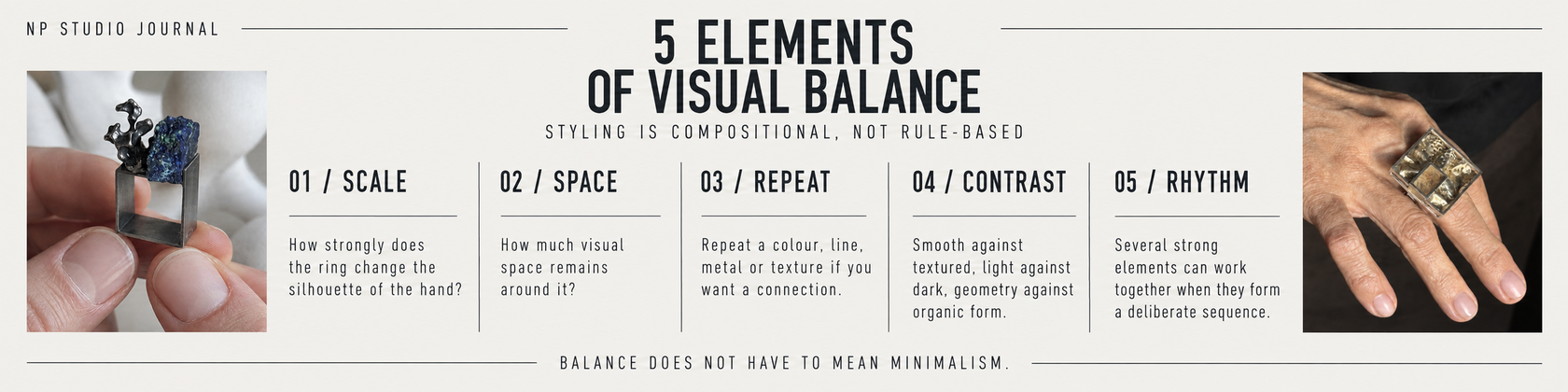
The easiest way to connect several rings is to repeat one characteristic instead of trying to make them identical. That characteristic might be line, geometry, colour, surface or metal. A rectangular statement ring can be supported by a simpler geometric band. A rough surface can sit next to another texture — or beside a smooth ring as a deliberate contrast.
Spacing is another tool. Leaving one neighbouring finger bare can create a useful visual interval. But this is not mandatory: several large forms can sit next to each other if their directions, scales and physical positions are intentional.
You do not need to stay within one collection. One ring can repeat a colour, another a frame or line, while the whole composition may also work through contrast: polished beside rough, light beside dark, circular beside rectangular.
Matching metal is one way to create continuity, not a requirement. Silver with silver gives an obvious link, yet silver itself can appear very different when polished, matte or darkened with patina.
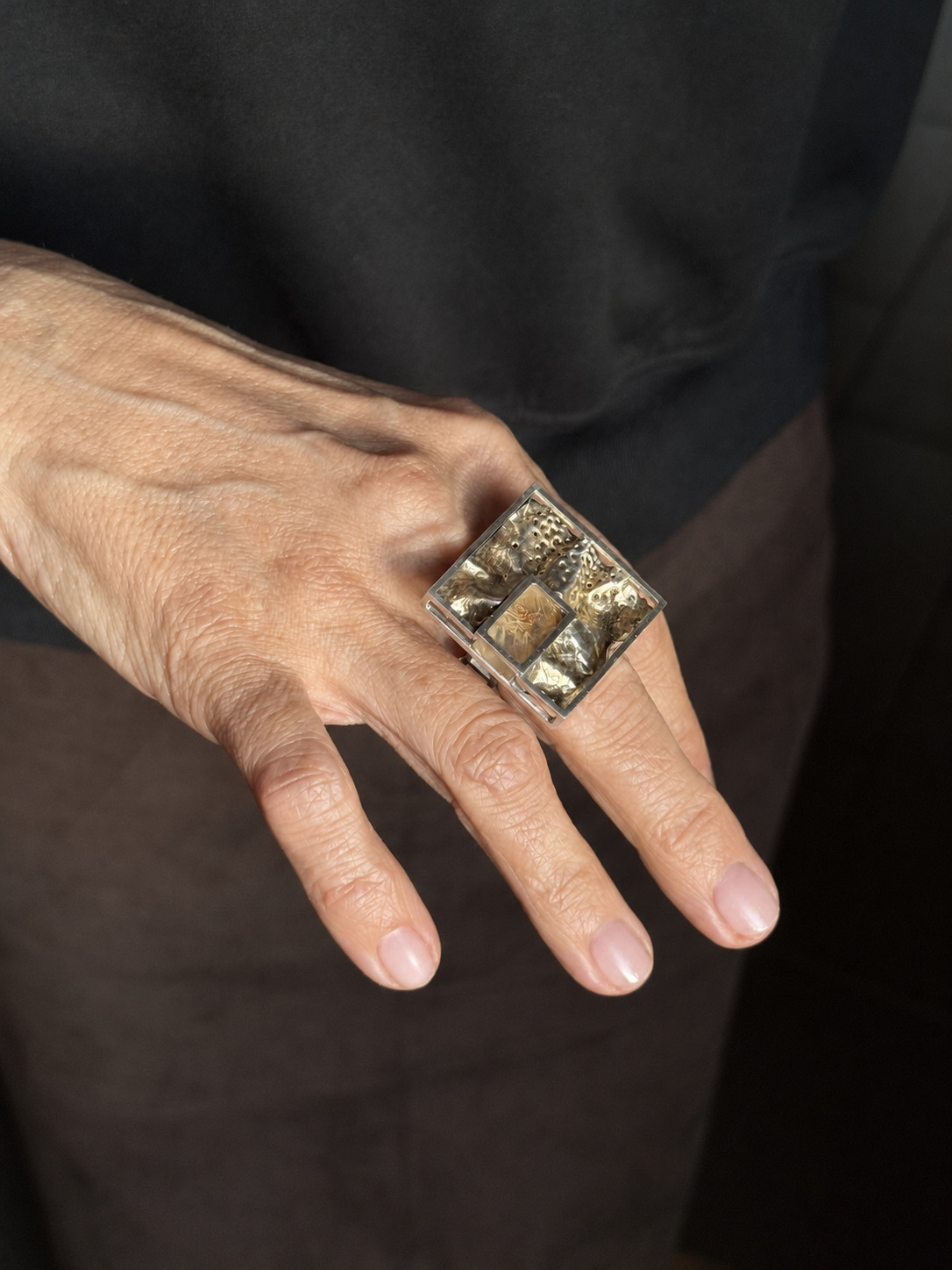
Golden Four Sectors demonstrates this within one object. A cool silver frame sits beside warm golden-toned zones and transparent rutilated quartz. Supporting the ring does not require finding another piece with the exact same tone. You can repeat warmth, leave it as the only warm note, or connect the jewelry through geometry instead.
Mixed metals can feel more deliberate when form, surface, scale or warm/cool contrast repeats, but that remains a compositional option rather than a rule.
Stone colour can be repeated, isolated or deliberately contrasted. All three approaches can work. What matters is the role colour already plays in the ring.
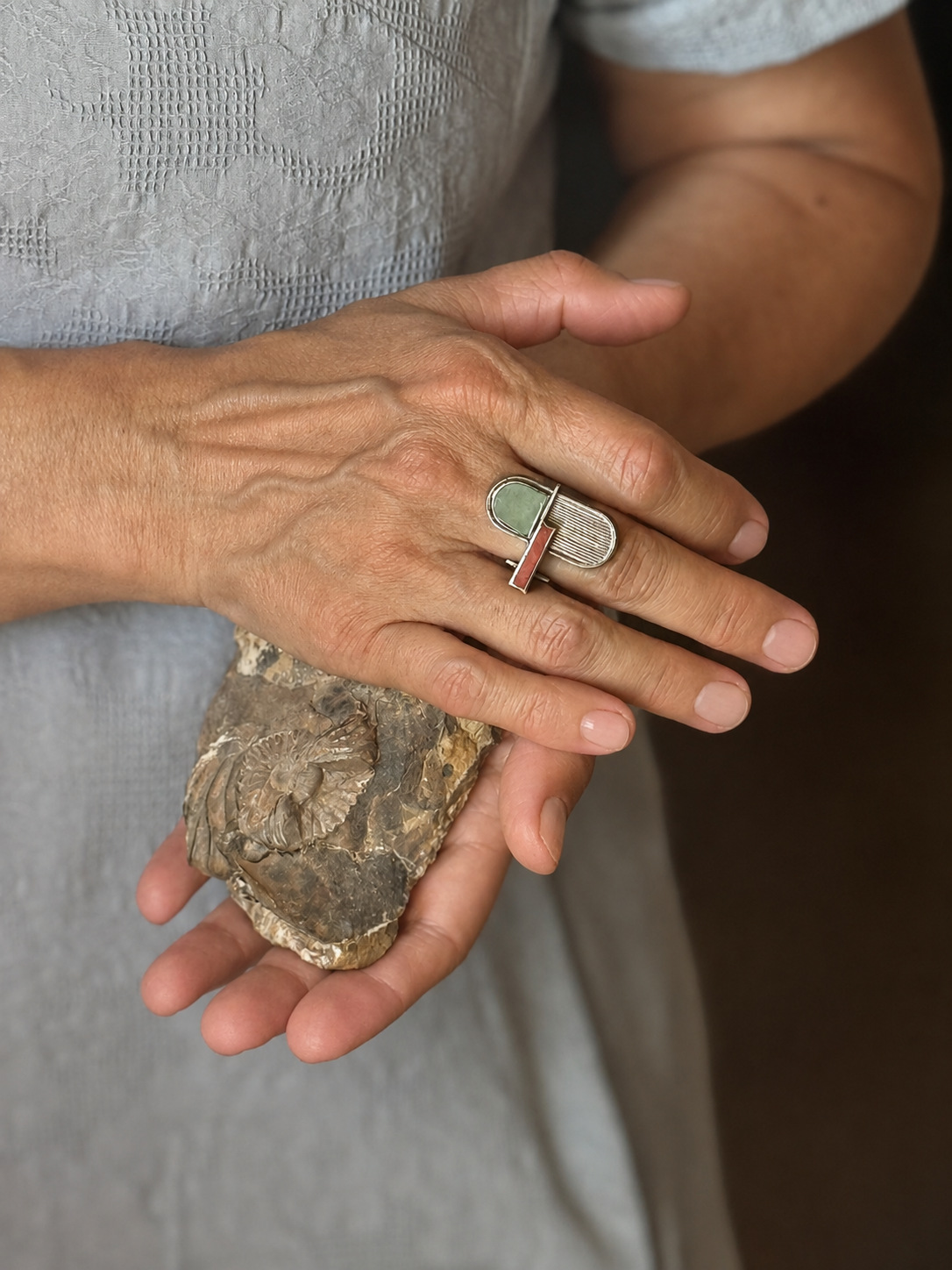
In Surface with Garnet, the small red garnet acts as a point inside dark silver. Keeping it as the only colour on the hand intensifies that effect. Construction already contains green jade and red jasper, so an additional ring could support one of those colours or remain entirely metallic.
Sculpture adds another possibility: azur-malachite already carries blue and green. Those colours do not have to be repeated in clothing or earrings. Sometimes the stone feels stronger precisely because no literal colour match appears elsewhere.
Ask whether you want the stone colour to repeat, contrast or remain the only colour point. For choosing a stone in a future commission, see How to Choose a Gemstone for a Custom Ring.
A statement ring can be worn with a bracelet or watch on the same hand. Again, scale and physical interaction matter. A projecting ring beside a substantial watch can make the whole hand feel engineered and object-like. That may be exactly the intended effect.
If you want more open space, move the watch or bracelet to the other hand. But there is no need to separate them automatically. A rectangular watch case may actually echo a geometric ring more clearly when they share the same hand.
Test the combination in motion. Jewelry should not collide painfully, restrict the wrist or constantly catch on itself. A visual composition only works if it can be worn comfortably enough for the situation.
No. A large ring does not automatically require tiny earrings or the absence of a necklace. A minimalist arrangement is only one option.
The ring remains the strongest object while earrings and necklace are quiet or absent. This creates maximum clarity and open space.
Repeat one characteristic elsewhere: dark metal, a rectangular line, similar texture or one colour. The pieces do not need to form a matching set.
Large ring, earrings and necklace can all be active. Coherence may come from repeated scale, material, rhythm, colour or general mood.
Maximalism is not the absence of structure. The more strong objects you use, the more visible their relationship — or their deliberate opposition — becomes.
What happens near the hand matters more than an outfit label. A long sleeve may hide the hand, a wide cuff can compete or act as a frame, and a bare wrist gives the ring more space.
A high projecting ring can catch on loose fabric, a narrow pocket or a glove. This is a practical property of the form, not an aesthetic prohibition.
Fabric texture can interact with metal: smooth cloth isolates relief, coarse knit can continue a rough surface, and an architectural cuff can echo geometry.
A minimalist composition uses empty space as an active element. One strong ring gets room around it, making silhouette and surface especially legible. This works when you want attention concentrated on a single object.
A maximalist composition works differently: several strong pieces create rhythm. That can mean multiple large rings, a ring with watch and bracelet, or an active ring and earrings. The goal is not to calm everything down but to understand what links the elements — repetition, contrast, scale, colour or line.
The same statement ring can work in both situations. A complex object does not lock its wearer into one wardrobe or one mode of styling.
These examples are not prescriptions. They show how different properties of a specific object can suggest different styling directions.
Dark volume, rough relief and a small red point already form a dense centre. Wear it alone for maximum space, or place it beside a smooth bright ring to heighten the contrast between surfaces.
The ring already contains green, red, projecting architecture and the rhythm of embossed bands. Support can come from a straight line, a geometric shank or one of the colours rather than from literally copying the stones.
Large stone and coral-like silver structure strongly change the hand silhouette. One approach is to leave generous space around it. Another is a deliberate dense composition with another sculptural object, provided they do not physically interfere.
Silver frame, warm golden-toned zones and transparent quartz already combine several colour temperatures. Other metals do not need to match literally; geometry or a repeated warm note can create the connection.
Instead of calling something a styling mistake, look for unclear relationships. A combination may feel accidental when several rings demand equal attention without sharing line, scale or colour, or when they physically collide.
Possible solutions move in opposite directions: remove one element, create space, repeat one characteristic, or strengthen the contrast until it reads as intentional.
Yes, when the specific construction, fit, stones and your daily routine allow it. The term “statement” says nothing about frequency of wear. A broad low ring may be easier in some situations than a tall object, but practical use depends on the actual form.
For frequent wear, stability on the finger and clearance around neighbouring fingers matter. If a large or unusual stone is involved, its durability and protection matter too; see the separate guide How to Choose a Gemstone for a Custom Ring.
The most useful approach is to forget the category for a moment and look at the ring itself. How tall is it? Where does the silhouette point? Is there a strong colour? Is the surface smooth, dark or heavily textured? How much physical and visual space does the object occupy?
Those answers suggest whether you need a bare neighbouring finger, quiet support or another active object. They also help decide whether to repeat metal, colour and line or to build the composition through contrast.
A statement ring does not automatically require the rest of the look to become quieter. It only asks that the chosen styling responds to the scale, form and real physical life of that specific ring. If you are choosing the ring itself, see How to Choose a Unique Silver Ring: Buyer's Guide.
There is no universal best finger. Choose a position where the ring is stable, does not interfere with neighbouring fingers and gets the amount of space its form and projection need.
Yes. It can stand alone, sit beside one or two quieter rings, or become part of a dense layered composition. Hierarchy and rhythm matter more than the number of pieces.
No. An empty finger can create a useful visual interval, but several large rings can sit together if they do not interfere physically and the composition feels intentional.
Yes. Consider the overall scale and whether the objects collide in motion. Move the watch or bracelet to the other hand only if you want more space or better comfort.
No. Matching metal is one easy connection, but bright silver, dark patina, warm-toned details and other metals can coexist when repetition or contrast gives the composition a clear relationship.
Yes. You can keep the ring as the only focal point, echo one of its features in the earrings, or build a deliberately maximal composition. There is no universal prohibition.
It can. Everyday practicality depends on fit, height, projecting elements, stones and your routine rather than on the statement-ring label itself.
No. It can work with simple clothing or a visually dense outfit. Sleeves, cuffs, fabric texture and the amount of space around the hand are usually more practical variables.
