Hardness
Hardness indicates resistance to scratches and abrasive wear. This matters in rings because hands regularly contact hard surfaces, but a high hardness value does not make a stone invulnerable to every type of damage.

NP STUDIO / JOURNAL / GEMSTONE CHOICE
Choosing a stone for a custom ring is not a search for one universally “best” gem. A better starting point is how the ring will be worn and what the stone is meant to do in the design: dominate the composition, add colour, become part of the structure or direct the movement of the form.
Choose a gemstone for a custom ring by looking at more than colour. Start with how the ring will be worn, then consider the stone’s durability, size and shape, colour and surface, and whether it should dominate the design or become one part of the composition.
A beautiful stone can make sense in a ring worn occasionally and be less practical in a piece that is exposed to desks, door handles, tools and other hard surfaces every day. The first useful question is therefore not “Which mineral do I like most?” but “What kind of life will this ring have?”
For frequent wear, discuss more than colour. Consider how far the stone projects, whether corners or edges are exposed and how protective the overall construction can be. A large sculptural ring and a compact everyday piece can tolerate very different relationships between metal, stone and surrounding space. There is no single forbidden or ideal material; the design and the gem have to be considered together.
Occasional wear can allow more freedom for unusual geometry, tall forms, raw surfaces or more delicate materials. Frequent active wear usually makes the balance between visual character and the durability of the complete stone-setting-ring system more important.
Begin with wear. Then consider the properties of the specific stone. Only after that decide its form, position and relationship to the rest of the ring.
One of the most common shortcuts is to reduce ring suitability to a single Mohs number. The scale is useful, but it measures only hardness: resistance to scratching and abrasion. GIA describes gemstone durability more broadly through three factors — hardness, toughness and stability.
Hardness indicates resistance to scratches and abrasive wear. This matters in rings because hands regularly contact hard surfaces, but a high hardness value does not make a stone invulnerable to every type of damage.
Toughness describes resistance to chipping, cracking and breaking under impact. A very hard material can still have structural directions or vulnerable areas where a sufficiently strong blow can cause damage.
Stability describes how a gem responds to heat, light, chemicals, humidity and sudden changes in conditions. Different minerals have different sensitivities, so stability cannot be inferred from scratch hardness alone.
The Mohs scale is not linear: neighbouring numbers do not represent equal steps in actual scratch resistance. “Higher on Mohs” is useful information, but not a complete answer to whether a specific stone suits a specific ring.
For a buyer, the practical conclusion is simple: you do not need to build your own ranking of minerals. Describe how the ring will be worn and assess the specific stone together with its geometry and intended setting. GIA itself discusses durability in relation to design, setting, repair and care rather than treating it as a single score.
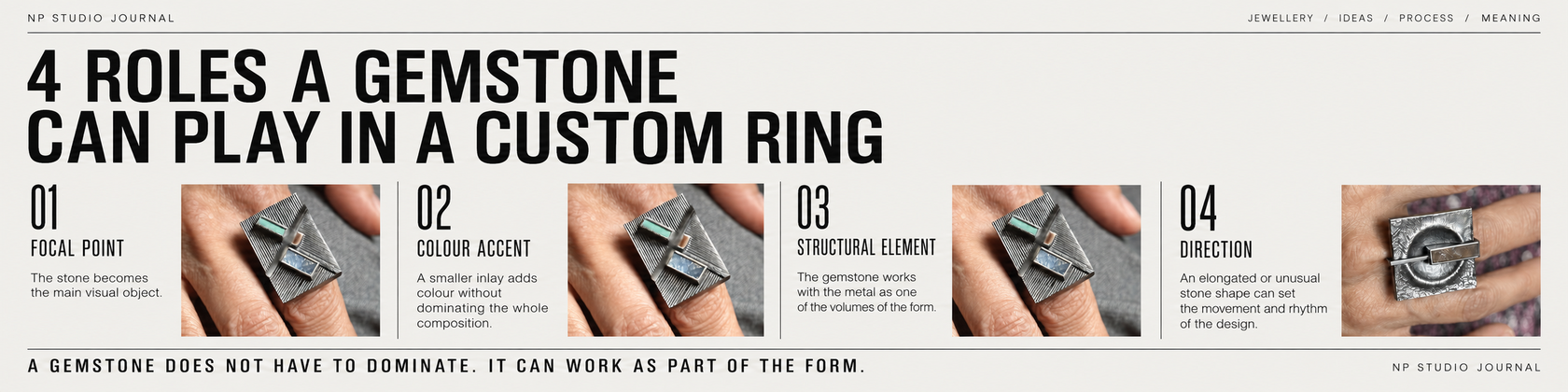
A gemstone is not a picture that is simply attached to a finished ring at the end. Its geometry can reorganise the whole composition. An elongated stone creates direction, a broad one requires a different support area, a tall or deep specimen changes the height of the ring, and an asymmetric natural shape can become the starting point for the entire construction.
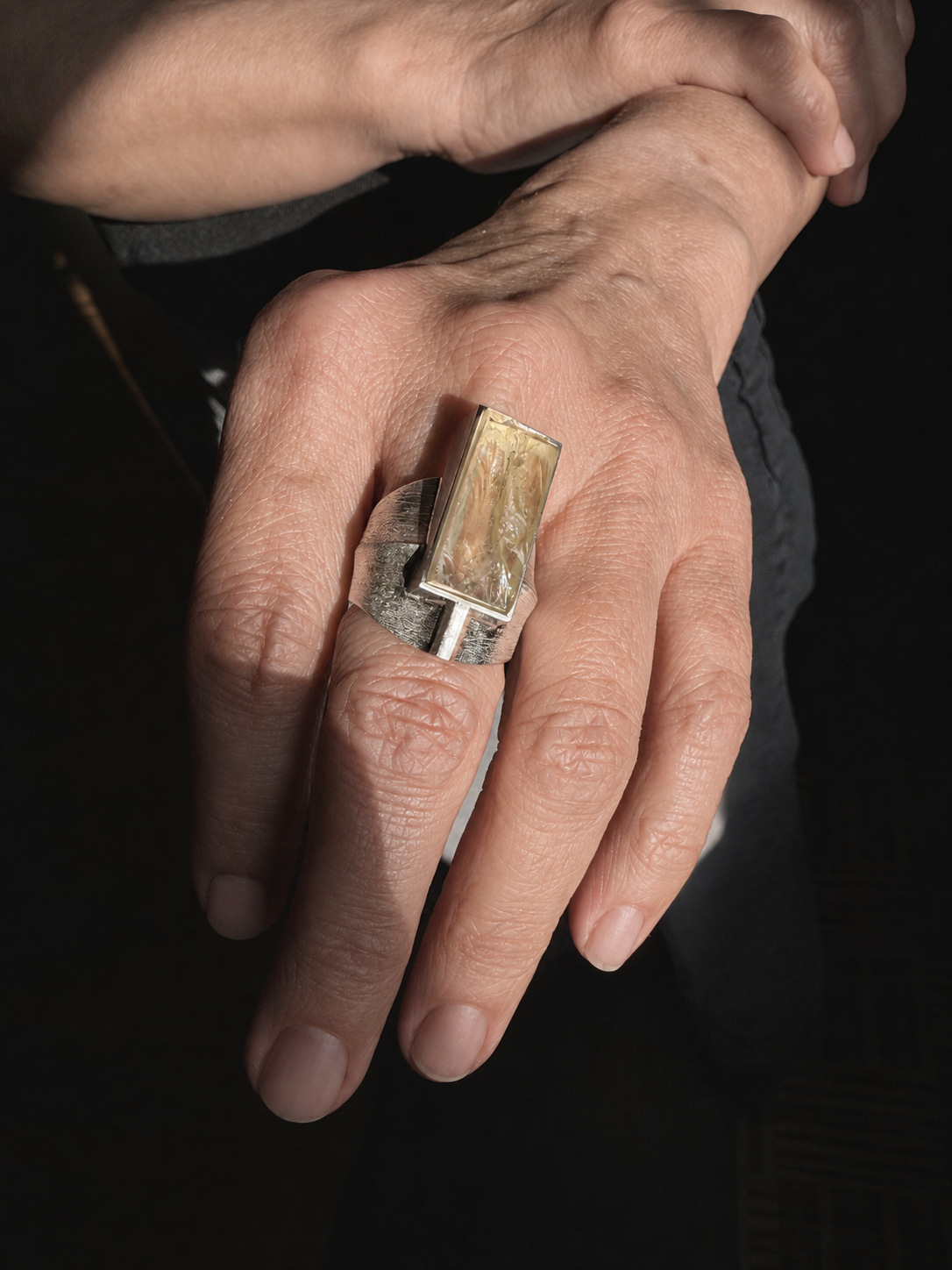
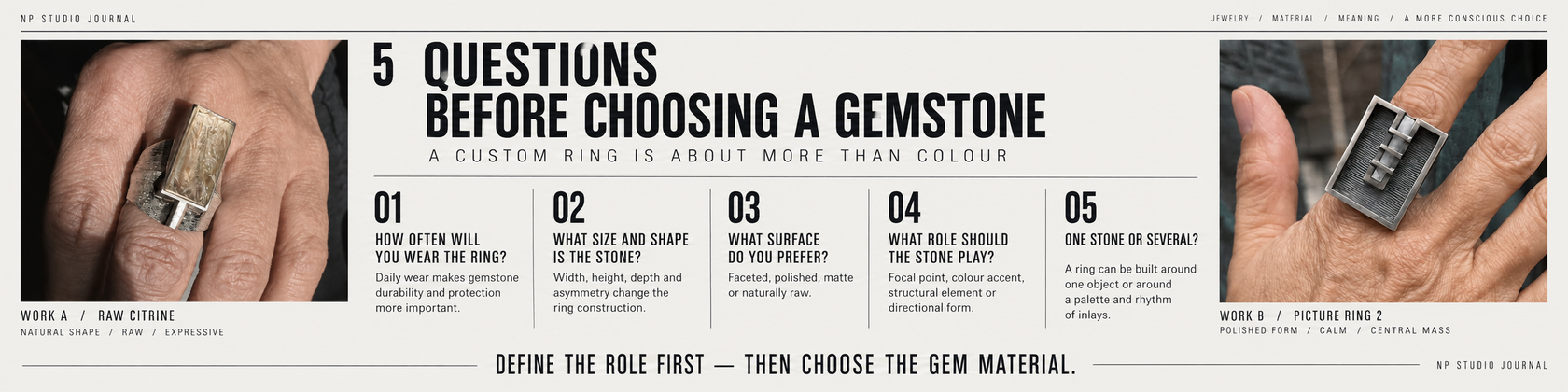
In Raw Citrine, the natural crystal is not forced into a conventional regular outline. The silver is built around its volume and preserves the irregular character of the stone. The specific object matters more here than the abstract word “citrine”.
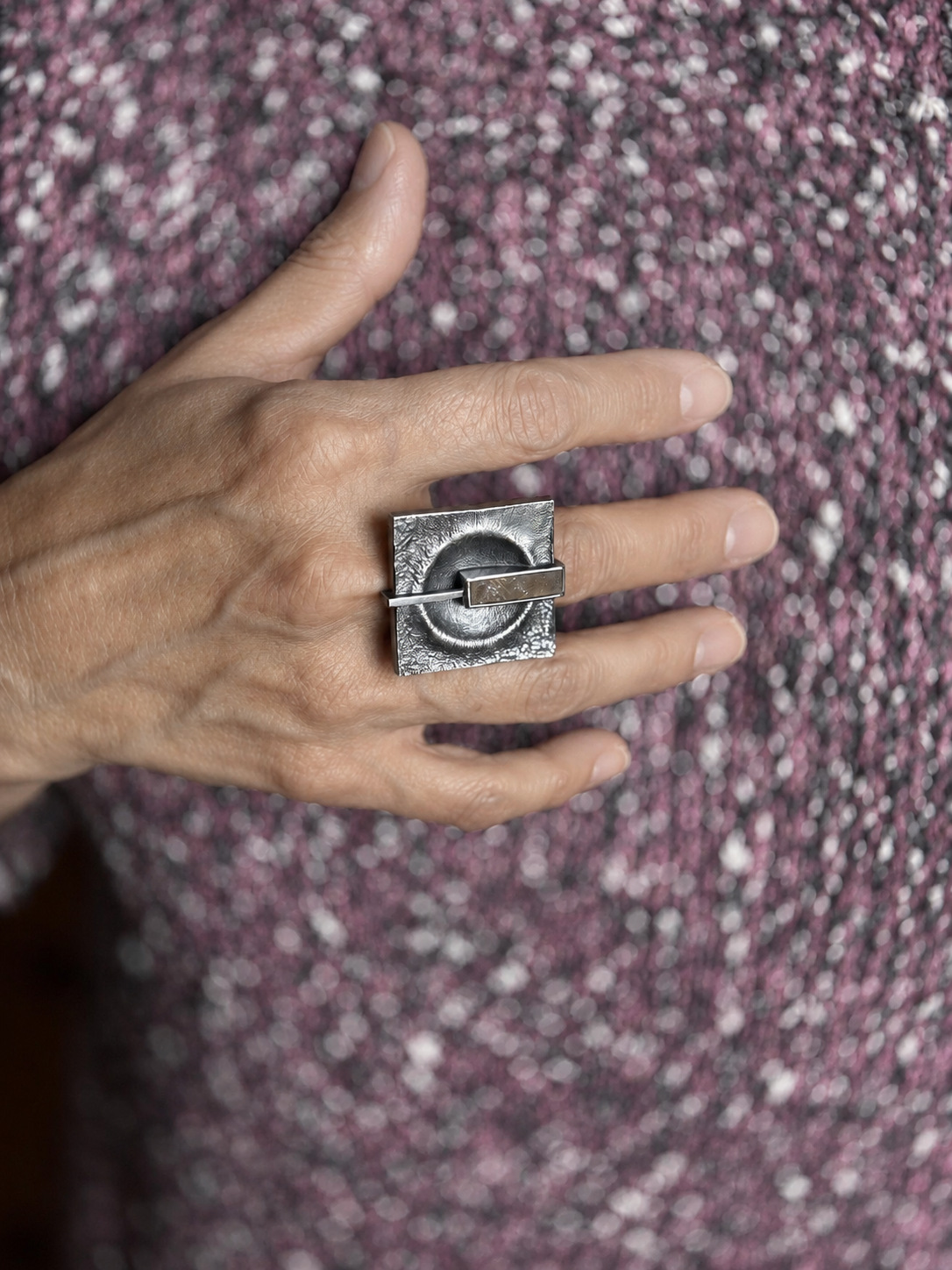
In Picture Ring 3, the elongated rutilated quartz crosses the centre almost like an arrow and directs the entire composition. Replacing it with a short round stone would change more than the insert; it would change the logic of the ring.
For a custom commission, it is useful to treat the gemstone as a physical object: length, width, depth, profile, edges and orientation all matter. The mineral name is only part of the information.
Surface treatment changes the way a stone participates in a ring. Facets generally create more active light return and sparkle. A polished cabochon or inlay can feel calmer and more graphic, placing more emphasis on colour, silhouette and its relationship with metal. A raw or natural surface makes the original material more visible through unevenness, growth planes and irregular thickness.
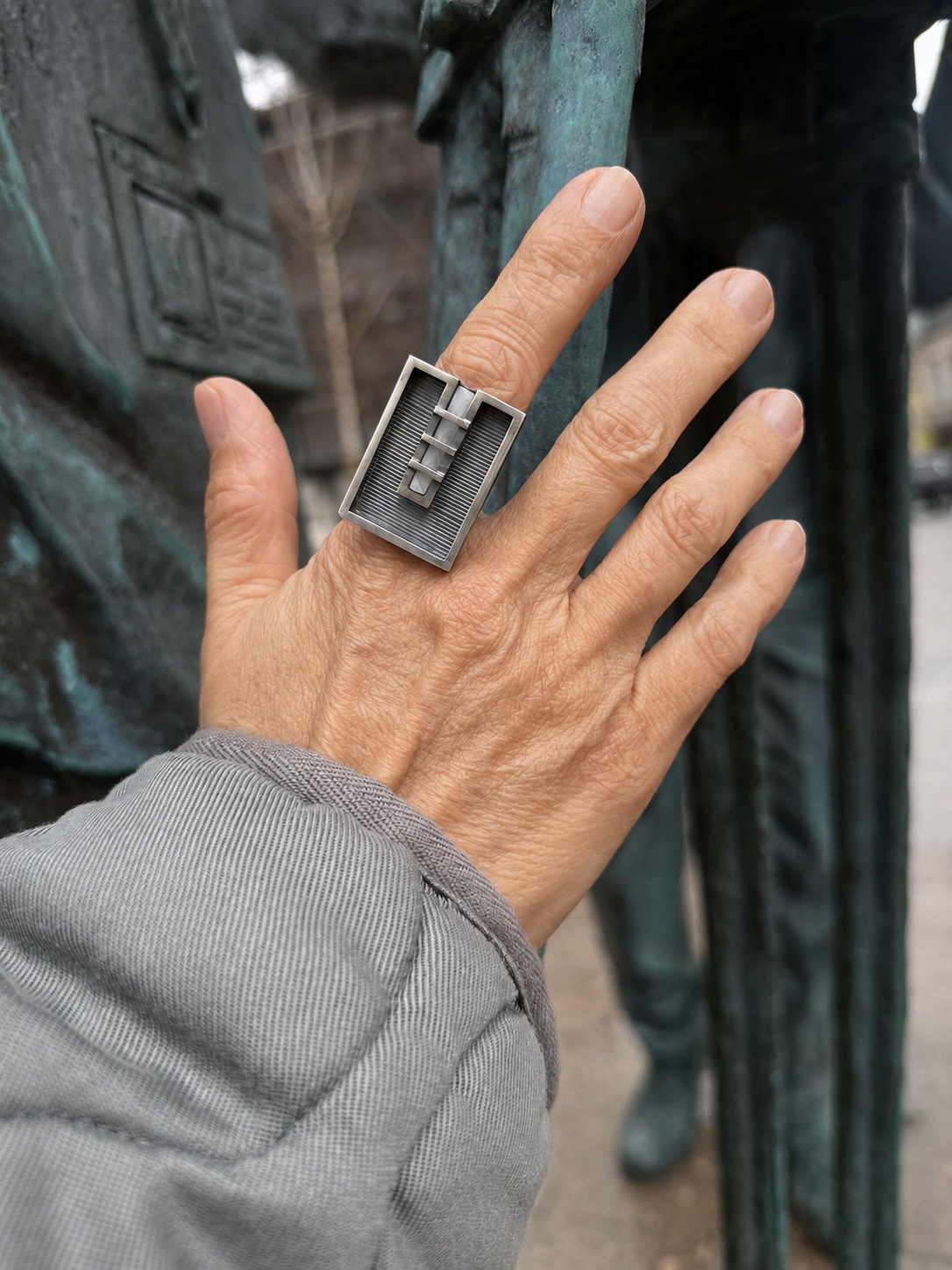
None of these options is automatically “higher quality”. The right choice depends on the composition. In Picture Ring 2, polished milky quartz softens a rigid architectural silver form and becomes a calm central mass. In Raw Citrine, the natural irregular surface is part of the point.
Matte or semi-matte treatment can change perception as well, reducing glare or making colour feel denser and quieter. Choosing a gemstone therefore also means choosing how its surface should behave inside the future ring.
Gemstone colour does not exist in isolation. It reads differently next to bright silver and dark patina. Polished metal introduces reflections, a matte finish calms the environment and a strong texture can intensify the contrast between gem and silver.
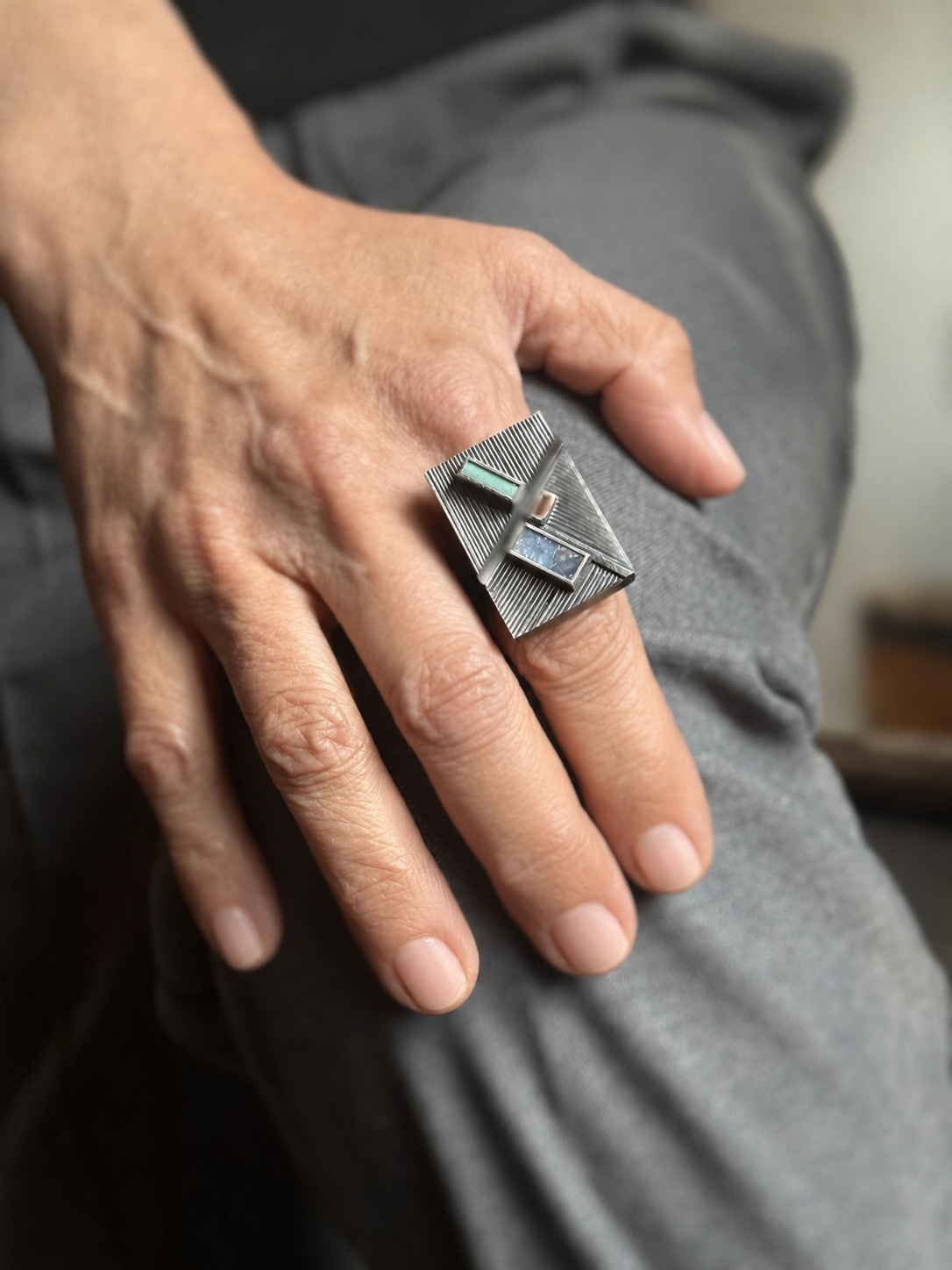
A stone can be the main colour centre or a small signal within a larger metal composition. In Picture with Lines, chrysoprase, kyanite and agate do not compete to become the “main gemstone”. They act as colour points linking several metal planes.
This means a custom ring can begin with a palette rather than a mineral name: cool blue, milky white, warm amber, muted green, transparent or opaque. The exact material can then be selected according to the design and intended wear.
Not every gemstone ring is organised around one dominant stone. In custom work, defining the stone’s role early can make the rest of the decisions clearer.
Once this role is clear, other choices become easier: scale, one stone or several, colour intensity and how much visual independence the metal should retain.
A single stone usually concentrates the composition. It gives the eye a clear centre around which mass, direction and surface can be organised. This does not necessarily make the ring visually quiet: a raw or strongly elongated specimen can be highly active.
Several stones allow a different approach — palette, rhythm and contrast. They do not have to match by mineral, colour or shape. Picture with Lines uses three different materials as individual colour points inside a geometric structure rather than as a set of identical gems.
For a commission, this creates another way to describe the brief. Instead of saying “I want kyanite,” you might say “I want several cool colour accents” or “one dark point and one pale one.” The exact minerals can then be chosen as part of the design rather than treated as the design itself.
Natural gemstones can vary in pattern, transparency, inclusions, saturation and shape. Two examples of the same mineral may look very different. In custom work, this means the specific specimen matters: it should be considered for how it actually looks beside the metal and at the intended scale.
At the same time, not every inclusion or irregularity should automatically be treated as desirable. Some features are mainly visual, while others may affect the practical suitability of a particular stone. This is why the condition of the actual specimen and the expected wear should be considered rather than relying on the assumption that “natural is always better”.
Raw stones make this especially clear. Irregularity may be central to the visual idea while also affecting the setting, height and exposure of edges. The ring needs to respond to the real object.
A customer does not need to know professional setting technique to understand the general principle: the position of the stone affects how protected it is and how far it projects from the ring. Exposed corners, elongated ends, tall placement and asymmetric geometry create different demands from a compact insert surrounded by metal.
GIA connects gemstone durability directly with design and setting choices, noting that vulnerable areas can sometimes be better protected by the mounting. This does not mean unusual stones cannot be used in rings. It means their properties and geometry should be considered together with the metal around them.
Stone depth also changes the overall height of a ring. A specimen that looks modest from above may be deep enough to require significant structure underneath. Final design therefore benefits from the actual stone or at least precise dimensions.
No. A first conversation with a jeweler can begin with a visual brief rather than a gemological specification. NP Studio's Custom Work page explicitly says that a project can start from an earlier work, a stone, a form, a mood, a collection or a single detail.
Instead of naming a mineral, you can describe colour, transparency, calm or vivid character, polished or raw surface, approximate scale and the role the stone should play. One or two reference works are usually enough to establish direction.
A particular stone can affect the cost of a project through size, quality, availability, rarity and the need to source a specific shape. Price is not the main subject here, however. Sometimes it makes more sense to preserve the desired colour, transparency or surface character and consider a different mineral that fits the construction and budget better.
For a dedicated cost discussion, see How Much Does a Custom Ring Cost?. For gemstone choice, the useful point is simply that availability is another design parameter rather than the sole reason for choosing a material.
These works are not rules. They show four different starting points from which a custom ring can develop.
The project begins with the character of a particular natural citrine. Its irregular surface is not hidden; it determines volume and its relationship with silver. A future version can use another stone or a smoother insert, but the character of the composition would change with it.
Polished milky quartz does not act as a glittering precious centre. It softens a strict architectural silver form and creates a quiet mass within the construction. Lightness, opacity and relationship to metal matter as much as mineral identity.
Chrysoprase, kyanite and agate work as three colour points. The ring shows that stone choice can begin with palette and rhythm rather than with one dominant gemstone.
The elongated polished rutilated quartz crosses the centre and organises the composition almost like an arrow. Its shape matters as much as the mineral name; a different silhouette would require a different balance across the top of the ring.
You do not need a finished gemological specification for the first conversation. Send a link to a work, name a colour you like, show one or several stones, indicate an approximate scale and say how everyday the ring should be. If you already own the stone, show it and provide its dimensions.
In NP Studio practice, a project can begin with a specific insert, an earlier work, a form or an overall mood. Stone and silver construction are then considered together. Sometimes the original mineral remains central; sometimes only the colour direction is retained and the actual material changes.
If you want to understand the physical making process after the stone is chosen, see How Handmade Silver Rings Are Made.
The right gemstone for a custom ring is not abstractly the most expensive, the hardest or the rarest. It is the stone whose properties, form, scale and visual role fit the construction and the way the ring is expected to be worn.
A useful sequence is straightforward: define wear, define the stone's role, consider durability, then look at size, shape, surface and colour. Only after that does it make sense to choose the exact mineral and the exact specimen.
This approach keeps more freedom in the design while making the conversation with the jeweler more precise. You are not selecting a gem in isolation; you are selecting a material that has to become part of a particular ring.
Start with how often the ring will be worn and what role the stone should play. Then consider durability, size, shape, surface, colour and how the gem works with the construction.
There is no single answer. Frequent wear depends on hardness, toughness, stability, stone shape and how well the ring construction protects vulnerable areas.
No. GIA describes durability through hardness, toughness and stability. Mohs hardness addresses scratch resistance, not every type of damage.
Yes, when the specific stone and construction suit the intended wear. A raw shape can become the starting point for the design, but its real edges, depth and volume need to be considered.
Both matter. The mineral tells you about the material, while the exact shape, size and depth determine how the stone can become part of the ring.
Yes. Multiple stones can create palette, rhythm or contrast and do not need to match by mineral, colour or shape.
No. A colour, transparency, surface preference, approximate size and one or two reference works are enough to start the conversation.
Yes. If the original gem is unavailable or unsuitable for the design, another material can preserve the colour, transparency or general visual character.
