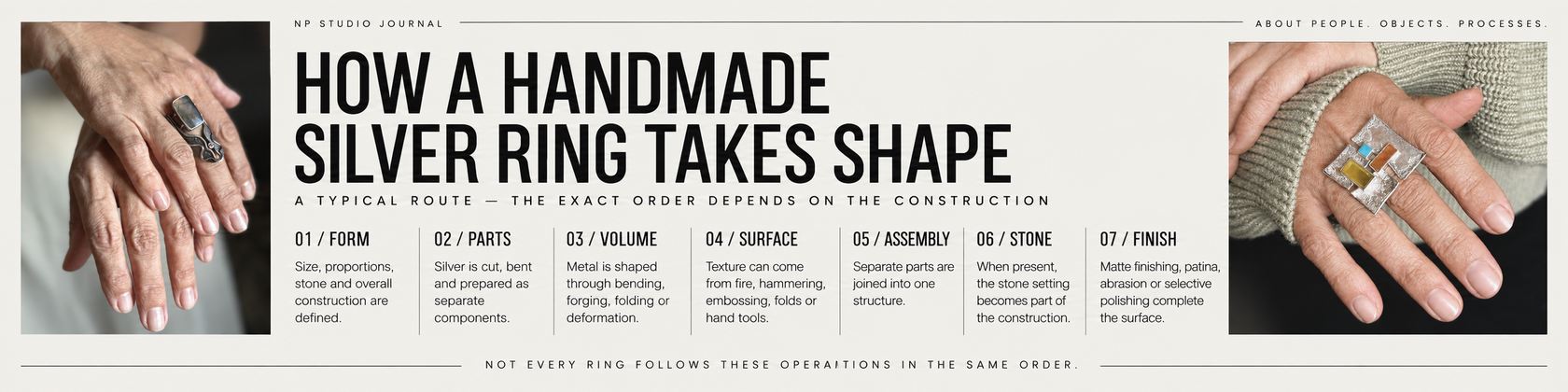
A handmade silver ring rarely comes from one operation. Its form develops through a chain of decisions about size, proportion, surface, joining, stones and finishing. Some rings are built from separate plates, others are formed from a single main blank, and some acquire their character through fire, hammering or folding.
A handmade silver ring is created through a sequence of operations: the maker defines the form, prepares and shapes the metal, builds the surface, joins components, sets a stone when needed, and finishes the piece through patina, abrasion or polishing. The exact sequence depends on the construction of the ring.
What “handmade” means in a silver ring
Handmade does not mean shaping metal with bare hands. Silver is cut, bent, forged, filed, drilled, compressed, joined and finished with tools. A studio may use a jeweler's saw, hammers, files, rolling mills, a torch, rotary tools, abrasives, diamond points, mandrels and many simpler fixtures. Tools extend the hand and make precision possible; using them does not automatically turn the work into mass production.
Form and surface develop through physical operations and decisions. The maker responds to bending, heat and impact, adjusting the next move as the metal changes.
The word handmade is therefore too broad to reveal the whole technical route. A ring may be formed from one blank, assembled from several components or made through a mixed process. More useful questions are where the main form appears, how parts are joined and how the surface is produced.
FormingMandrels, hammers, rolling mills and simple forming tools change the geometry of the metal.
Cutting and openingSaws, drilling, abrasives and rotary tools separate, pierce or refine individual parts.
HeatA torch is used for soldering and in some surface processes; heating has to be planned together with the construction.
TextureHammering, embossing, fire, folds and hand tools can build surface while the form is still changing.
FinishingAbrasives, diamond tools, brushes and polishing methods control matte areas, highlights and edges.
CheckingSize, fit, joins and stone position are checked during construction, not only at the very end.
Before the silver takes shape, the maker has to understand what kind of object is being built. Ring size matters, but the technical problem is wider than the inner diameter. Width of the shank, height of the upper structure, balance on the finger, stone position, spacing between elements and areas that must resist stress all influence the route ahead.
A raised stone needs different support from a flat inlay, while a folded structure or several separated plates require their own joining logic. These choices decide what can be textured early, where soldering access is needed and what must remain adjustable.
A formal engineering drawing is not required for every author-led ring. Form may develop through sketches, marks, templates or trial positioning, but ring size and structural logic still set the boundaries.
Key point
Ring size is only one parameter. Construction determines which parts have to be prepared, what can be textured in advance, where joining is needed and when a stone can safely become part of the piece.
Step 2. Preparing the silver and separate parts
A handmade ring does not always begin from the same kind of blank. Silver can be used as sheet, strip, wire, small elements or other prepared components. The set depends on the construction. A simple shank and a ring made from several planes need very different preparation.
Metal may be cut, straightened, bent, drilled or divided into parts. Wire lines, stone frames, plates and structural ties are prepared when the construction requires them.
Handmade also does not imply that the studio alloys sterling silver from pure metals. The relevant point here is that prepared sterling silver is shaped into the parts of a specific object; where that chain begins varies by studio and project.
At NP Studio, sterling silver has been the main material since 2020. The material itself is covered separately in What Is Sterling Silver?. Here the important question is how pieces of metal begin to become a ring.
Step 3. Building the form
A flat or linear piece of metal becomes a ring through deformation. Silver can be bent on a mandrel, forged, folded, stretched, compressed or shaped through many small controlled movements. Some operations mainly change geometry; others change geometry and surface at the same time.
The shank must acquire a stable inner form and fit. The upper section may stay flat, rise above the finger or split into several surfaces. In substantial rings, volume distribution matters as much as the top-view silhouette.
Forging shows the link between form and surface: hammer blows change thickness and curvature while leaving a visible rhythm. Folding creates a deformation line that becomes part of the spatial structure.
There is no universal order. One ring is best shaped first and textured later. Another needs surface work while a part is still flat because the same tool would no longer reach it after assembly.
Step 4. Texture: when surface becomes part of the form
Texture is not always a decorative layer added at the end. In handmade fabrication it can develop together with the volume and even influence the construction. A hammer mark changes the metal and records the action at the same time. A fold creates both geometry and a visual line. Fire treatment can alter the character of the silver before the piece is fully assembled.
Possible approaches include hammering, embossing, fire-worked surfaces, folds, abrasives and diamond-tool work. Repeated heating can also create a subtle reticulation effect, but reticulation is only one possible surface process.
Timing matters. Heat can alter a finished surface, soldering can require cleanup, and diamond-tool work is often more logical after the main geometry is established. The maker plans both the texture and the moment it is created.
Step 5. Soldering and assembly
If the ring is made from several metal parts, they have to become a stable structure. Silver soldering is one common way to join components through controlled heat without turning the entire object into a cast form.
A complex piece may need several joins. The maker has to consider earlier joints, torch access and later cleanup, so construction often determines the assembly order.
After joining, the seam is finished to suit the design. It may nearly disappear or remain visually legible, but it first has to work structurally.
In rings built from multiple planes, assembly can change the object dramatically. Before joining, the components may look like unrelated pieces of silver. Once connected, direction, balance and the relationship to the finger become clear.
Step 6. The stone and its place in the construction
A stone can be the visual center, a small point of light or one structural element among several. Even when the insert appears to be a late detail, its position usually has to be considered much earlier.
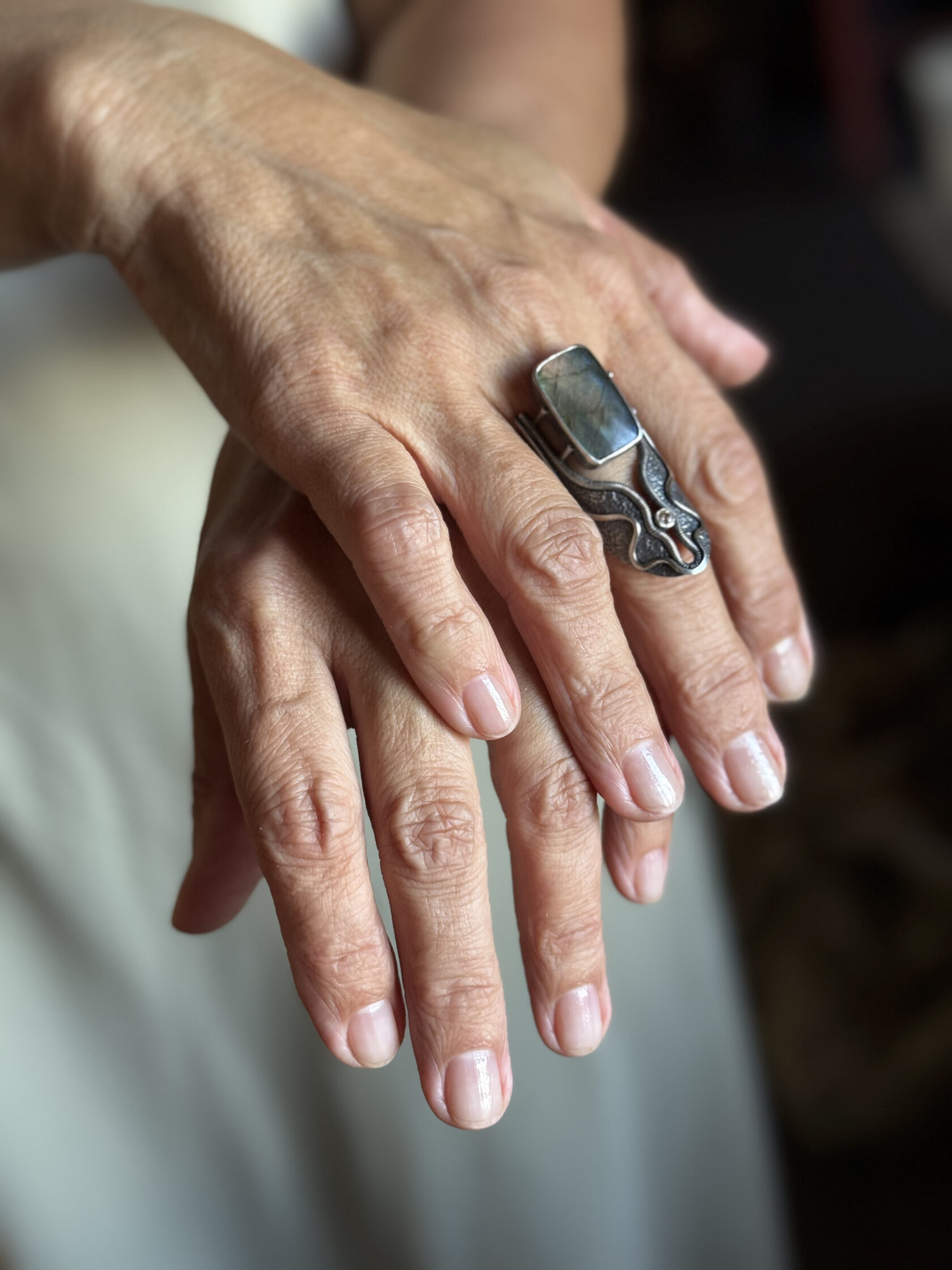
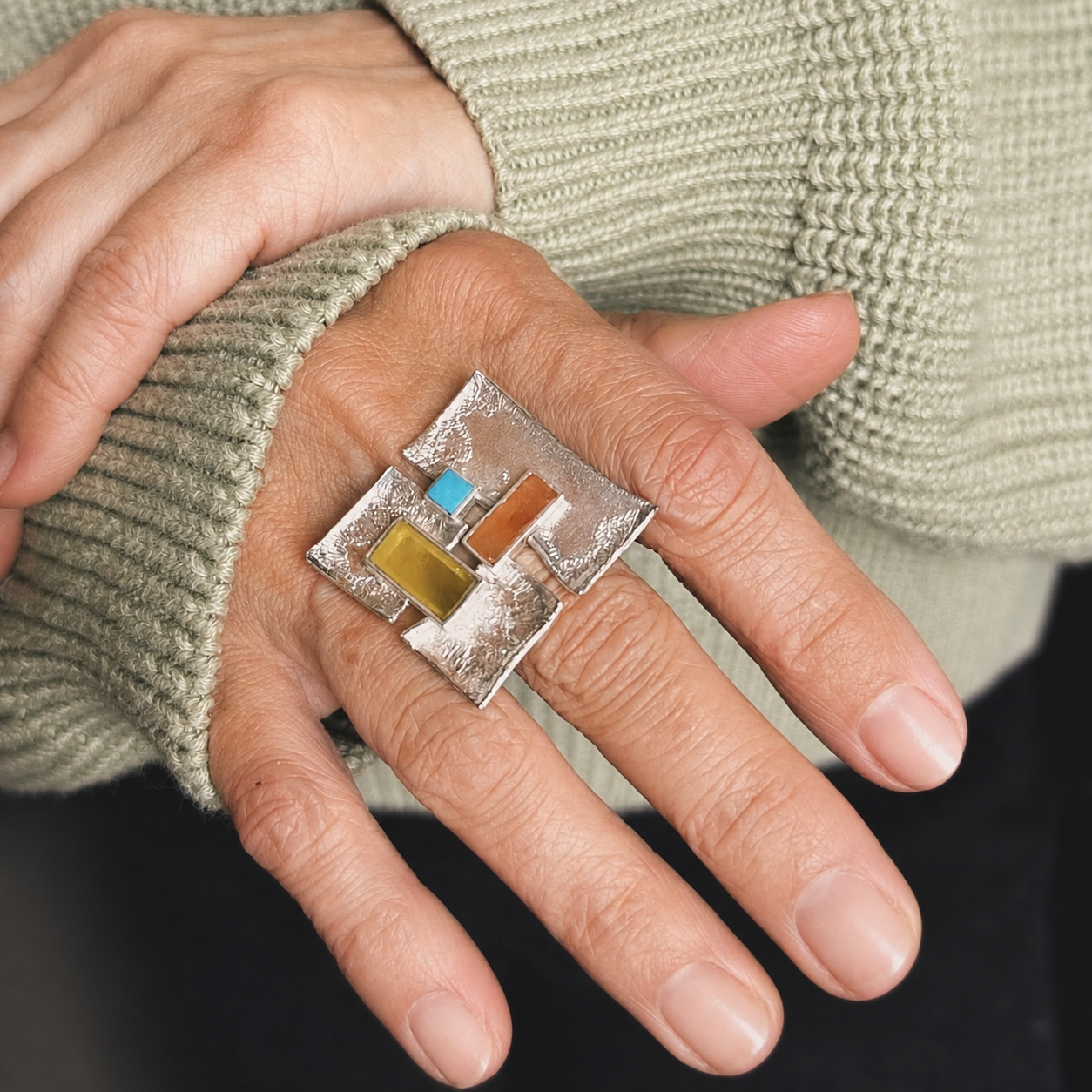
Stone size and shape affect the setting, surrounding metal and structural height. In Elongated with Labradorite the stone is raised above the main plane; in Picture with Three Stones, three inserts help connect separate silver plates.
Natural stones add variation in thickness, edge shape and geometry, so the real specimen may need to be checked against the metal during construction rather than treated only as a nominal measurement.
The exact moment of setting depends on the construction and later operations. Strong heat, aggressive abrasion or certain surface treatments can dictate one order, while another setting method allows a different route. “Set the stone at step six” is therefore a useful explanatory sequence, not a professional rule.
Step 7. Patina, abrasion and finishing
Finishing does not automatically mean mirror polishing. A handmade silver ring may stay matte, rough, darkened or deliberately contrasted. Abrasives can remove unwanted marks and clarify edges without making every surface equally smooth.
Patina darkens silver and can make relief more legible. If recessed areas remain dark while selected edges are lightly polished, the surface develops stronger depth. At NP Studio, Italian patina is often used to emphasize fire texture or folded planes rather than simply add a uniform color.
Finishing also includes checks for sharp edges, fit, stone security and final size. A small correction can send the work back to an earlier operation.
This is another reason the making process is not always a straight line from rough metal to finished object. Small loops between stages are normal in hand fabrication, especially with complex forms.
Why the sequence changes from ring to ring
The sequence “form — surface — assembly — stone — finish” is useful for understanding the process, but the real order depends on construction. A simple shank and a multi-plate composition do not need the same route. A raised stone changes access to surrounding surfaces and solder joints. Folded parts may need to be formed before joining, while fine lines may make more sense after the main silhouette is established.
Fire-worked surfaces alter the route because later heat can damage completed details. Patina generally comes after most mechanical work because sanding or polishing would remove it.
It is therefore more accurate to describe groups of operations rather than seven mandatory steps. Each ring rearranges them into its own path — sometimes nearly linear, sometimes involving parallel preparation and small returns.
Four NP Studio rings, four different process paths
The work pages do not document complete workshop timelines, so these are not manufacturing instructions. They use documented features to show how different the routes can be.
The work page describes a fire-worked surface, raised labradorite, lines, springs and Italian patina. The main form must support the elevated setting, added elements reinforce the elongated silhouette, and the final darkening reveals the relief.
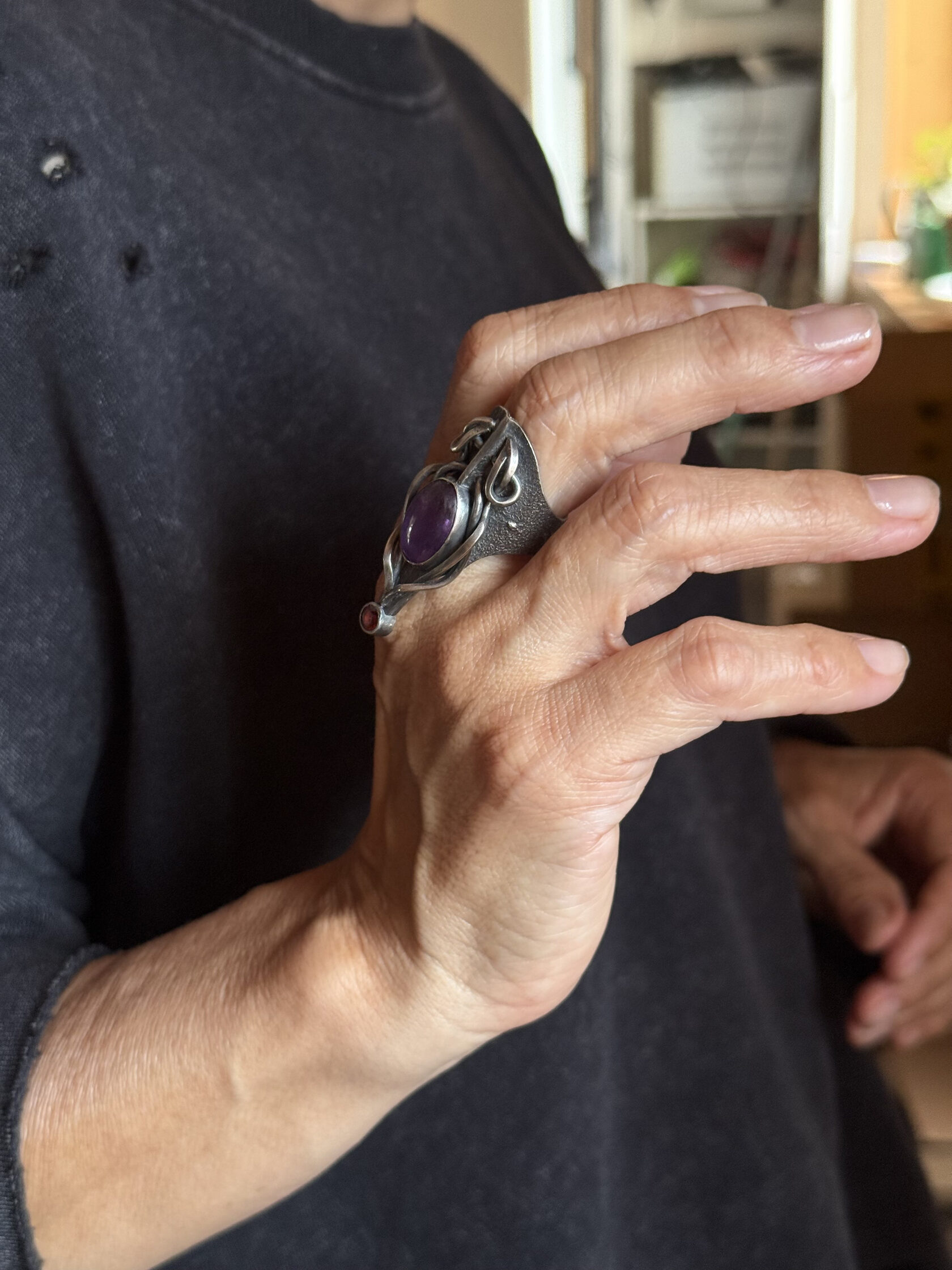
Fire-worked silver is combined with amethyst, garnet and intersecting lines that the site describes as both structural and decorative. Surface and assembly therefore work together rather than as separate layers.
Three silver plates carry fire-created texture and a subtle reticulation effect, while turquoise, amber and agate connect the composition. Planes, spacing, surface and stones become one construction problem.
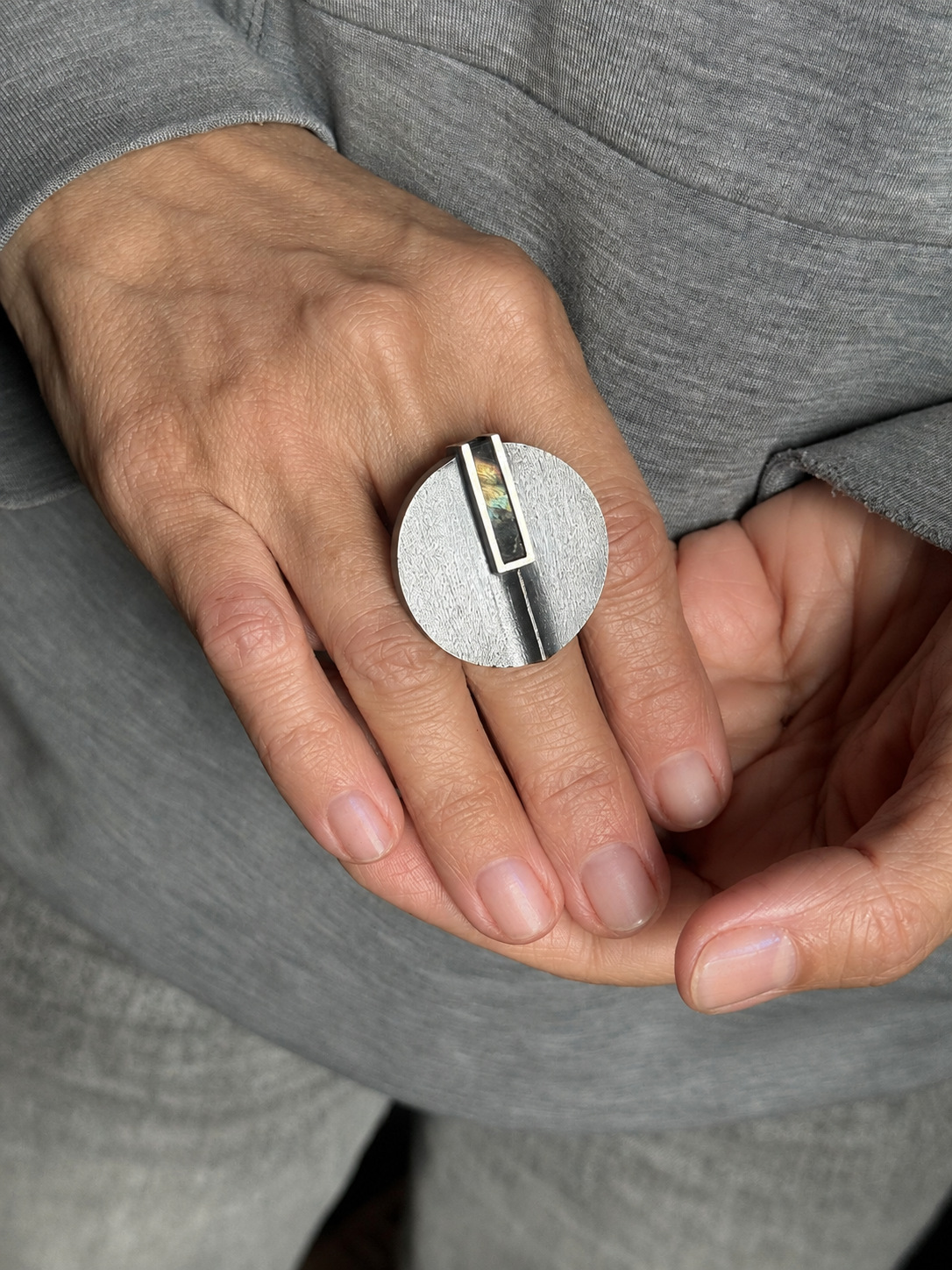
Two joined folded planes are diamond-tool worked and darkened with Italian patina, while a U-shaped element holds polished labradorite. Folded geometry establishes the structure; graphic surface treatment and patina define the final reading.
Does handmade mean there is no casting?
No. Handmade should not be treated as a technical absolute. A cast component can be soldered to other parts, stone-set, ground, patinated and finished by hand. Conversely, a ring directly formed from sheet, strip or wire can involve powered tools at several stages.
This article focuses on direct fabrication, assembly and surface work. Casting is another way for the primary form to appear and can still be followed by substantial handwork.
The distinction is covered in more detail in Handmade vs Cast Jewelry: What's the Difference?. For the present article, the useful conclusion is simple: the word handmade alone does not reveal the complete technical route.
What the making process leaves in the finished ring
Sometimes the process remains legible in the finished object. Forging leaves a rhythm of deformation. A fold changes the direction of reflected light. Fire texture makes silver less uniform. Patina stays deeper in relief and can make lightly polished edges appear brighter.
But a photograph cannot reliably reconstruct every operation. A smooth section may have passed through several stages specifically designed to remove tool marks. A visible line may come from a join or from a deliberate decorative element. Slight asymmetry may be part of the design rather than an accidental sign of handwork.
It is more useful to read process as a set of decisions that sometimes remain visible in the material, not as a checklist of imperfections proving that something is “truly handmade.” Tool marks and small variations deserve a separate discussion and are not the main subject here.
How rings are made at NP Studio
Sterling silver is the primary material at NP Studio. On the About page, Ruslan Murtazin describes metal texture, patina, soldering, folds, reticulation, tool marks and manual surface treatment as part of the studio's practice. That does not mean every ring passes through every one of those operations; the combination depends on the form.
Some works develop through fire, others through deformation or diamond-tool treatment. Stones enter the process when they support the construction rather than as an automatic final decoration.
Maximum polish is not the default goal. Fire marks, folds or matte areas can remain when they strengthen the object, while selected edges may be polished for contrast. Finish is treated as part of the form.
This describes NP Studio practice, not all handmade jewelry. Other studios may begin with wax models, use casting more extensively, work from repeatable components or build surfaces in a very different way.
Conclusion: a handmade ring is built through a chain of decisions
A handmade silver ring is better understood as the result of connected operations than as an object made by one technique. Construction comes first. Metal parts are prepared and formed. Surface may appear before assembly, during deformation or after joining. A stone needs a specific place in the architecture of the ring. Soldering connects components, while finishing resolves both surface and fit.
The order is not universal. In one ring, fire has to come before joining. In another, a fold determines the whole structure. In a third, several planes exist separately before stones and metal connect them. The construction of the specific ring is what turns tools and techniques into an actual making process.
Frequently asked questions
How is a handmade silver ring made?
The form is defined, silver is prepared and shaped, separate parts are joined when needed, texture is developed, a stone may be set, and the ring is finished. The exact order depends on the construction.
What are the main stages of making a silver ring?
A typical route includes construction, part preparation, forming, texture, assembly, stone work and finishing. These groups of operations do not have to occur in the same order for every ring.
What tools are used to make a silver ring by hand?
Depending on the task, makers may use saws, hammers, files, rolling mills, torches, mandrels, rotary tools, abrasives, diamond points and other hand or powered tools.
Is a handmade ring always made from one piece of silver?
No. Some rings develop from one main blank, while others are assembled from several plates, strips, wires, settings and additional metal elements.
When is texture added to a silver ring?
It can be created before assembly, during forming or after some structural operations. The timing is chosen so later heat and finishing do not destroy the intended surface.
When is a stone set in a handmade ring?
The position is planned early, but the actual setting happens when later heat and aggressive finishing no longer create unnecessary risk for the stone or its seat.
Why is patina used on silver jewelry?
Patina darkens the metal and can emphasize relief, recesses and contrast with selectively polished edges. It is one possible finish, not a mandatory step for every silver ring.
Does handmade mean that casting is never used?
No. Handmade and casting are not mutually exclusive. A cast component can still involve substantial hand assembly and finishing; the exact route should be read from the description of the piece.