Axis A — how is it made?
Hand-formed / fabricated, cast, stamped, CAD/CAM, assembled or mixed. This is the method axis.
NP STUDIO / JOURNAL / PRODUCTION MODELS
The handmade-versus-mass-produced discussion is often reduced to a simple image: a craftsperson with tools on one side and a factory full of machines on the other. Real jewelry production is less binary. The useful distinction begins by separating how a form is made from how production is organized.

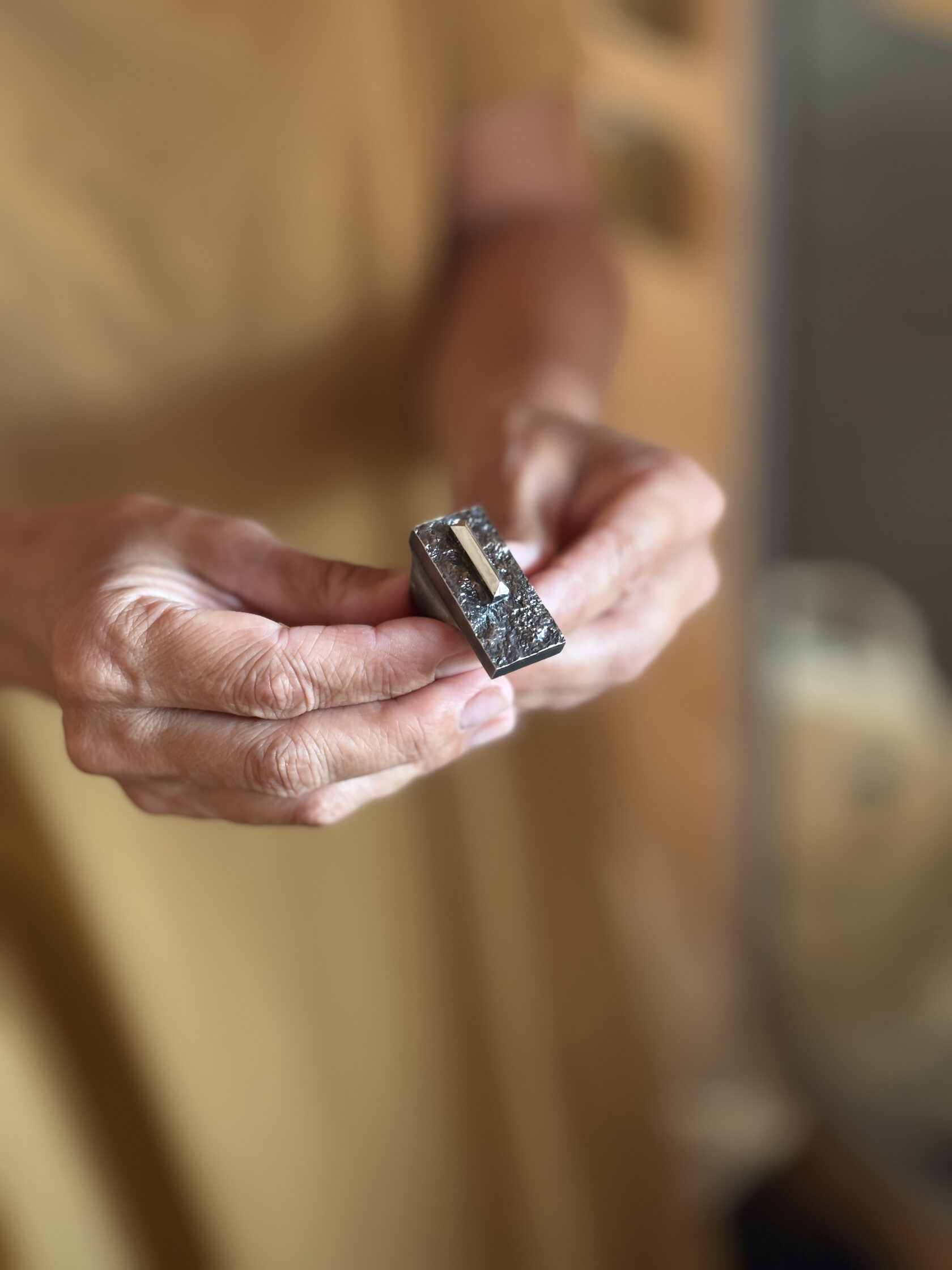
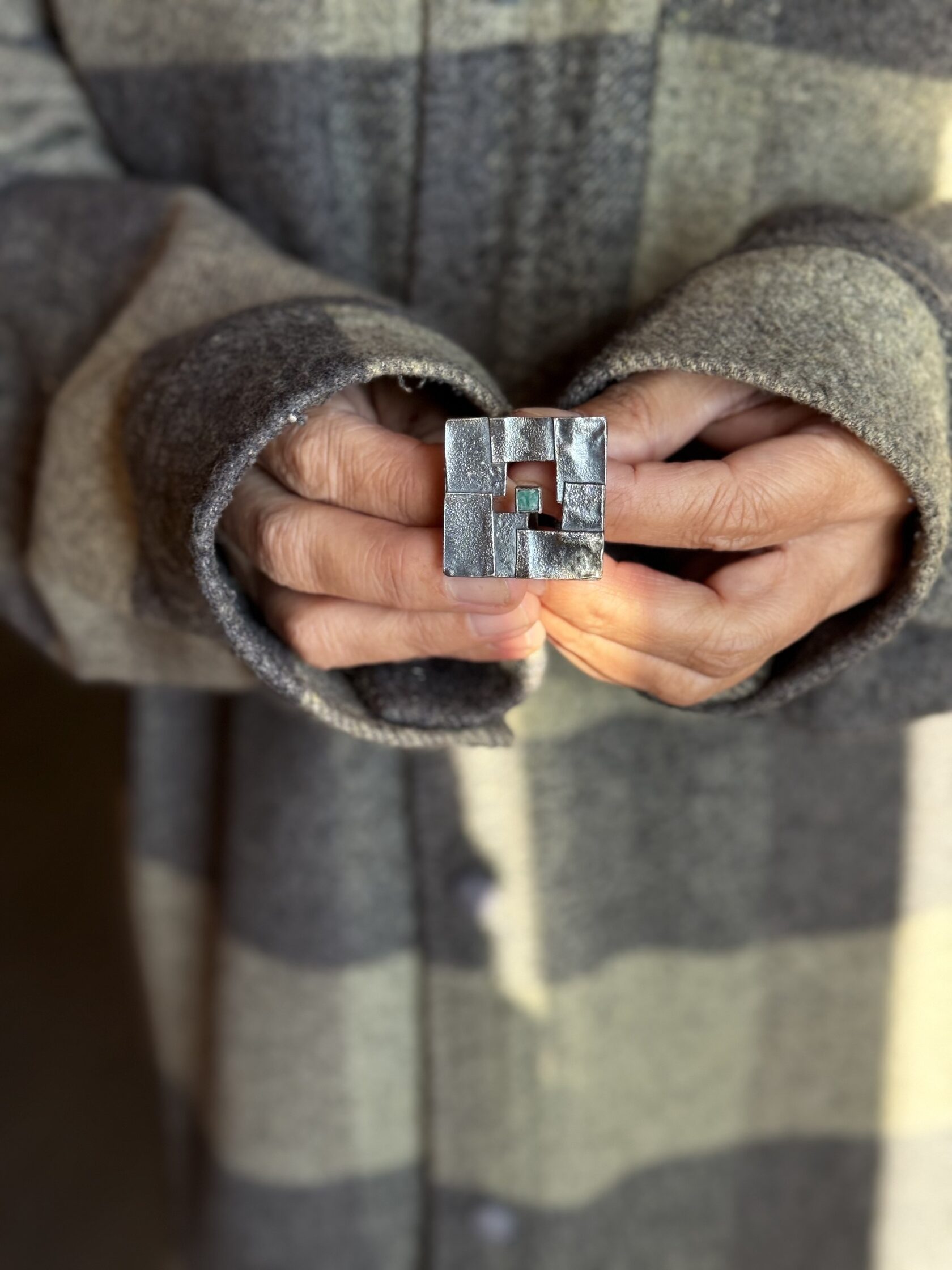

The difference between handmade and mass-produced jewelry is not simply whether machines are used. The central distinction is the production logic. In handmade or studio practice, the maker may adjust form, surface and individual decisions from piece to piece, while mass production is organized around a repeatable workflow designed to create many substantially consistent units. Mass-produced jewelry can still involve handwork, and handmade practice can use powered tools or other technologies depending on what is actually being claimed.
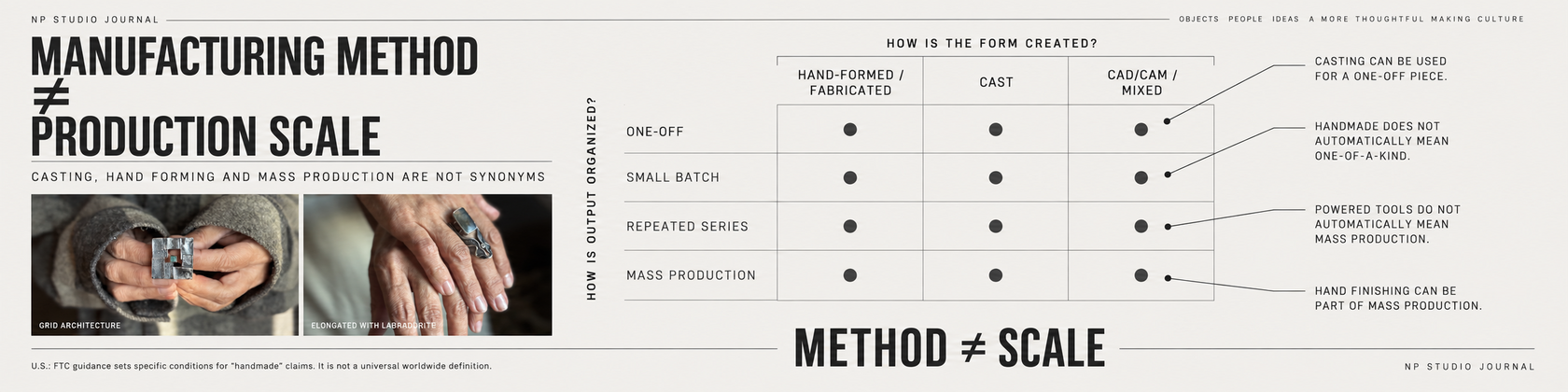
This is the central idea of the article. Manufacturing method asks how the form is created: it may be hand-formed or fabricated, cast, stamped, designed through CAD/CAM, assembled from components, or made through a mixed process. Production scale asks something different: how output is organized — as a one-off, a small batch, a repeatable studio design, a standardized series, or mass production.
Hand-formed / fabricated, cast, stamped, CAD/CAM, assembled or mixed. This is the method axis.
One-off, small batch, repeated studio design, standardized series or mass production. This is the scale axis.
Casting is a manufacturing method; mass production is a production model. They are not synonyms.
A cast piece can be a one-off, while a hand-finished object can belong to a large manufacturing system. The separate method comparison is covered in Handmade vs Cast Jewelry.
In ordinary consumer language, handmade is used broadly and not identically across every market. The label by itself therefore does not provide a universal technical history of a piece.
In the United States, the FTC framework is stricter. 16 CFR §23.2 addresses advertising claims such as handmade and hand-wrought. It focuses on shaping and forming from raw materials, finishing and decoration through hand labor and manually controlled methods that allow the maker to control and vary construction, shape, design and finish.
This is U.S. advertising guidance, not a universal worldwide definition and not legal advice for every jurisdiction.
For this article, handmade/studio practice is used operationally for maker-led production in which decisions about the individual piece can remain active during making.
In this article, mass-produced jewelry means jewelry designed and organized for repeatable production of many substantially consistent units through a standardized workflow. There is no single universal legal threshold at which 100 or 1,000 pieces automatically becomes “mass production.”
Typical features include a repeatable design, a standardized route, production capacity, consistency targets for dimensions or weight, defined components and quality-control procedures.
GIA’s field reporting shows modern jewelry manufacturing in which digital design, molds and casting coexist with skilled manual operations. In Shenzhen, GIA documented a workflow that included stone sorting and matching, selecting a mold from a library, wax injection, casting, preparation for setting, stone setting, final polishing and quality control.
The classification depends on the production system and its repeatability, not on whether a human hand touches the piece. Mass-produced jewelry can still include skilled handwork in setting, assembly, finishing or quality control.
A tool does not automatically turn a studio process into mass production. There is a meaningful difference between a manually controlled powered tool and an automated repeatable process. A maker may use motorized tools, rolling mills, drilling systems or digital stages while still making decisions at the level of the individual work.
The Metropolitan Museum of Art provides a useful historical counterexample at the level of appearance: a Jean Després ring from about 1925 has a machine-made look, yet The Met notes that he made such pieces by hand in his own studio. Appearance is not proof of production model.
Mass production requires a design to move through a repeatable route with predictable results. This does not mean perfectly atomic identity: materials and manual stages still operate within tolerances. But substantial consistency is a system goal.
Studio making may treat repeatability differently. NP Studio’s Forged Ring is shaped almost entirely with hammers. Its work page states that an exact copy is impossible because the texture comes from hammer blows and the metal behaves a little differently each time. The overall character can be repeated without turning the surface into an identical standardized pattern.
Variation is not automatically a defect. In Silver Stone, heated silver receives a real imprint from natural granite, so the surface changes slightly each time. In Grid Architecture, small silver fragments are fused by fire without solder; the work page explains that an exact repeat is impossible because the metal behaves differently during fusion.
At the same time, handmade does not excuse poor construction, insecure settings or failure to meet an agreed size. Controlled variation and technical defect are different things.
Standardization can offer practical advantages: controlled dimensions, repeatable stone sizes, consistent weight targets, defined QC and visual consistency between units.
In Sri Lanka, GIA contrasted traditional small workshops with modern factories and noted mass-production capacity and consistent weight as features of the factory model. That is a description of a different production objective, not a verdict that one model is inherently superior.
Quality depends on design, material, structure, joins, setting, finish, fit and execution. Handmade can allow more piece-specific decisions, but the word alone does not perform a technical inspection for the buyer.
The reverse is also true: mass-produced does not automatically mean poor quality. In both models, the finished object must be judged by how well it is designed and made.
Handmade and one-of-a-kind are not synonyms: a handmade design may be repeated, while a unique object can involve digital or casting processes. Handmade describes making and maker control; one-of-a-kind describes the status of a specific object as a singular piece.
For the category definition, see What Is One-of-a-Kind Jewelry?.
Real manufacturing is not a binary switch. An independent studio may make one-off objects, repeat an idea with changes, produce a small batch or maintain a stable series. A large company may also produce limited or more labor-intensive lines.
It is often more accurate to think in terms of a continuum than to force every piece into one of two poles.
A high price does not prove handmade production, and a low price does not prove mass production. Price can reflect metal, stones, brand, volume, labor, distribution, tax, marketing and many other factors.
Price is an economic variable, not a manufacturing certificate.
Ethics and sustainability depend on the actual supply chain: sourcing of metals and stones, labor conditions, energy use, packaging, logistics, recycling and transparency. A production label alone does not reveal all of those facts.
Handmade is not automatically sustainable. Mass-produced is not automatically unethical.
With handmade/studio work, the buyer may encounter more variation: an individual stone, surface or proportion can be specific to one piece, and exact replication may be less certain. Maker-led adjustment can sometimes allow adaptation to size or a particular stone.
With mass-produced jewelry, repeatability is usually greater: components are more standardized, visual consistency is more predictable and availability may be broader while the line is active. Matching or replacement can be easier when the manufacturer supports the model and its components.
These are typical tendencies, not guarantees. A particular studio or brand may differ from any individual point.
| Dimension | Handmade / studio | Mass-produced |
|---|---|---|
| Production goal | One-off, small-scale or maker-led repeat with room for adjustment | Repeatable output of many substantially consistent units |
| Variation | May be part of the process or design intent | Usually controlled within defined tolerances |
| Repeatability | May be limited; exact replication is not always the goal | High repeatability is a central production goal |
| Workflow | The maker may change decisions while making a piece | The route is standardized and often divided into specialized stages |
| Human decisions | Often made directly for the individual piece | Many decisions are built into design files, tolerances and QC procedures |
| Tools / technology | Hand, powered and digital tools may all be used | CAD/CAM, molds, casting, stamping, hand setting and finishing may coexist |
| Availability | Usually more limited in output and lead time | Can be broader while the production line is active |
| Customization | Often possible, depending on the studio | Usually limited to options built into the system |
| Quality | Depends on execution | Depends on execution |
| One-of-a-kind status | Possible, but not guaranteed by the word handmade | Not the typical goal; a unique object can still involve digital or casting processes |
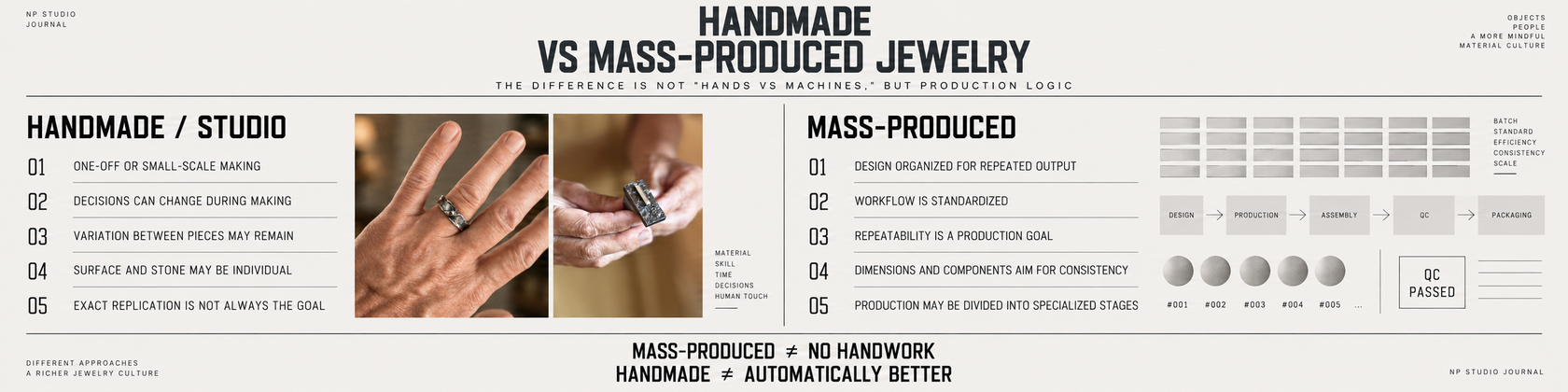
There is no universal winner. If variation, maker-led adjustment and the absence of a requirement for exact replication matter, studio work may fit the goal better. If stable repeatability, broad availability, matching and predictable specifications matter more, a standardized product may be the rational choice.
The useful comparison is based on the buyer’s task, not a moral hierarchy.
NP Studio is one studio case study, not a universal definition of handmade jewelry. Here, a repeat usually means preserving a direction while allowing the new work to change rather than producing an identical duplicate.
Hammering builds both the overall form and the surface. Tool blows and metal response create variation that cannot be reduced to an identical relief.
Natural granite is pressed into heated silver. The process itself makes each surface slightly different.
Small silver fragments are fused by fire. The overall idea can return, while the exact configuration and metal behavior do not.
The recognizable elongated direction may remain while the specific stone, size, surface and details change in a new work.
The useful question is not whether a machine touched the piece, but who and what makes decisions, how repeatable the route is, which parameters are standardized and what the maker or manufacturer is actually claiming to the buyer.
The central difference is production logic. Handmade/studio work may keep more decisions active at the individual-piece level, while mass production is organized around a repeatable standardized workflow.
Not necessarily. Studio practice can include powered or other manually controlled tools. The legal meaning of a handmade claim depends on the market; U.S. FTC guidance sets specific conditions for U.S. advertising.
Casting and handmade are not the same axis. Depending on the process, jurisdiction and exact claim, casting can coexist with substantial handwork, but whether a piece may be advertised as handmade must be assessed under the relevant rules.
No. Casting is a manufacturing method; mass production is a production model. They are not synonyms. Casting can be used for one-off or small-scale work.
No. A handmade design may be repeated. One-of-a-kind describes the singular status of a particular piece, not simply the presence of hand labor.
Yes. Setting, assembly, finishing and quality control can be performed by skilled workers inside a standardized production system.
No. In both models, quality depends on design, material, construction and execution. Production model alone does not guarantee a high or low standard.
Because some decisions and processes occur at the individual-piece level: forging, fire, surface treatment, individual stones or manual assembly can produce variation.
Small-batch jewelry is limited-series production between one-off making and mass production. The degree of standardization and hand variation depends on the studio.
It depends on the goal. Some buyers prioritize maker-led variation and adaptability; others prioritize repeatability, availability and predictable specifications. There is no universal winner.
