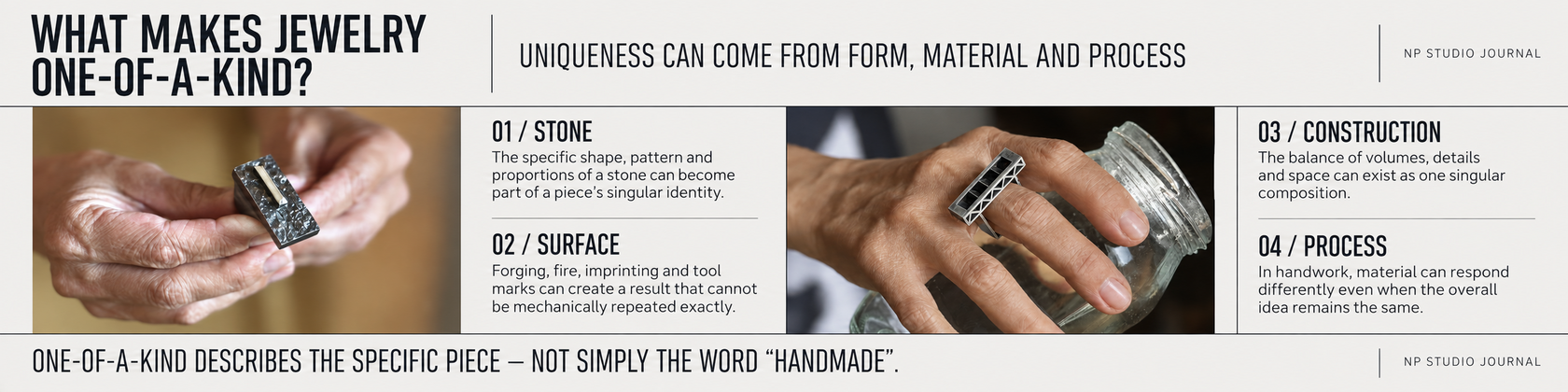
One-of-a-kind jewelry is made as a singular piece rather than as a standard design intended for exact repetition. Its uniqueness can come from a particular stone, handmade form, surface, construction or the making process itself.
One-of-a-kind jewelry describes the status of a particular piece. It exists as an individual work rather than as a standard model designed to be reproduced again and again in the same form. The category is not defined by size, price or visual drama. A sculptural ring can be one of a kind, but so can a quiet silver object if its exact form or surface is not intended for repeat production.
Singularity can come from different parts of the work. A particular gemstone may dictate proportions and composition. A surface may develop through heat, pressure, forging or hand tools in a way that cannot be mechanically duplicated. In another piece, uniqueness may lie in the exact balance of several parts — the location of a stone, the spacing between elements or the relationship between solid metal and open space.
This does not mean that every one-of-a-kind piece must invent a completely new artistic language. A jeweler can return to a familiar idea, visual vocabulary or construction principle. What remains singular is the specific object: its material, proportions, surface and final composition.
Core definition
One-of-a-kind describes the relationship between a specific piece and repetition: the object exists as an individual work rather than as a standard repeatable unit.
What makes jewelry genuinely one of a kind
No single feature automatically makes every piece one of a kind. Singularity usually comes from several factors working together. The useful question is not whether the object carries the label, but what in that particular work is not meant to be reproduced mechanically in exactly the same way.
A particular stone
A natural stone has its own shape, pattern, inclusions, transparency and proportions. Two stones may be close in type and size, yet a specific specimen can influence the design strongly enough that an exact visual replica makes little sense. A natural stone does not automatically make a piece one of a kind; what matters is how that particular stone becomes part of the composition.
A handmade surface
Forging, heat, imprinting, fusing, reticulation, relief and hand tools can produce surfaces where small differences are inherent to the process. Even with the same sequence of operations, depth, light response, tool marks and texture boundaries can shift.
Construction
Singularity can come from the arrangement of parts rather than from texture. The balance of volumes, distance between elements, placement of a stone and distribution of open space can form one particular composition. The principle can be repeated without reproducing every relationship exactly.
Process and controlled variation
Some handmade processes contain an element of variation: heated metal, pressure, fusing or a tool mark may respond differently each time. This is not the absence of control. The maker controls material, scale, direction and intervention while accepting that the result is not a mechanically identical impression.
One-of-a-kind does not simply mean handmade
Handmade primarily describes how a piece is made and the role of manual work. One-of-a-kind describes the status of the specific piece as singular. They often overlap, but they are not synonyms.
A jeweler can make a small repeatable series entirely by hand, keeping dimensions, form and main details consistent. The objects remain handmade without necessarily being one of a kind. Conversely, a singular work can contain repeated or standardized components if the final composition, stone, surface or construction exists only in that specific combination.
Handwork often encourages variation because it leaves more room for material response and decisions made during fabrication. But “made by hand” alone does not explain why an exact replica is not intended.
Handmade
Describes making: how much of the object is formed, assembled or finished through manual work.
One-of-a-kind
Describes singularity: whether this particular object exists as an individual piece rather than a repeatable model.
One-of-a-kind and custom are not the same thing
One-of-a-kind describes the singular status of the finished piece. Custom jewelry describes a way of creating jewelry for a particular request. The categories can overlap: a custom commission often becomes one of a kind because size, stone, proportions and surface are resolved for one project.
But a custom piece can also be based on a repeatable design, while a one-of-a-kind object can be created without a client request at all — as an independent work, prototype or experiment. A full comparison belongs to a separate topic; for this definition it is enough to understand that singularity and commissioning describe different aspects of the object.
Often a related piece can be made from the same direction without becoming an identical copy. The maker may keep a construction principle, mood, surface character or type of composition and rebuild the object around a new ring size, stone or set of proportions.
What might remain? The engineering quality of the form, an open composition, several concave planes, or a contrast between rough and polished metal. What may change? The stone, dimensions, spacing, shank line, degree of relief, patina and final balance.
This is why “repeat the work” does not always mean reproduce every millimeter. In an author-led practice, it can mean making a new piece in the same direction — related by principle but independent as an object.
Why an archived or sold piece still matters
A sold or archived piece remains useful after it leaves the studio. It documents the maker's visual language: forms, surfaces, constructions and technical ideas that have already been explored. For a client, an archived work can act as a reference — not as an item still in stock, but as a clear starting point for a conversation.
Archives are especially important in one-of-a-kind practice. If exact repetition is not the main goal, earlier works become a map of directions. One may show an approach to stones, another an open construction, another a particular surface. A future piece can continue one of those principles without reproducing the original object.
This creates continuity without turning the archive into a catalogue of identical models. The author's language remains recognizable while the individual works retain their own identity.
How one-of-a-kind works at NP Studio
In NP Studio practice, many pieces exist as individual works or prototypes. Exact duplication is generally not the central aim. When an earlier idea is revisited, ring size, stone, proportions, surface, line and final composition can all change. Archived work pages therefore function not only as documentation of past pieces but as possible directions for future ones.
The role of surface is a good example. Some NP Studio rings are built through forging, others through fused fragments, patina, imprinting or the interaction of heated silver with a textured material. The technical principle can be repeated while the actual surface remains different.
The same applies to stones. A particular insert can determine width, direction, color balance and the geometry of the entire top of the ring. Replacing the stone may require the composition to be rebuilt rather than simply substituting one mineral for another.
This is a case study of NP Studio practice, not a universal rule for all jewelry makers. Other studios may work with repeatable small editions, strict production models or different forms of uniqueness.
Four different reasons an exact replica may not make sense
The four hero works show different sources of singularity. None of them is a universal definition on its own. Together they demonstrate how one-of-a-kind status can emerge from surface, construction, composition or the development of an idea.
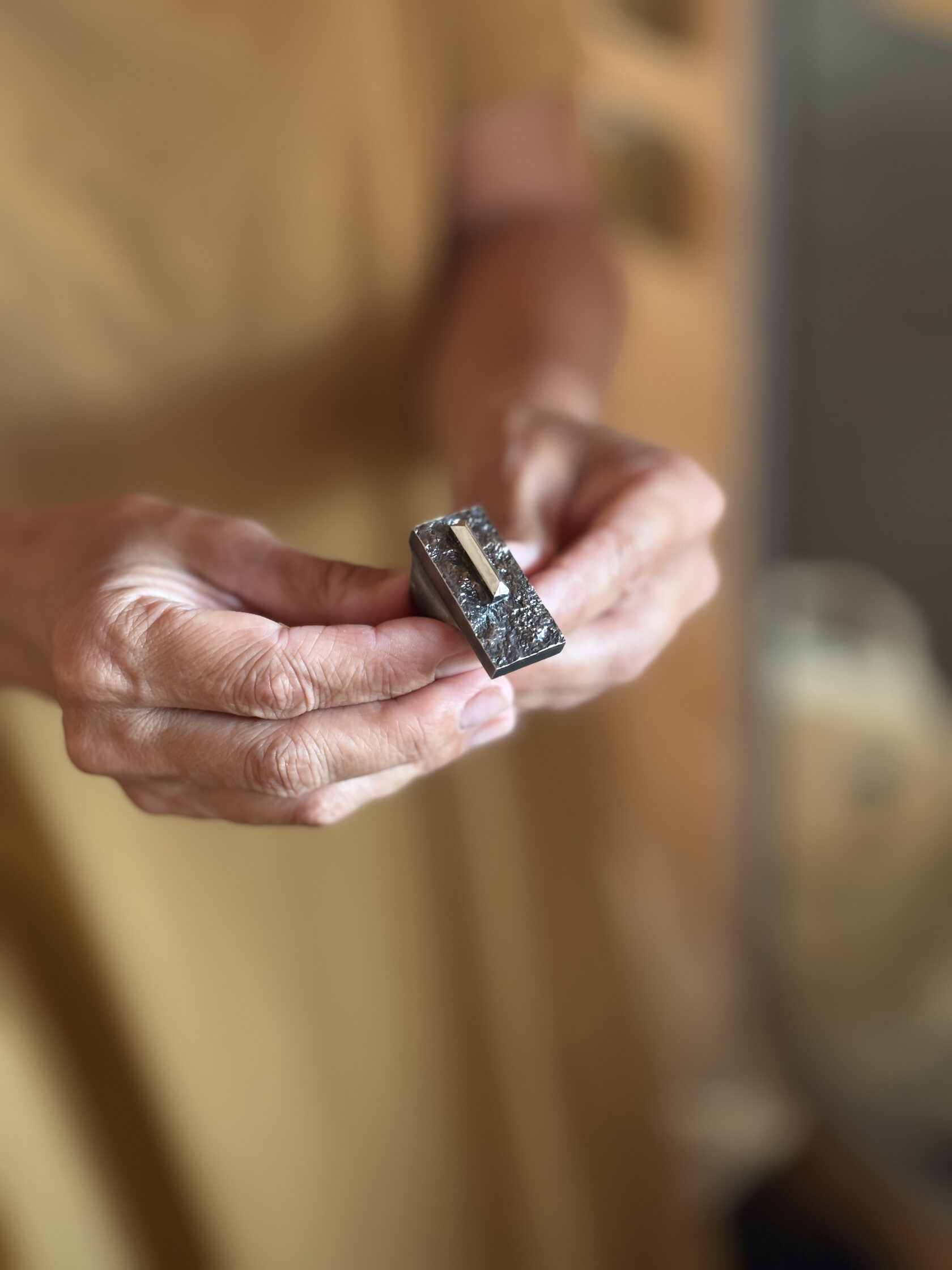
Its surface is made by pressing natural granite into heated silver. The technical principle can be repeated, but the imprint and relief distribution vary each time. Here singularity comes from the interaction between material and process rather than from a gemstone insert.
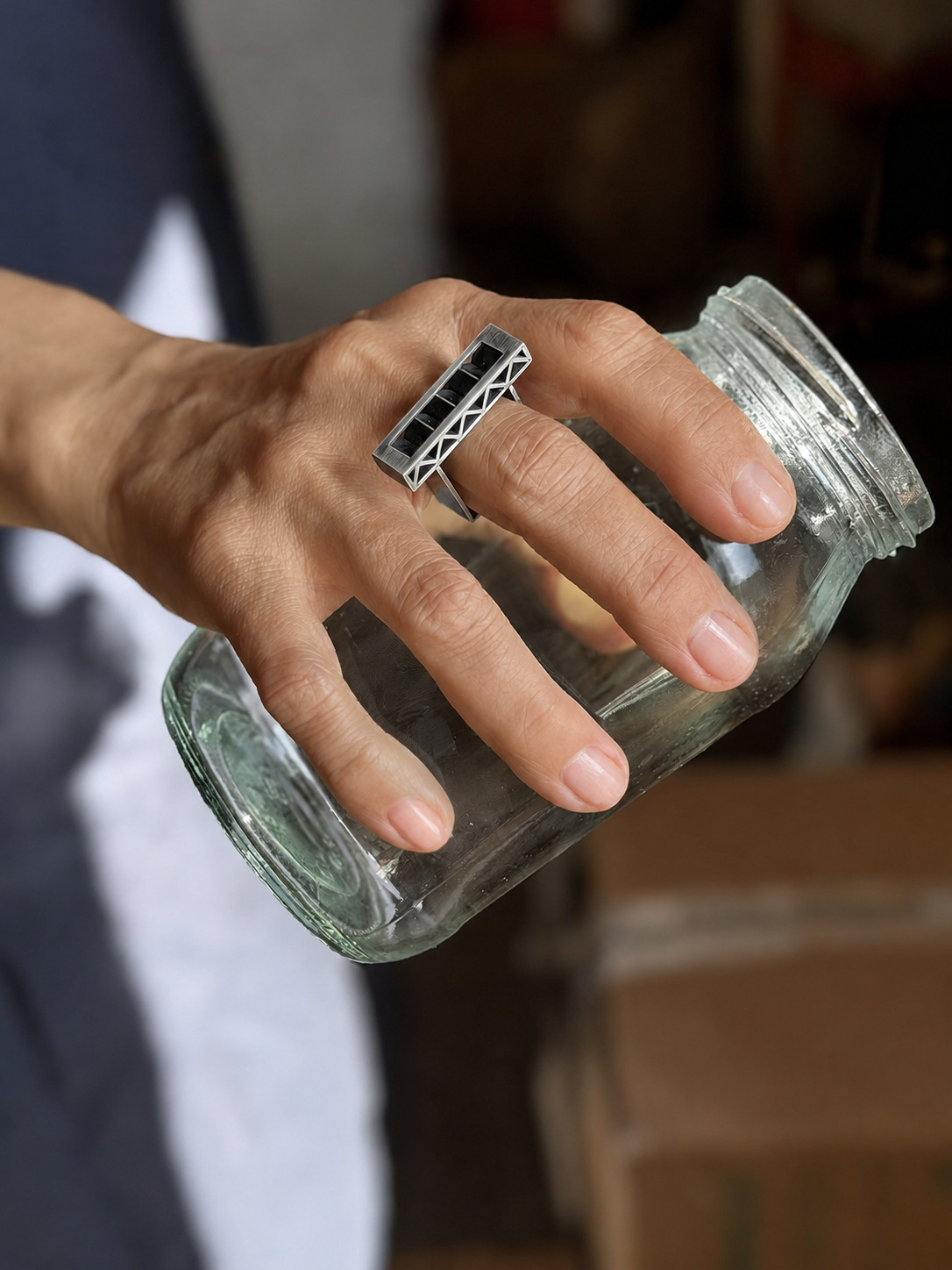
This archival ring is built as a small open engineered structure. A new piece can preserve the idea of supports, lines, voids and architectural character without reproducing the original geometry exactly.
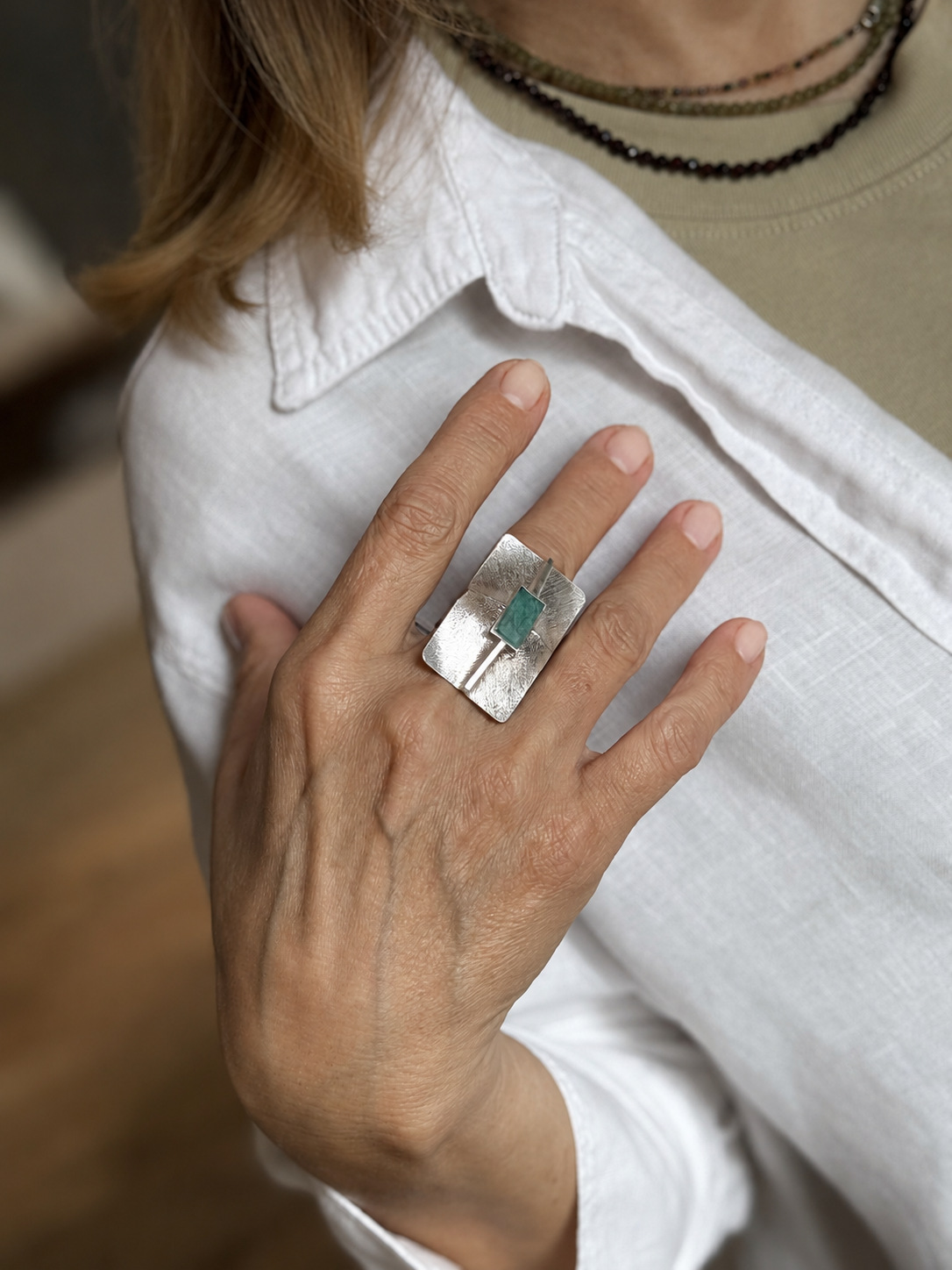
Amazonite and four concave silver planes form a specific composition. A new version may change the stone, size, number and proportions of the surfaces; an exact replica of the archival ring is not the intention.
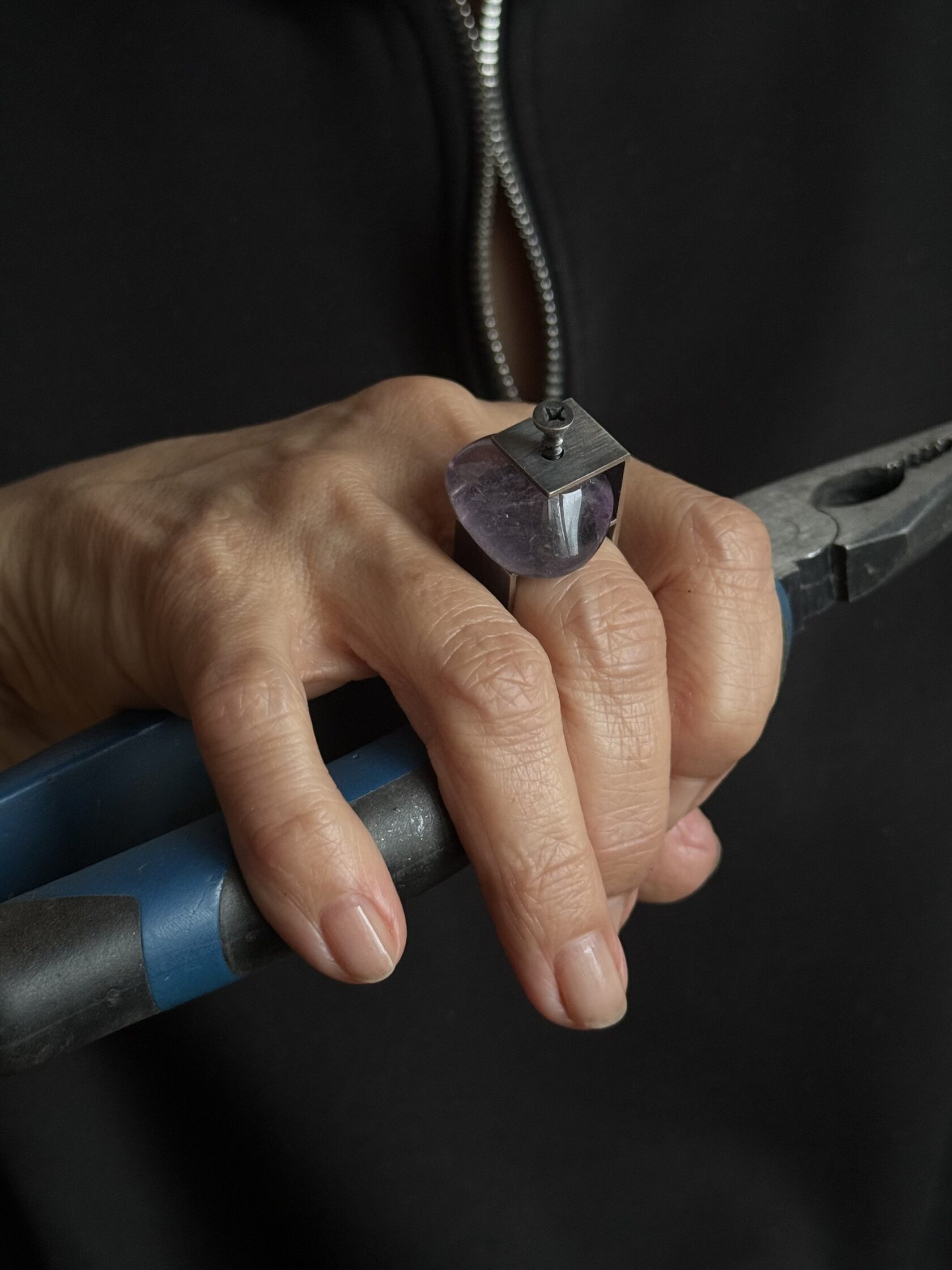
This sculptural prototype is most useful as a direction: the tension between mineral, metal plate and industrial detail can be developed in another object while the new piece remains an independent composition.
Conclusion: uniqueness is a property of the specific work
One-of-a-kind jewelry is not simply a flattering label for anything handmade. The term is meaningful when there is a clear reason the particular object exists as an individual piece — because of its stone, surface, construction, combination of elements or a process that is not designed to produce mechanically identical results.
Singularity does not require maximum complexity. A small metal-only ring can be one of a kind if its form and surface are resolved as a specific object. And a natural gemstone does not automatically create one-of-a-kind status if the rest of the design is intended for repeat production.
The most useful way to understand the category is through the relationship between idea, material and repetition. A piece can have relatives, later versions and works made from the same direction while the original remains singular in its particular form.
Frequently asked questions
What does one-of-a-kind jewelry mean?
It means a specific piece exists as a singular work rather than as a standard model intended for exact repetition. Its uniqueness may come from stone, form, surface, construction or process.
Is one-of-a-kind jewelry always handmade?
No. Handwork often encourages variation, but handmade and one-of-a-kind describe different things. The key point is the singular status of the specific piece.
How is one-of-a-kind jewelry different from custom jewelry?
One-of-a-kind describes singularity; custom jewelry describes making a piece for a particular request. A custom piece can be one of a kind, but the terms are not interchangeable.
Can a one-of-a-kind piece be reproduced?
A related piece can often be made from the same direction while changing stone, dimensions, proportions, surface and final composition rather than copying the original exactly.
Can jewelry without a gemstone be one-of-a-kind?
Yes. Singularity can come from form, construction, handmade surface or process even when there is no stone.
Does a natural gemstone automatically make jewelry one-of-a-kind?
No. A particular stone can contribute strongly to uniqueness, but the status of the piece depends on the whole object and how that stone is integrated into it.
Can a related piece be made from an original design?
Yes. The maker can preserve a construction principle, mood or surface direction while making a new independent object instead of an identical replica.
Why can handmade surfaces be difficult to repeat exactly?
Metal, heat, pressure and hand tools respond slightly differently each time. The maker controls the process, but the result is not a mechanically identical impression.