Chaotic Lines
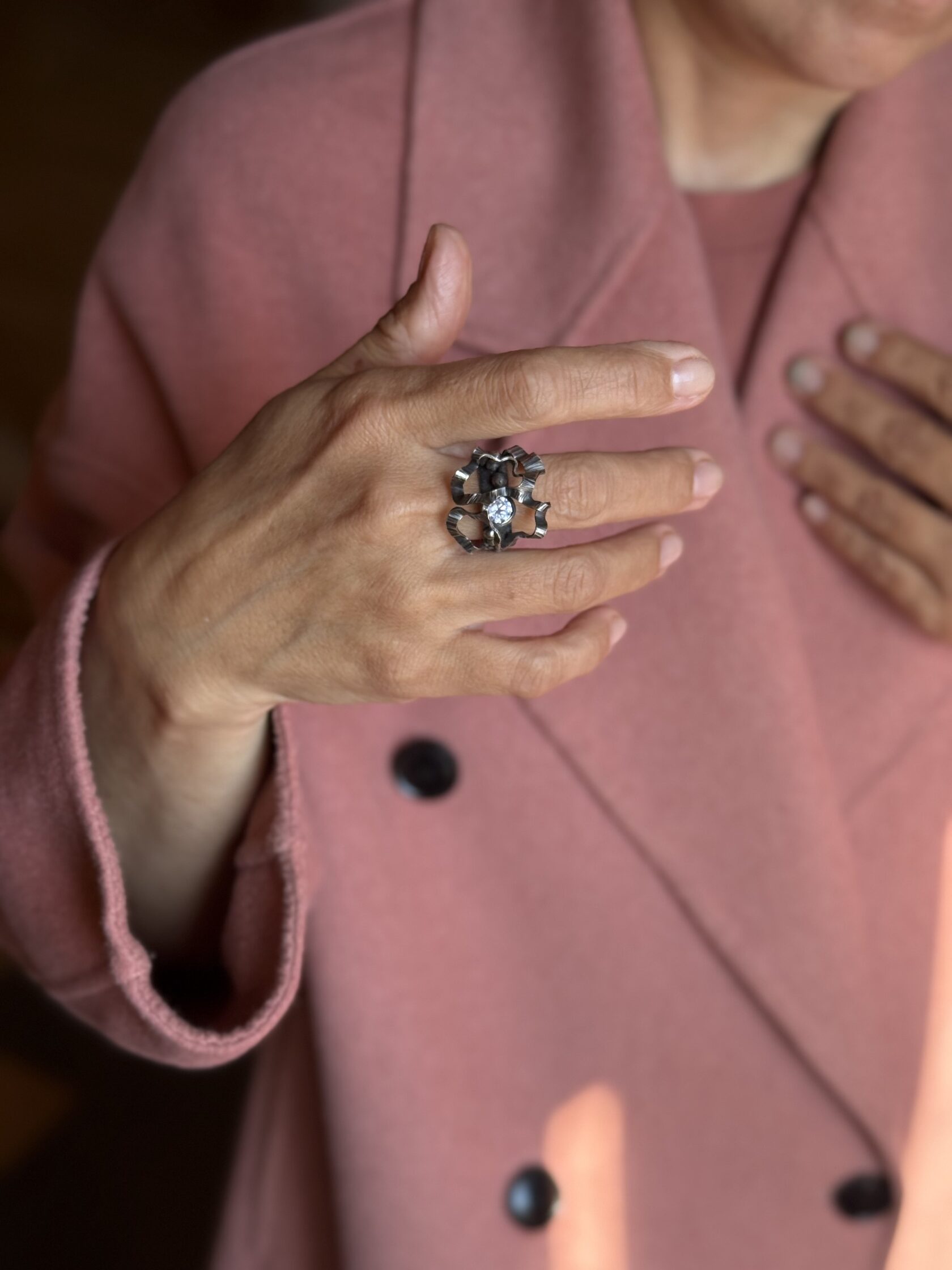
A projecting wave of metal creates a sense of arrested motion. Sculptural quality comes from direction and an active profile.
NP STUDIO / JOURNAL / SCULPTURAL JEWELRY
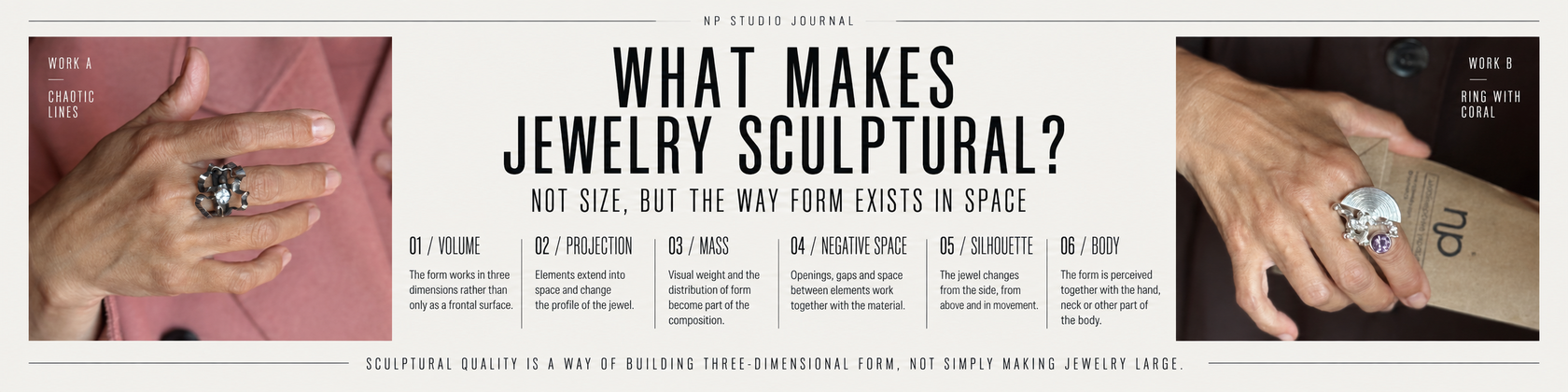
Sculptural quality does not begin with size or unusualness alone. It emerges when three-dimensional form — volume, projection, mass, negative space, direction and silhouette — becomes one of the principal ways the jewel is constructed.
Sculptural jewelry is jewelry in which three-dimensional form is not merely a setting or support but a central part of the composition. Volume, projection, mass, negative space, line, stones and silhouette work together as an object that exists both in space and on the body.
“Sculptural jewelry” is best used as a descriptive term rather than treated as a universally codified museum category with one official definition. The useful question is how the form behaves: does it develop through height, width and depth, possess a strong profile, change as the hand turns, and operate as more than frontal decoration?
Cooper Hewitt, Smithsonian Design Museum uses the phrase “sculptural jewelry” in discussing Felieke van der Leest’s Grey Heron Airplane ring. The museum notes that the sculptural quality is so arresting that the fact that the object is a ring becomes clear only on closer inspection. The example shows how a piece can remain jewelry while its spatial form dominates perception.
Every ring is physically three-dimensional, of course. Sculptural quality begins when space and volume are deliberately organised as central parts of the composition.
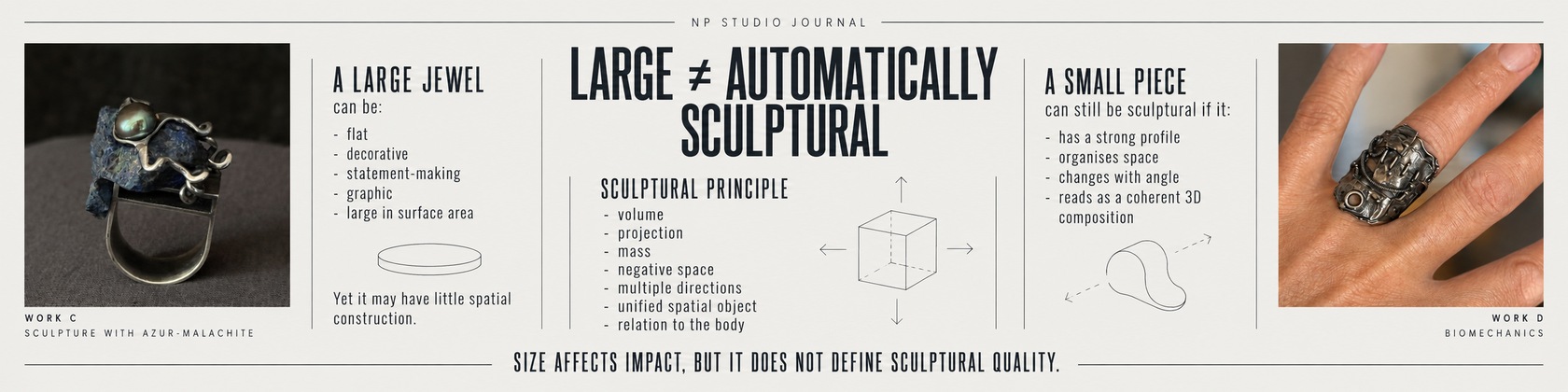
A large jewel can be flat, decorative or simply visually dominant without being strongly sculptural. A small jewel can be sculptural if it has a decisive profile, projects into space, organises voids and changes meaningfully from different viewpoints.
SCULPTURAL ≠ JUST LARGE. Size affects impact, but spatial construction defines sculptural quality.
Sculptural jewelry works with visual mass as well as physical mass. A thin line may project far into space and feel more active than a heavier flat plate. A large stone can act as a centre of gravity, while arcs, springs or layered metal distribute tension around it.
Wearability adds another problem: centre of gravity, stability on the finger, contact zones and the way projections behave in movement. Sculptural form does not remove structural responsibility.
Metal is only one part of volume. Openings, gaps, bridges, loops, distances between elements and the air around a stone can be active components of the composition. Voids separate masses, create depth, admit light and alter the silhouette.
This is especially clear in open constructions, where the object is not a single closed block. The space inside the jewel begins to function as a material in its own right.
Sculptural form cannot be reduced to a frontal view. The side profile, top view, transition between shank and upper structure, and changes created by movement all matter.
Chaotic Lines demonstrates this through a projecting wave-like structure. The ring weighs 10 g including its amethyst, yet it reads as visually active because direction and silhouette carry the form into space. Sculptural quality here comes from movement rather than heaviness.
Conventional jewelry is often perceived as stone plus setting. Sculptural logic can dissolve that division: stone, metal, springs, projections and negative space become one spatial object.
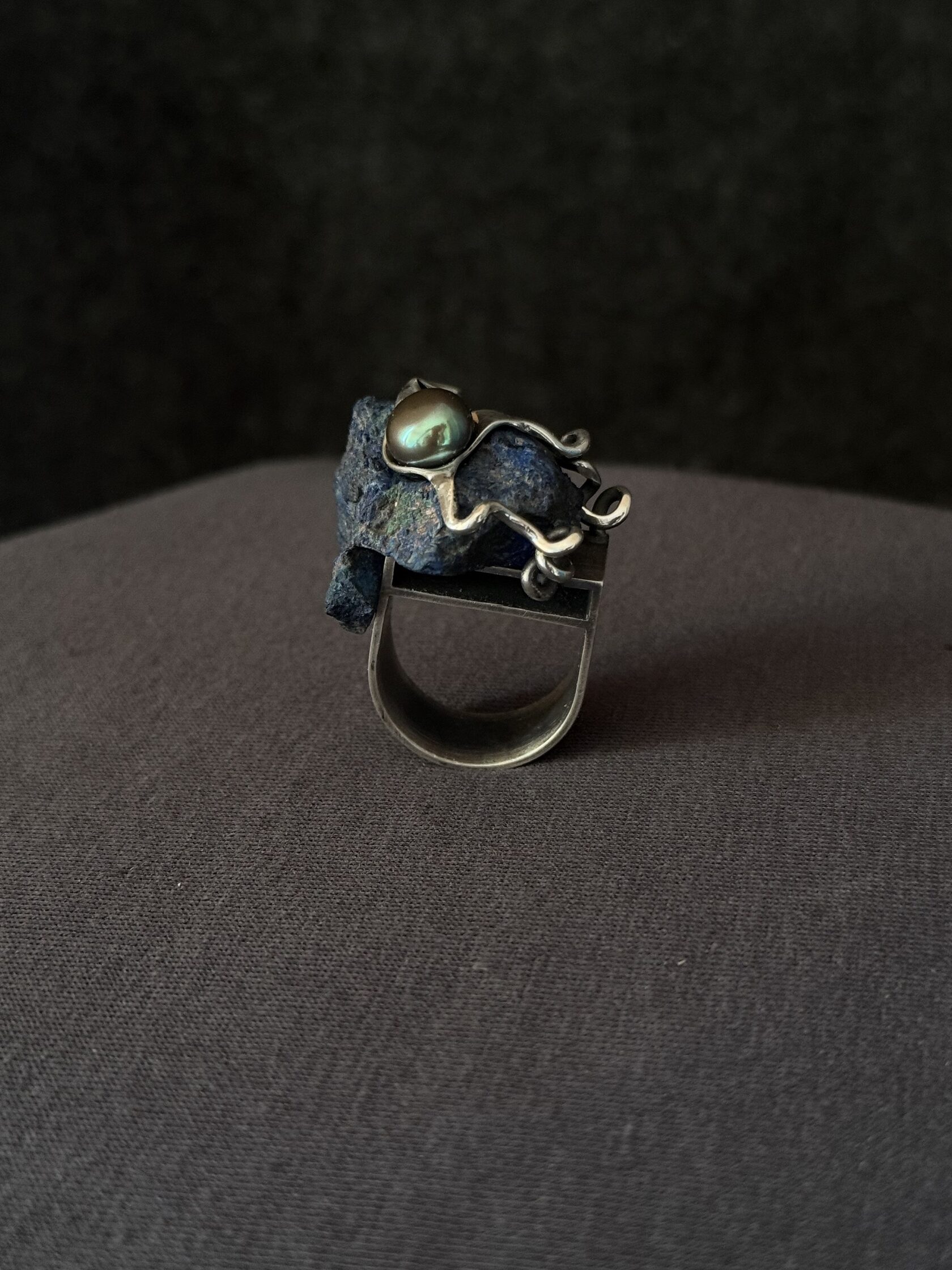
In Sculpture with Azur-Malachite, the large blue-green stone, green pearl, spring-like elements and unconventional shank are perceived as one construction. The stone behaves as a mass around which the rest of the object builds tension.
Texture stops being merely decorative when it expands into relief — producing projections, cavities, edges and internal depth.
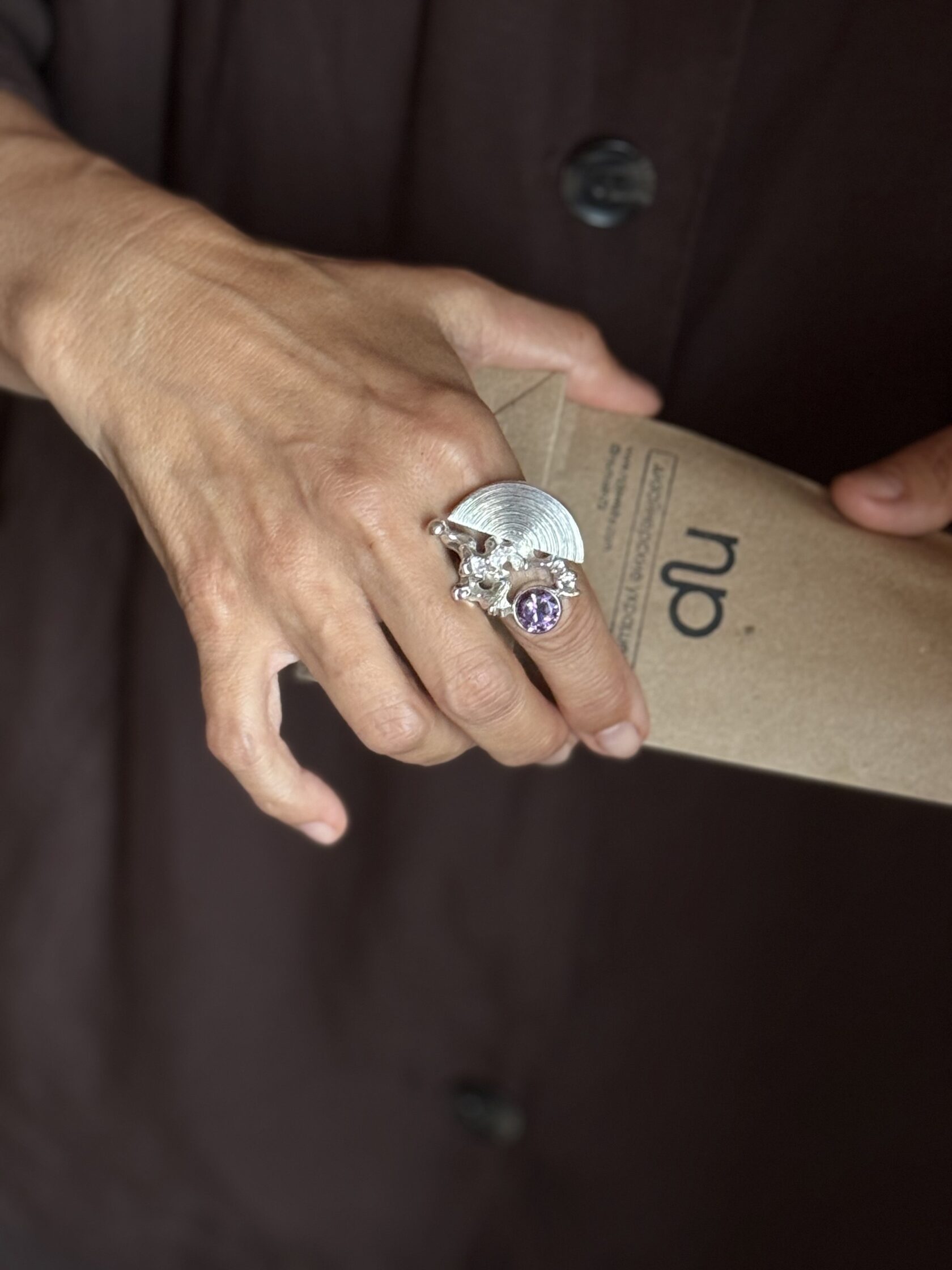
In Ring with Coral, the porous silver structure resembles a natural fragment. It is not a pattern added onto an already complete form; the surface itself becomes a three-dimensional environment into which the amethyst is embedded.
On a table, a ring is a small object. On the hand, fingers, gaps between them, wrist movement and bodily scale become part of the reading. The body therefore changes the silhouette and perceived proportions of the form.
This broader boundary is explored separately in Jewelry as Wearable Sculpture. For sculptural jewelry, the narrower point is that the body is not simply a display surface; it is part of the spatial context.
Strong projection or visible volume does not automatically mean poor fit. Comfort depends on the underside, shank, distribution of mass, placement of protruding elements and contact with neighbouring fingers.
NP Studio’s page for Sculpture with Azur-Malachite notes that despite its volume, its unconventional shank remains wearable. That is not a universal promise for every large form, but it demonstrates that spatial complexity and practical fit can coexist.
A statement ring is defined primarily by its visual role: it becomes a focal point and attracts attention. Sculptural jewelry describes the character of the form: three-dimensional organisation of volume, mass, void and silhouette.
The terms can overlap. A sculptural ring is often noticeable, but visibility is not its definition. A large statement ring may remain flat or decorative without having a strongly developed spatial construction.
Sculptural jewelry generally remains clearly functional as jewelry while making sculptural form central. Wearable sculpture can move further toward an autonomous artwork or a body-based sculptural practice in which the boundary itself becomes the subject.
The Museum of Arts and Design used “wearable sculpture” for its exhibition Picasso to Koons: Artist as Jeweler, devoted to jewelry made by artists. The broader philosophical boundary is already covered in NP Studio’s separate essay Jewelry as Wearable Sculpture.
Art jewelry is a broader artistic category or approach. Sculptural is a formal characteristic. A sculptural jewel may also be art jewelry, but an art jewel can be flat, textile-based, graphic, conceptual or organised around an entirely different logic.
For the broader category, see What Is Art Jewelry?. For the wider field, see What Is Contemporary Jewelry?.
A projecting wave of metal creates a sense of arrested motion. Sculptural quality comes from direction and an active profile.
A porous silver structure turns surface into a three-dimensional environment, with the amethyst embedded into the mass.
A large stone, pearl, spring-like elements and an unconventional shank act as a single spatial construction.
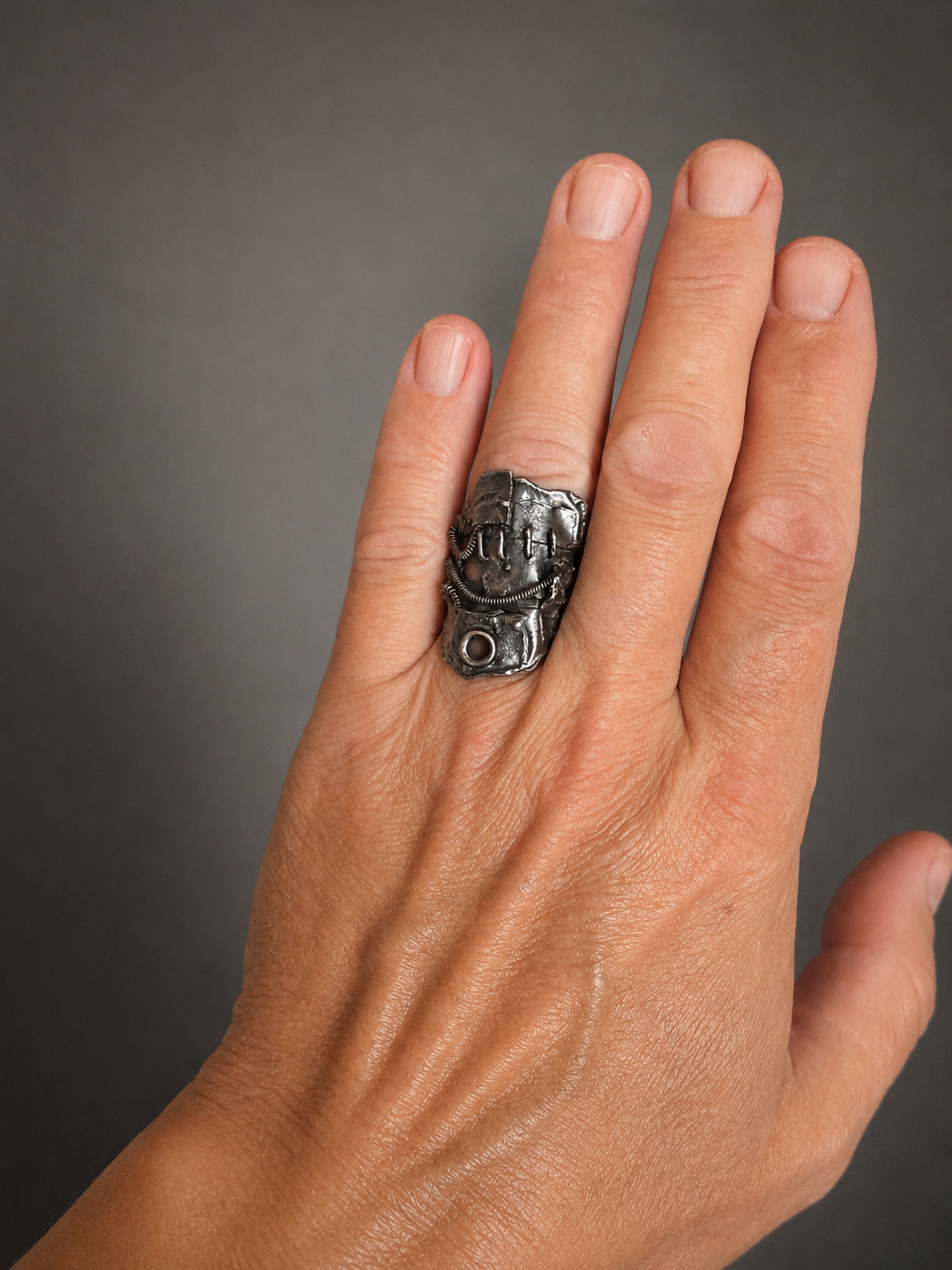
Plates, staples, springs, gaps and relief create dense sculptural qualities within a distinctly biomechanical design language.
Sculptural quality does not depend on preciousness. Metal, glass, textile, plastic, found materials, stone or 3D-printed structures can all become sculptural when spatial organisation is central to the object.
The Metropolitan Museum of Art explicitly describes JAR’s work as “sculptural jewelry designs” while noting both precious metals and gemstones and unconventional materials such as beetle wings. The example makes the larger point: sculptural form is broader than any single material hierarchy.
Sculptural jewelry does not have to be huge, heavy, uncomfortable or made from unusual materials. What matters is how the object occupies space, how mass and void are organised, how the silhouette changes, and how the form behaves on the body.
It is a descriptive term for jewelry in which three-dimensional form, volume, projection, mass, negative space, silhouette and the relationship to the body become central to the composition.
No. Large scale can intensify impact, but a small piece can be sculptural if it actively organises space and changes meaningfully from different viewpoints.
Statement describes a jewel’s visual role as a focal point. Sculptural describes the three-dimensional character and spatial construction of the form. The terms can overlap.
Sculptural jewelry usually remains clearly jewelry while giving sculptural form a central role. Wearable sculpture may move further toward autonomous art or body-based sculpture.
Yes. Size is not the definition. Profile, projection, voids, direction, volume and spatial organisation can make a small ring strongly sculptural.
No. Wearability depends on construction, shank design, mass distribution and contact zones. A visually complex form can still be designed around the real hand.
No. Sculptural quality comes from spatial organisation, not from the material itself. It can exist in metal, glass, textile, plastic, stone or mixed media.
No. Art jewelry is a broader artistic approach or category, while sculptural refers primarily to formal qualities of volume and space. A piece can be both.
