
NP STUDIO / JOURNAL / CARE
Can Sterling Silver Get Wet?
Brief contact with ordinary fresh water is usually not a problem for sterling silver 925 itself. But water is rarely the only factor: chlorine, salt, soap, shampoo, cosmetics, heat and the length of exposure can all affect the surface. A piece may also include stones, patina, coatings or other construction details that tolerate water less well than the silver alloy.
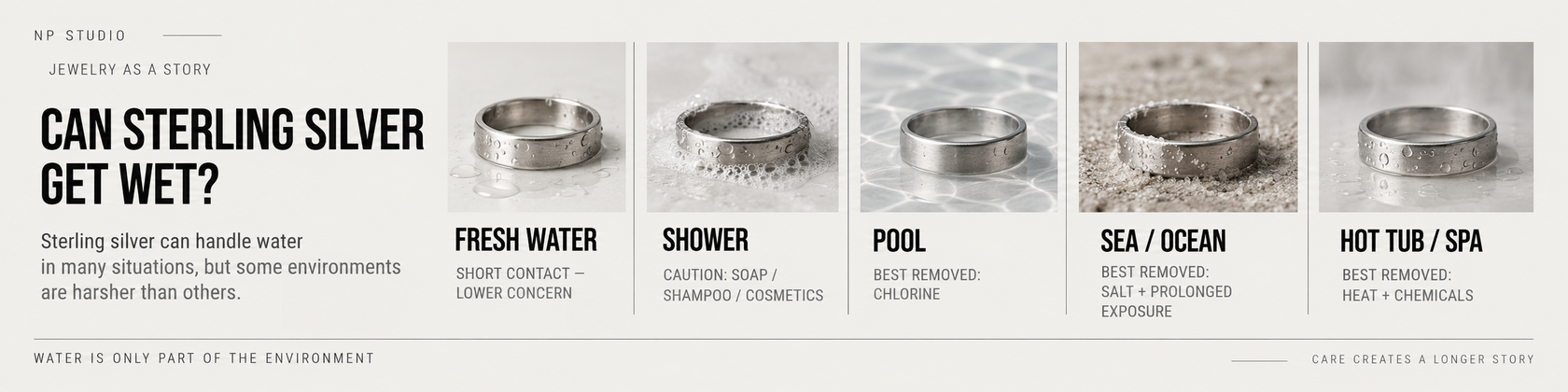
Short answer: can sterling silver get wet?
Yes. Brief contact with ordinary fresh water generally does not mean that sterling silver has been damaged. A simple silver ring getting wet while you wash your hands is a normal everyday situation.
With repeated exposure, however, what is in the water often matters more than the fact that the piece is wet. Chlorine, salt, soap, shampoo, cosmetics, perspiration and heat can all change the conditions around the jewelry.
For the alloy itself, see What Is Sterling Silver? →
What happens when sterling silver gets wet?
Fresh water is only one part of the environment. Dissolved salts, soap, cosmetics, perspiration and other substances can remain on the surface at the same time.
Temperature and duration also matter. One quick rinse under a faucet and a long swim in a chemically treated pool are not equivalent exposures.
The detailed chemistry of tarnish belongs to a separate topic; see Why Does Sterling Silver Turn Black? →
Can you wash your hands with a sterling silver ring?
Usually, a simple sterling silver ring does not need to be removed for every brief contact with ordinary water.
The more relevant variables may be soap, hand sanitizer, cream, stones, patina and recessed texture. A plain silver ring and a stone-set or heavily patinated piece do not necessarily have the same practical answer.
For everyday use more broadly, see Can You Wear Sterling Silver Every Day? →
Can you shower with sterling silver?
A single shower does not automatically damage sterling silver 925. Regular showering while wearing jewelry, however, repeatedly exposes the piece to shampoo, soap, conditioner, skincare products and moisture.
For that reason, treating the shower as a permanent place to wear jewelry is not the most practical choice, particularly for stone-set, patinated or highly textured pieces.
Can you wear sterling silver in the pool?
It is better to remove it before swimming. The issue is not simply water, but a chemically treated environment, including the use of chlorine-based pool chemicals.
One accidental exposure does not mean the piece is ruined. A pool is simply not an environment worth choosing for regular sterling silver wear, especially when the jewelry also has stones, patina or a complex finish.
Can sterling silver go in the ocean?
It is better to remove jewelry before swimming in the sea or ocean. Salt water, long exposure, sunscreen, sand and mechanical friction all occur at the same time.
There is also a very practical issue: jewelry is easier to lose in the water, especially when skin is cold or slippery.
What about lakes and rivers?
Natural fresh water should not automatically be treated as identical to clean tap water. Its composition varies, and sand, silt and organic material can add other kinds of contact.
There is also the simple risk of losing the piece, so taking jewelry off before a long swim is usually the easier choice.
Can you wear sterling silver in a hot tub or spa?
It is better to remove it. Hot tubs and spas combine elevated temperature, chemically treated water and prolonged exposure.
That does not mean the alloy is instantly destroyed, but it is an avoidable environment for jewelry.
What if it rains?
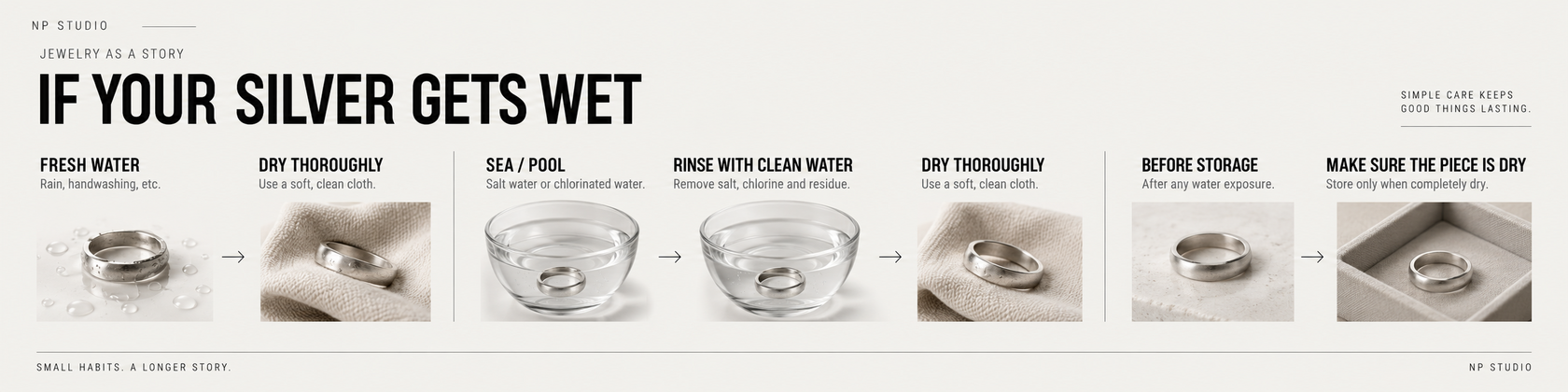
Getting caught in the rain while wearing a sterling silver ring is not a reason to panic. Remove excess moisture and let the piece dry completely afterwards.
Brief rain exposure and prolonged swimming are very different situations.
Does hard water matter?
In practical terms, yes. Hard water can leave visible mineral residue after it dries, particularly on matte or strongly textured surfaces.
That does not mean hard water automatically damages the sterling silver alloy, but it can change how the surface looks.
What to do if sterling silver gets wet
For physical storage, see How to Store Sterling Silver Jewelry →
What if sterling silver looks darker after water exposure?
There is no need to jump immediately to aggressive polishing. First consider what actually changed and what kind of finish the piece has.
If cleaning is necessary, use the separate guide How to Clean Sterling Silver Jewelry →. For the reason silver can darken, see Why Does Sterling Silver Turn Black? →
Stone-set silver jewelry has different rules
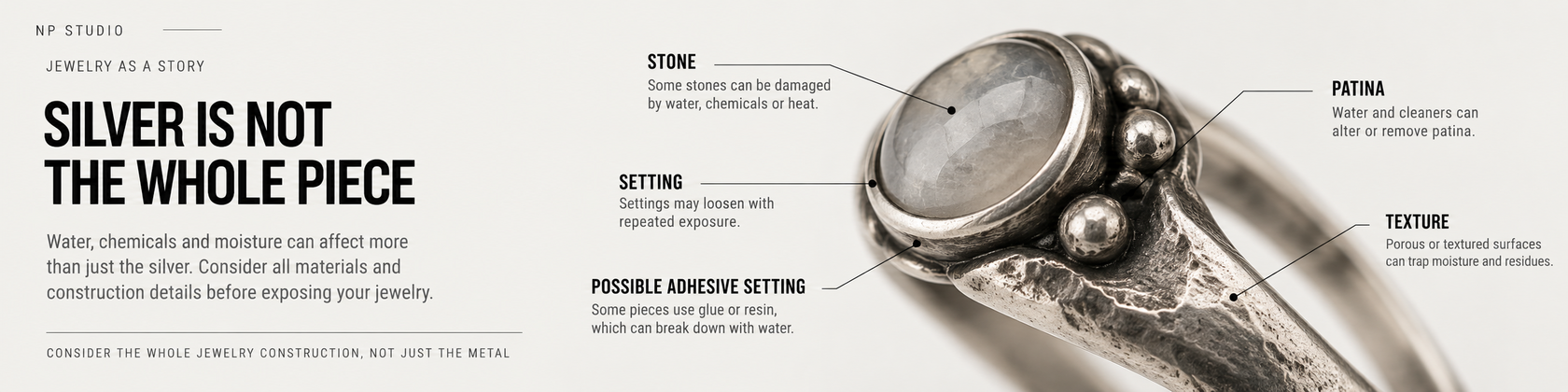
In a finished piece, the sterling silver may tolerate water better than the stone or the way the stone is mounted. That is why the number 925 alone is not enough to judge the whole object.
Pearls, turquoise, opal and other sensitive materials
Pearls, turquoise, opal and some other sensitive or porous materials may have stricter water-contact requirements than the sterling silver alloy around them.
So a general statement such as “sterling silver can get wet” should never be turned into universal permission for every stone-set piece.
What happens to patina?
Water by itself does not necessarily remove an intentional patina. But soap, cosmetics, friction, repeated contact and later polishing can gradually alter a darkened surface.
On patinated jewelry, the goal is not only to preserve the metal but also the intended contrast between darker and brighter areas.
What about matte and textured surfaces?
Water spots, mineral residue, soap and cosmetics can sometimes be more visible on matte or deeply textured silver than on a smooth polished surface.
Constantly polishing those marks away is not a good default solution because polishing itself can alter matte finish and texture.
How I think about water and silver at NP Studio
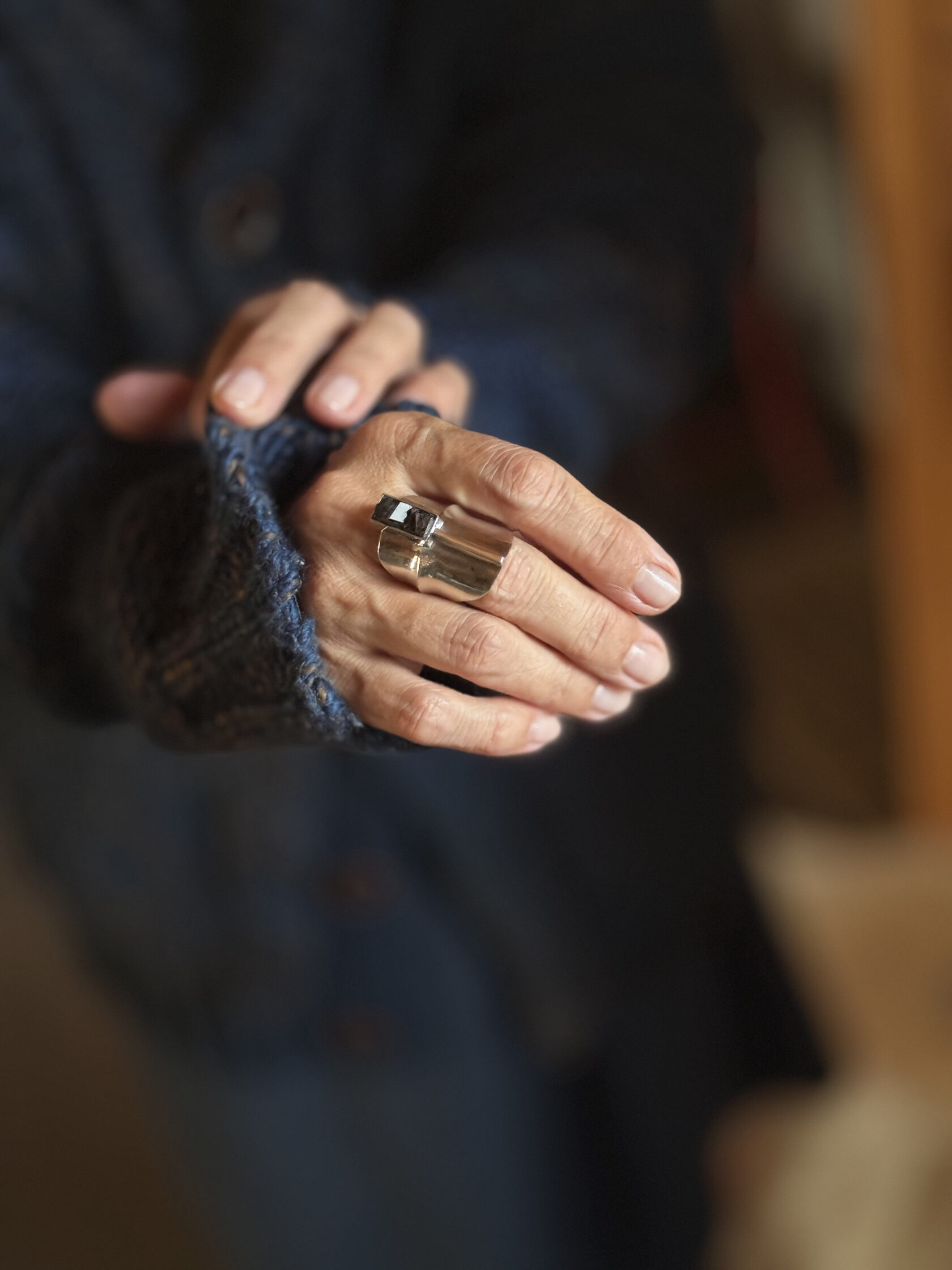
In the workshop, I separate two questions: “can sterling silver come into contact with water?” and “should this particular piece be worn in water all the time?”
For a simple silver ring, brief fresh-water contact is usually unremarkable. But a complex piece includes more than metal: stone, setting, patina, texture and joints. I therefore look at the whole object rather than the 925 mark alone.
View NP Studio worksFrequently asked questions
READ NEXT / NP STUDIO JOURNAL
