
NP STUDIO / JOURNAL / FORM
What Is Architectural Jewelry?
Architectural jewelry does not have to depict a building. Its architectural quality comes from the way the form is organized through structure, proportion, rhythm, geometry, mass, negative space and relationships between parts. On the body, those relationships gain an additional scale and orientation.

Short answer
It does not have to resemble a building. The term is most useful as a design description rather than as a rigid academic category.
Architectural jewelry is not a miniature building
Jewelry that literally reproduces a facade, tower or floor plan certainly exists, but that is only one possible interpretation. An architectural approach can be completely abstract.
The more useful question is how the object is organized: what acts as a frame, which parts dominate, where mass is concentrated, where space opens up, how lines repeat and how the whole piece holds visual balance. Historical architectural associations are a separate visual language; for that context, see What Is Gothic Jewelry?.
Structure: how the parts hold the form
Architectural thinking often begins with a legible structure. That may be a frame, a set of lines, several connected masses or a hierarchy of primary and secondary elements.
Visible construction here does not mean a fabrication tutorial. It means that the relationships between parts remain readable and help explain how the object is organized.

Mass and negative space
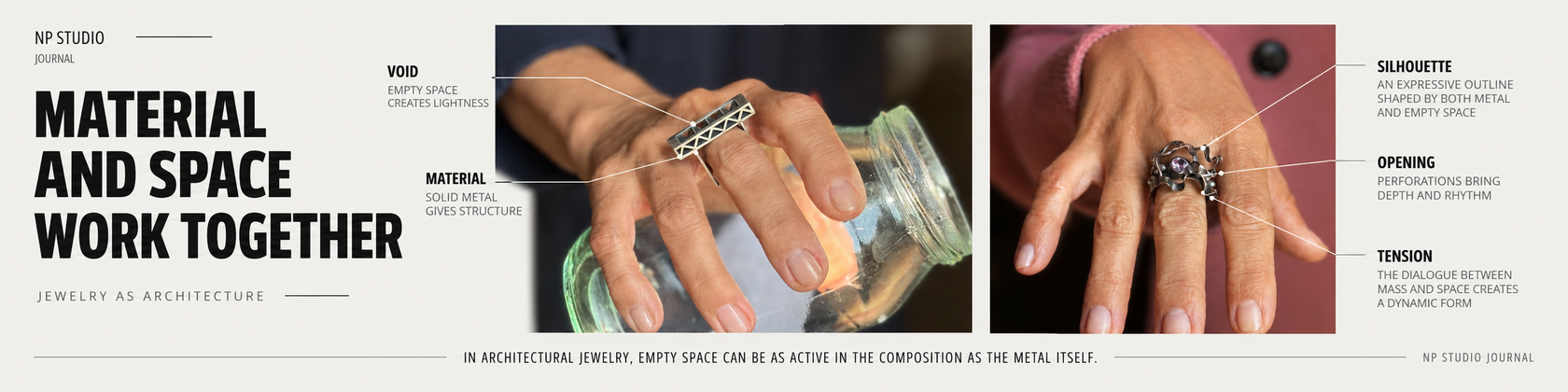
In architecture, space matters as much as material. Jewelry can work the same way: openings, intervals, frames and gaps can become active parts of the composition.
Negative space changes the silhouette, can make a substantial form feel lighter and allows skin or the finger to become visible inside the object. The void is not missing metal; it is organized space.
Rhythm and repetition
Rhythm appears when lines, modules, intervals or dense and open areas form a sequence. Repetition does not need to be mechanically perfect; it can accelerate, break, compress or open up.
At jewelry scale, even a small number of repeated directions can quickly become a strong organizing system.
Proportion and balance
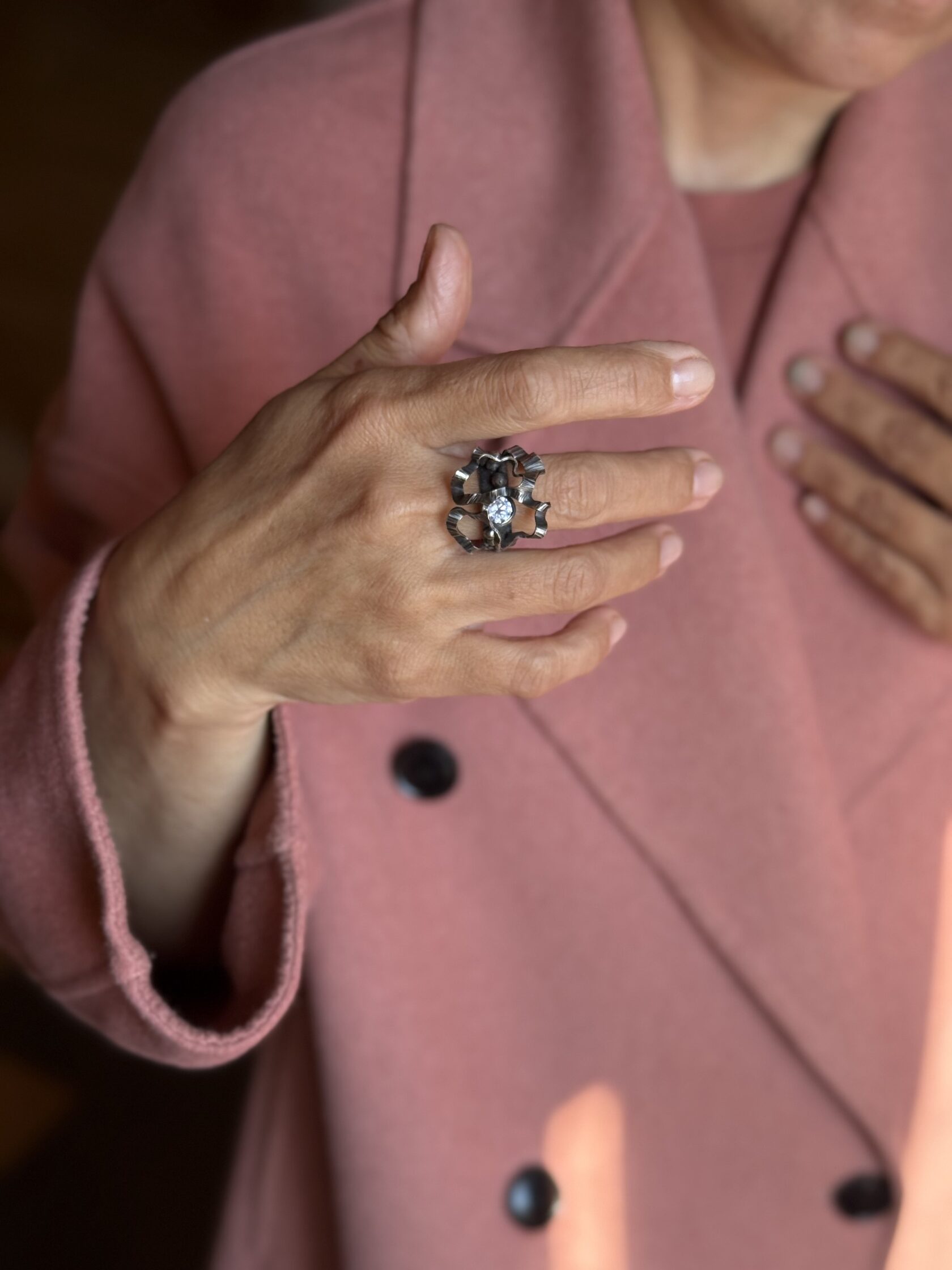
Architectural thinking is not only about geometry but about relationships between parts. Height can oppose width, a large mass can answer a small one, and a dense area can be balanced by an open zone.
Balance does not have to be symmetrical. An asymmetrical object can still feel stable when visual weight is organized consistently.
Geometry — but not simply geometric decoration
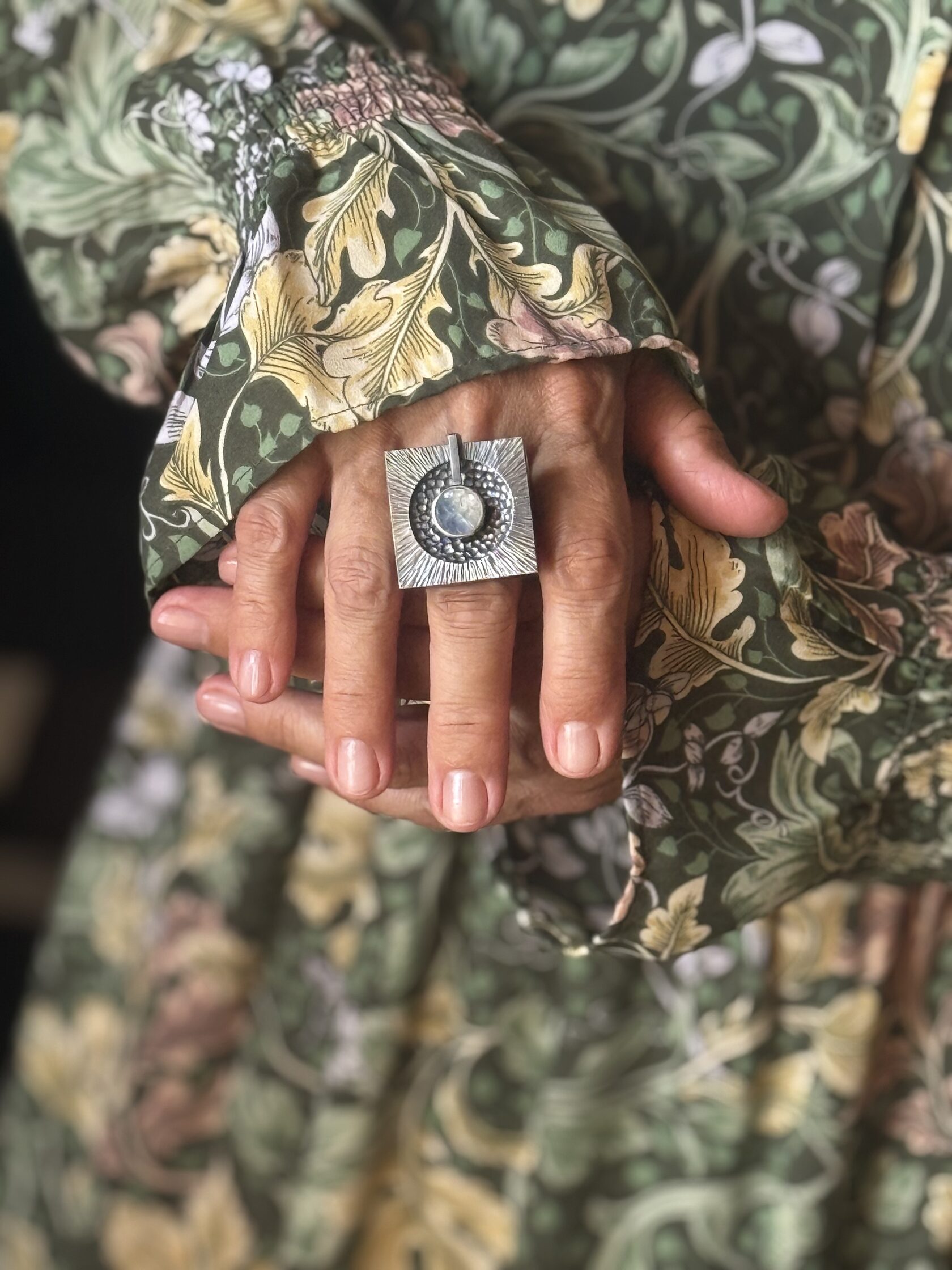
Geometric jewelry may use a circle, square, line or repeated pattern as a visual motif. Architectural jewelry goes further only in one specific sense: geometry begins to organize the whole object together with structure, space and proportion.
Geometric
The emphasis may be on clean shapes, lines or geometric motifs.
Architectural
The emphasis is on relationships between parts, structure, space, rhythm, support and visual weight.
Sculptural
The emphasis is more often on volume, plastic form and three-dimensional presence.
These categories can overlap. None is automatically more advanced than another. For a historical jewelry language built around geometry, rhythm and decorative structure, see What Is Art Deco Jewelry?.
Tension and structural contrast
Architectural form can become expressive through oppositions: rigid versus open, heavy versus light, horizontal versus vertical, dense versus empty, stable versus apparently unstable.
This is design tension rather than an engineering calculation. It directs attention and creates movement inside a static object.
How the jewelry interacts with the body
The body matters here primarily as scale and orientation. A finger establishes direction, skin appears through openings, and the same structure changes as the viewing angle changes.
For an architectural composition, that matters because the object has to work beyond a single top view — from the side, in movement and through changing relationships with the hand.
For the broader subject of jewelry as an independent three-dimensional object, see Jewelry as Wearable Sculpture →.
Are architectural and sculptural jewelry the same?
Not necessarily. Sculptural jewelry usually emphasizes volume, plasticity and three-dimensional presence. Architectural jewelry places more emphasis on how the object is organized through relationships between parts, support, rhythm, proportion and void.
A single piece can be both sculptural and architectural when both logics are genuinely present.
Architectural jewelry at NP Studio
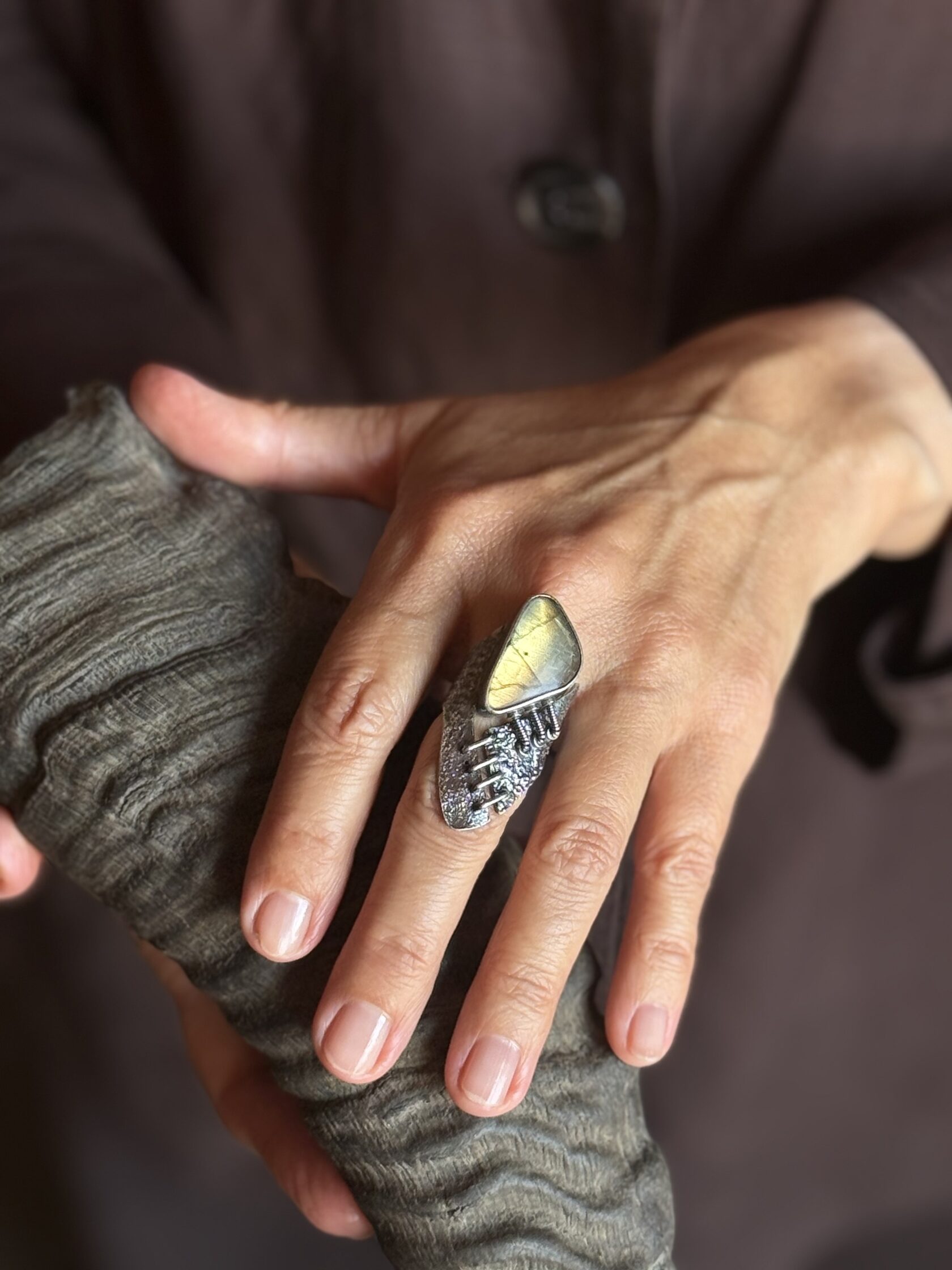
In some NP Studio works, an architectural reading becomes especially clear where there is a visible frame, linear organization, openings, layers, large and small volumes, rhythm and contrast between dense and open areas.
That does not mean the entire studio should be labeled architectural jewelry. The term is useful only where the structural and spatial logic is actually visible.
How to recognize architectural thinking in jewelry
This is not a strict test and it is not a scoring system. Five questions can simply help you see whether architectural logic is active in a piece.
- Is the structural logic visible? Can you understand how the parts relate and what establishes the main frame?
- Does negative space work as form? Are openings, intervals and gaps active parts of the composition?
- Is there rhythm? Do lines, modules or dense/open zones form a sequence?
- Is visual weight organized? Is there a relationship between large, small, heavy and light areas?
- Does the composition change on the body? Does the piece gain direction, scale or a new pattern through the finger and skin?
Frequently asked questions
Author
Related NP Studio materials
For the broader idea of jewelry as a wearable three-dimensional object, continue with Jewelry as Wearable Sculpture. For another visual language, see What Is Biomechanical Jewelry?. The practical selection guide is How to Choose a Unique Silver Ring, while the process question is covered in Handmade vs Cast Jewelry.
