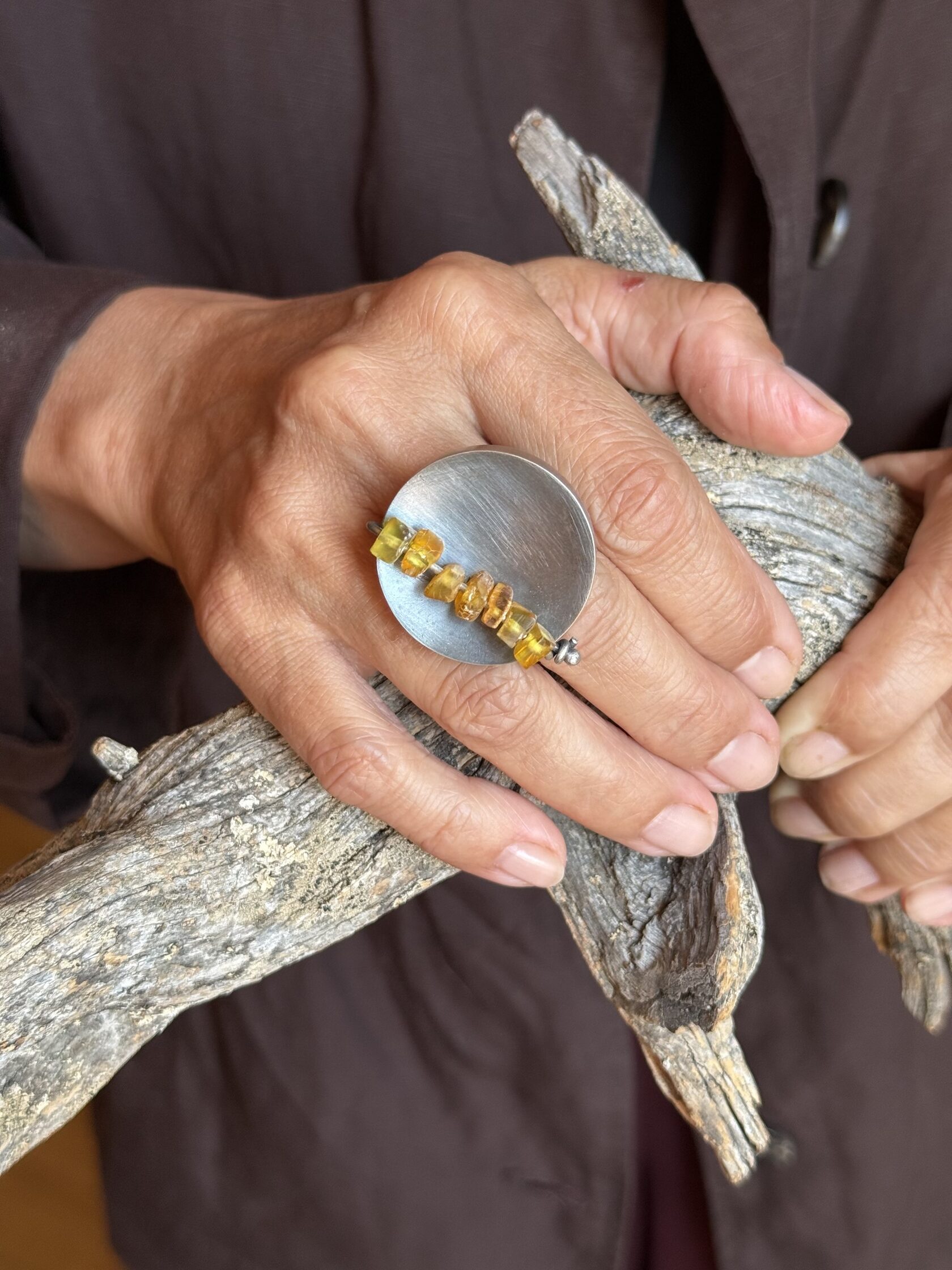
Plate with Amber
Circular geometry and strong material contrast. Those qualities alone do not create Art Deco.
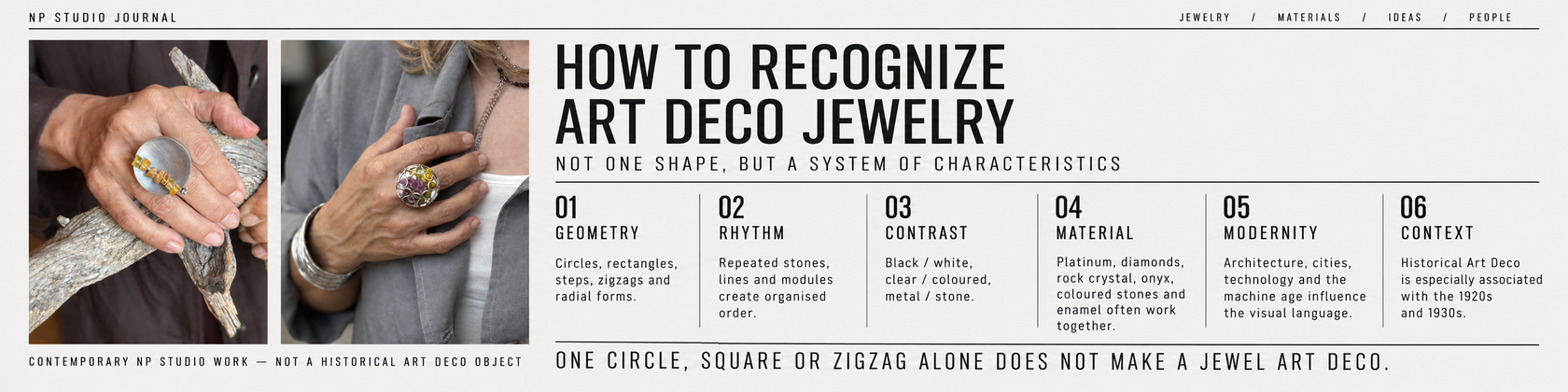
Art Deco jewelry is not simply jewelry with geometry. It is a historical design language of the 1920s and 1930s in which form, rhythm, contrast, precious materials and machine-age modernity were organised into a distinct visual system.
Plate with AmberA circle and contrast do not automatically equal Art Deco 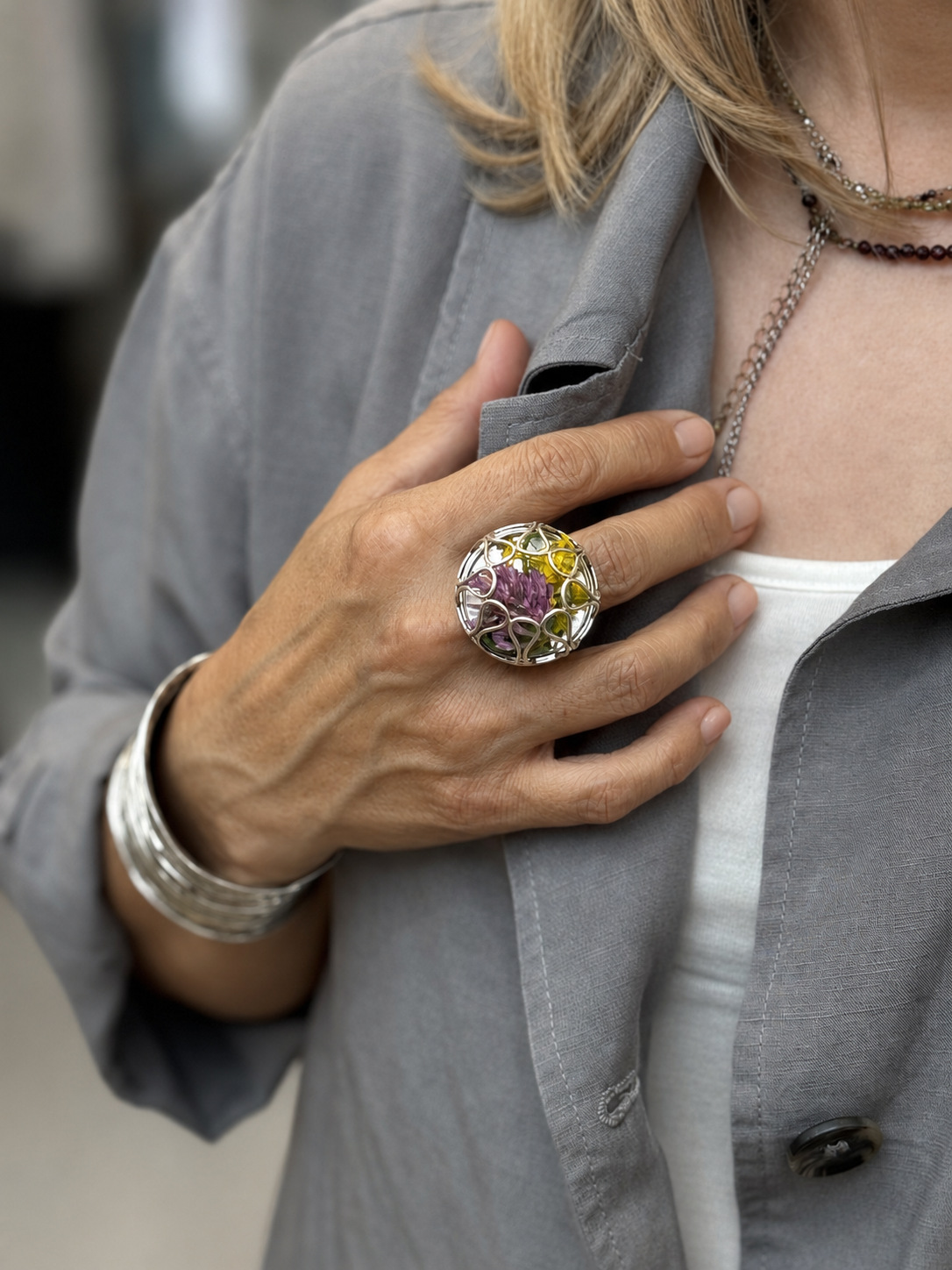 Container RingRhythm and mechanism outside historical Art Deco
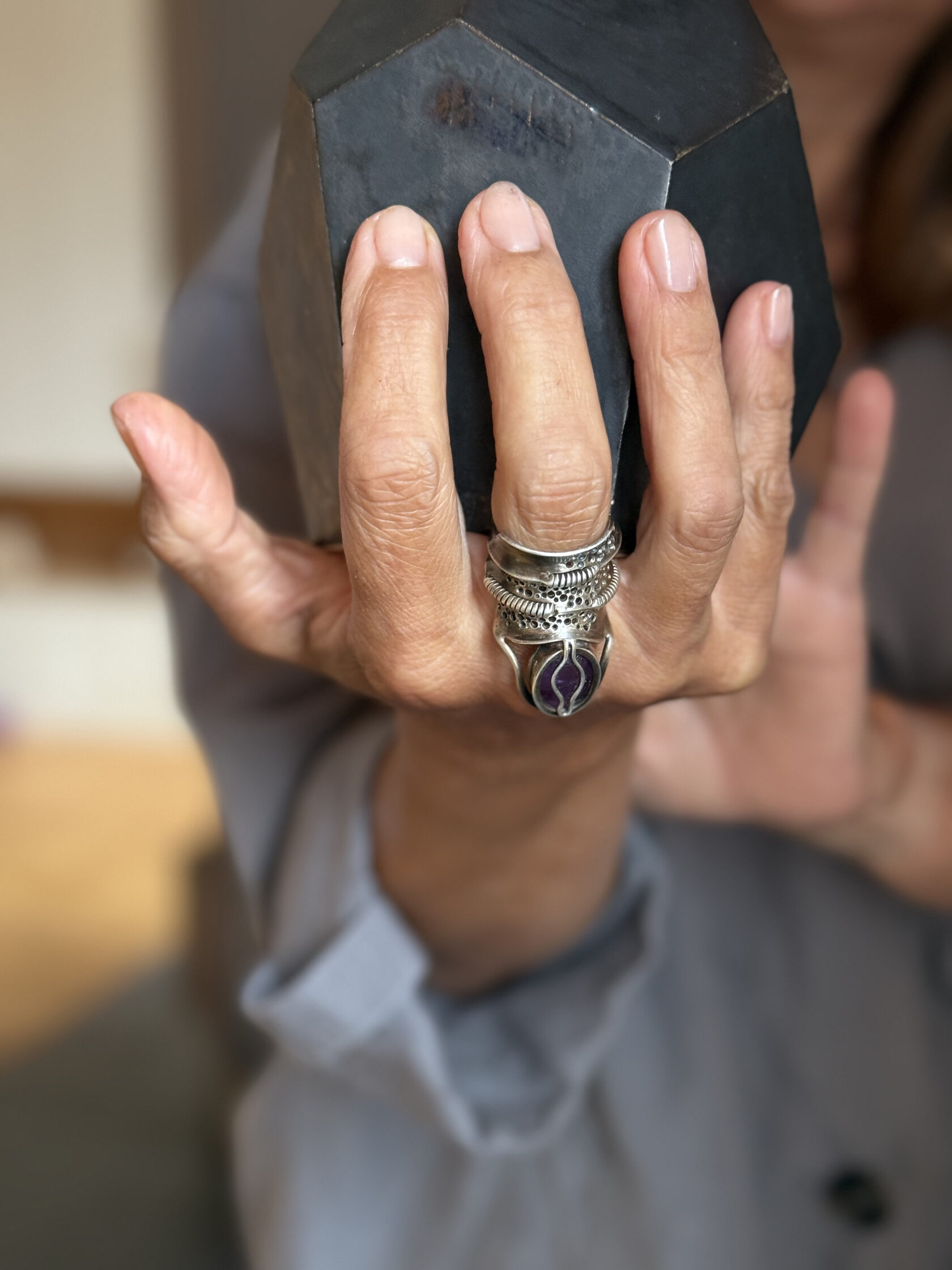 Martian ChroniclesA technical feeling is not enough to make Art Deco
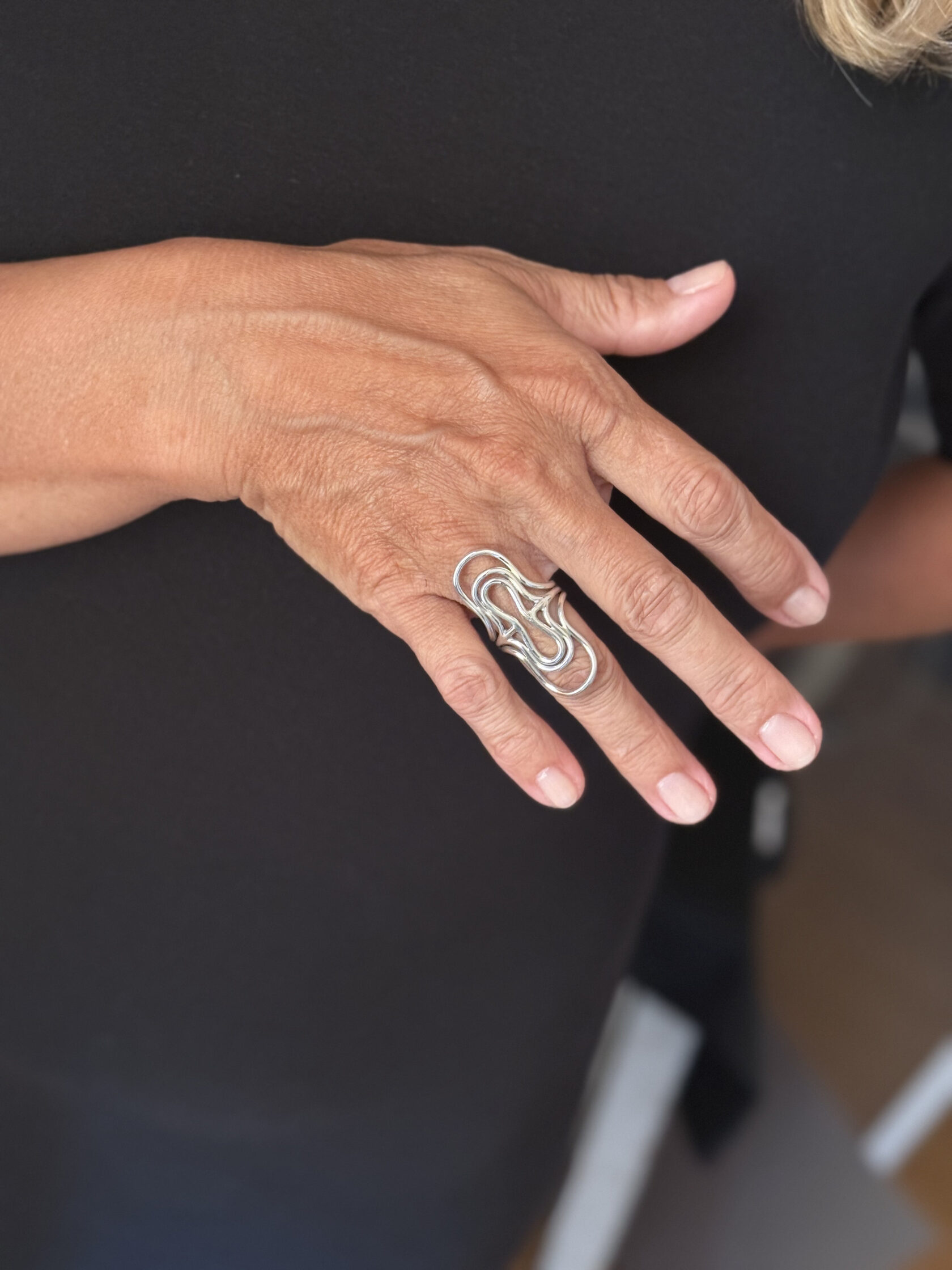 Silver LoopLine and repetition also exist outside Art Deco
Art Deco jewelry is especially associated with the 1920s and 1930s, combining organised geometry, rhythm, contrast and clear silhouettes with the glamour and modernity of the machine age; platinum, diamonds, black-and-white combinations and strong colour accents are common, but no single shape or material defines the style on its own.
Art Deco did not suddenly begin in 1925. Its foundations were developing earlier, and the international decorative arts exhibition eventually held in Paris had first been planned before the First World War. The war delayed it until 1925.
The Exposition Internationale des Arts Décoratifs et Industriels Modernes became a major international showcase and later supplied the name by which the style is known. The Metropolitan Museum of Art notes that by 1925 Art Deco was already an internationally mature style and that its influence continued well into the 1930s. It is therefore more accurate to treat the fair as a culmination and a powerful public platform, not a literal birthday.
Circles, rectangles, triangles, stepped forms, zigzags, radiating compositions and repeated modules appear frequently in Art Deco. Yet the individual shape matters less than its organisation. Clear outlines, measured proportions and deliberate rhythm turn geometry into a broader visual language.
This is why a twenty-first-century minimalist ring, an architectural object or a contemporary geometric piece does not become Art Deco simply because it uses a circle, square or straight line. Historical context and the combination of features matter more than a single motif.
Many Art Deco jewels create order through repeated stones, mirrored structures, bands, radial layouts and measured intervals. Symmetry often strengthens that effect, but it is not an absolute rule. Historical works can also achieve balance without being perfectly symmetrical.
It is more useful to look for compositional organisation: the sense that individual parts belong to a deliberate system.
Art Deco developed in a culture increasingly identified with cities, speed, transport, technology and new architecture. In jewelry, this influence did not require literal pictures of machines. It could appear as abstract geometry, structural clarity and an urban sense of movement.
Raymond Templier is a useful example. The V&A records his 1930 remark that he found ideas for jewelry in wheels, cars and the machinery of the day. His bold abstract designs connect Art Deco with the visual experience of modern urban life.
By the end of the 1920s, an all-white look became particularly fashionable: diamonds, rock crystal and platinum. The V&A notes both the popularity of this combination and platinum's practical advantage: its strength allowed less metal to be used, giving stones greater visual prominence.
Platinum was not mandatory. Gold never ceased to exist in Art Deco jewelry, and the V&A notes that from about 1933 gold returned strongly to fashion, partly because it was cheaper than platinum.
Black-and-white combinations are one of the most recognisable possibilities within Art Deco: diamonds could be paired with onyx or black enamel. Yet the palette could also be vivid. Emeralds, sapphires, rubies, turquoise, jade, coral and other materials supplied strong colour accents.
A useful museum example is Georges Fouquet's dress ornament of about 1923 in The Met, which combines jade, onyx, diamonds, enamel and platinum. It demonstrates how contrast could emerge through colour, surface and material as much as through geometry.
Art Deco jewelry was international and drew on visual traditions and materials beyond Europe. The V&A and The Met describe strong interest in the Near and Far East, while surviving jewelry and design drawings show jade, turquoise, onyx, enamel, lacquer, pearls and coloured gemstones used alongside precious metals.
Egyptian, Chinese, Japanese and Persian-inspired motifs became part of the period's broad vocabulary. These influences are best treated as historically specific sources of form and ornament rather than collapsed into a single idea of the “exotic.”
The Paris fair of 1925 became the major international event most closely associated with the name Art Deco. The Met explains that the modern term derives from the title Exposition Internationale des Arts Décoratifs et Industriels Modernes.
Cartier was among the jewelry participants. The V&A notes that the house showed work in the Pavillon de l'Élégance alongside leading couturiers. That connection underlines the relationship between Art Deco, fashion, luxury and modern public culture, while still not making the fair the moment at which the style suddenly appeared.
Templier's work makes it easier to see Art Deco as a modern abstract construction rather than a catalogue of ornaments. His jewelry used bold geometry and the energy of urban culture. This helps explain why Art Deco can feel architectural or mechanical even when there is no literal building, wheel or machine represented in the object.
Art Nouveau came earlier and is more often associated with flowing lines, natural forms and organic movement. Art Deco belongs to a later period and more often uses geometry, organised rhythm, sharper contrast and the language of modern urban and machine-age culture.
The distinction should not be reduced to a simple formula of “nature versus geometry.” Both styles contain internal variety, and the historical transition was gradual.
Contemporary minimalism can be geometric. Modernist jewelry can be geometric. Architectural or sculptural jewelry can use circles, rectangles and strict lines without referring to Art Deco at all.
For related but distinct visual languages, see What Is Architectural Jewelry?, What Is Avant-Garde Jewelry?, and What Is Gothic Jewelry?.
NP Studio's Plate with Amber is built around a broad circular plane and the contrast of silver with amber. Martian Chronicles has a technical, object-like presence. Both are contemporary works and useful counterexamples: a single feature or mood does not turn a piece into historical Art Deco.
Circular geometry and strong material contrast. Those qualities alone do not create Art Deco.
Ornamental rhythm, mechanism and object-like presence function here as a contemporary authorial construction.
A technical feeling is combined with hand-built irregularity rather than classical Art Deco order.
Line and repetition are universal compositional tools, not the property of one historical style.
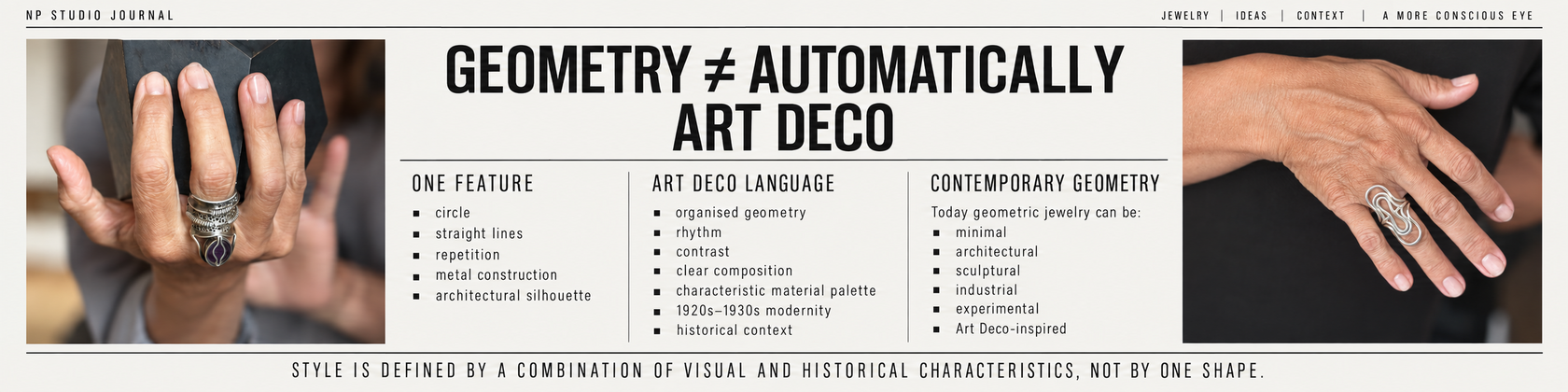
Yes. A contemporary designer can deliberately quote the Art Deco vocabulary through stepped or radial geometry, period-like proportions, black-and-white contrast, repeated modules or a historically informed material palette.
The distinction matters: Art Deco-inspired describes a modern work referring to the historical style. A historical Art Deco object belongs to the relevant period and requires separate evidence of date and provenance.
The more of these qualities work together—and the stronger the historical evidence—the more meaningful an Art Deco attribution becomes. A single circle, square, zigzag or black-and-white combination is not enough on its own.
Art Deco jewelry is especially associated with the 1920s and 1930s and commonly uses organised geometry, rhythm, contrast, clear silhouettes and the visual language of modernity. Platinum, diamonds, black-and-white combinations and strong colour accents appear in many historical examples.
Its central period was the 1920s and 1930s. The style had earlier roots, while the 1925 Paris Exposition became a major international showcase rather than a literal starting date.
Circles, rectangles, triangles, stepped forms, zigzags, radial compositions and repeated modules are common. Their organisation into rhythm and structure is more important than any one shape.
Platinum is strong, allowing relatively fine settings that can give gemstones greater visual prominence. It also suited the late-1920s fashion for an all-white combination of diamonds, rock crystal and white metal.
Diamonds, rock crystal, onyx, enamel, emeralds, sapphires, rubies, jade, turquoise, coral and pearls all appear in period work. Platinum was prominent, while gold also remained important and returned strongly to fashion from about 1933.
Art Nouveau is earlier and more often associated with flowing natural lines and organic forms. Art Deco is later and more often geometric, ordered, high-contrast and connected with modern urban and machine-age culture.
No. Geometry appears in minimalism, modernism, architectural jewelry and contemporary jewelry. Art Deco requires a broader combination of stylistic features and, for a historical object, credible period context.
Yes. A modern piece can deliberately quote Art Deco geometry, rhythm, proportions, contrast or materials. It should still be described as contemporary Art Deco-inspired jewelry rather than as a historical Art Deco object.
