History + romance + architecture
Historical or architectural memory, verticality, tracery-like structure, dark-romantic tension and motifs working as a coherent system.
NP STUDIO / JOURNAL / GOTHIC JEWELRY
Today, “Gothic jewelry” can describe several connected but different contexts: medieval Gothic visual language, nineteenth-century Gothic Revival, modern goth/subcultural styling, and contemporary neo-Gothic reinterpretation.
Gothic is therefore not one fixed recipe. Blackened silver, a cross, a skull, garnet or an elongated silhouette can contribute to the reading, but no single feature makes a piece Gothic on its own.
Gothic jewelry is not one fixed formula and not simply jewelry made from black metal. Historical Gothic and Gothic Revival provide architectural and ornamental references; modern goth and neo-Gothic jewelry can reinterpret pointed or elongated forms, verticality, tracery, darkened metal, romantic botanical motifs and dramatic contrast.
Historically, Gothic is first a broad medieval artistic and architectural context, not the name of one jewelry formula. The V&A dates the emergence of the Gothic style to the early twelfth century in northern France and describes its spread across architecture, sculpture, textiles, painting, stained glass and manuscripts. Pointed arches, vertical height and increasingly complex tracery are among the important architectural features.
When those associations appear in contemporary jewelry, they work as visual signals rather than proof: structure, verticality, rhythm, depth and architectural memory.
Medieval Gothic and Gothic Revival belong to different historical contexts. Gothic developed from the twelfth century and continued in different regional forms into the sixteenth century. Gothic Revival appeared much later as a deliberate return to medieval forms and ideas.
That distinction matters in jewelry. A nineteenth-century piece using tracery or a cross as a revival motif is not medieval simply because its visual language looks medieval.
| Context | What it is | What matters here |
|---|---|---|
| Medieval Gothic | Historical artistic and architectural language of the 12th–16th centuries | A source of structural and ornamental references |
| Gothic Revival | Later return to Gothic forms, especially visible in the 19th century | Revival ≠ medieval original |
| Modern Goth | Modern subcultural and styling context | Can use black, symbolism and dark romantic language, but has a different history |
| Neo-Gothic | Contemporary reinterpretation of Gothic-associated signals | Does not require copying an antique object |
There is direct museum evidence for Gothic Revival jewelry. The Met describes a Berlin ironwork necklace with cross pendant, dated around 1830, as one of the museum’s finest pieces of Gothic-revival jewelry. Its record connects the object to the renewed early-nineteenth-century interest in Gothic art and identifies the tracery cross as a revival feature.
The V&A also documents nineteenth-century jewelry by William Burges in the context of renewed interest in Gothic design. The boundary is essential: Gothic Revival uses medieval inspiration, but the object belongs to a later historical period.
In contemporary jewelry, Gothic character is usually read through a combination of signals rather than one symbol. Seven useful visual signals are:
These signals are cumulative. No single one proves Gothic.
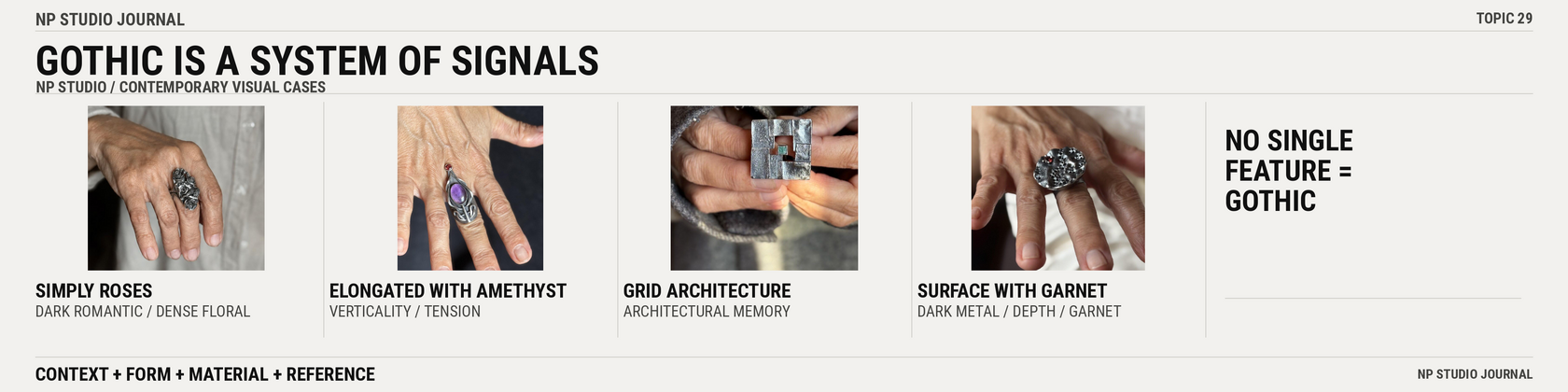
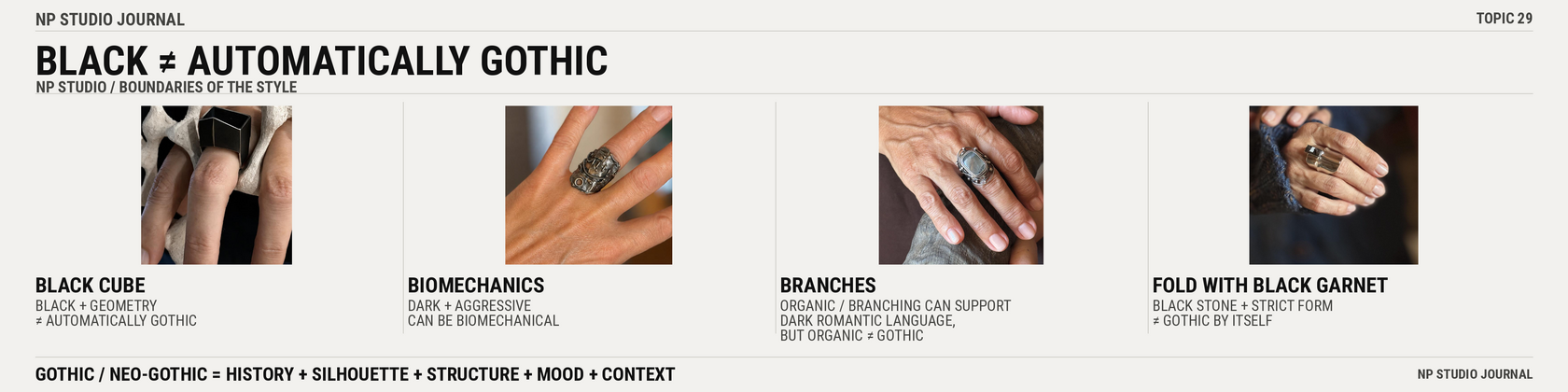
Black metal is one of the fastest stereotypes, but it does not define Gothic. A dark surface can belong to minimalism, geometric object jewelry, biomechanical aesthetics, Brutalist-inspired form, or simply a surface treatment.
Black Cube is a deliberate counterexample: a dark, architectural, geometric and minimal object does not become Gothic because of colour alone.
If the actual subject is deliberately darkened silver surface rather than Gothic style, see What Is Oxidized Silver?.
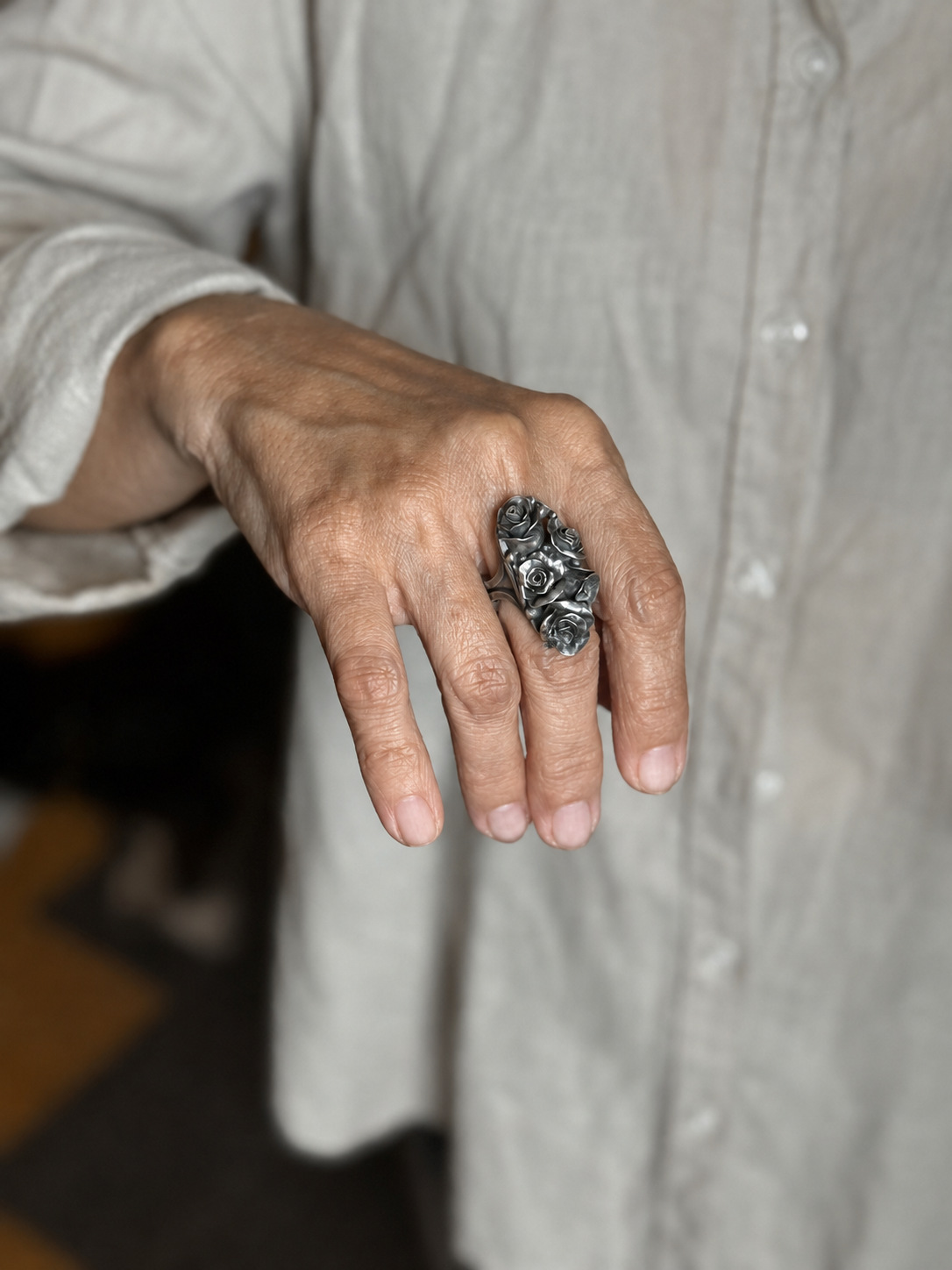
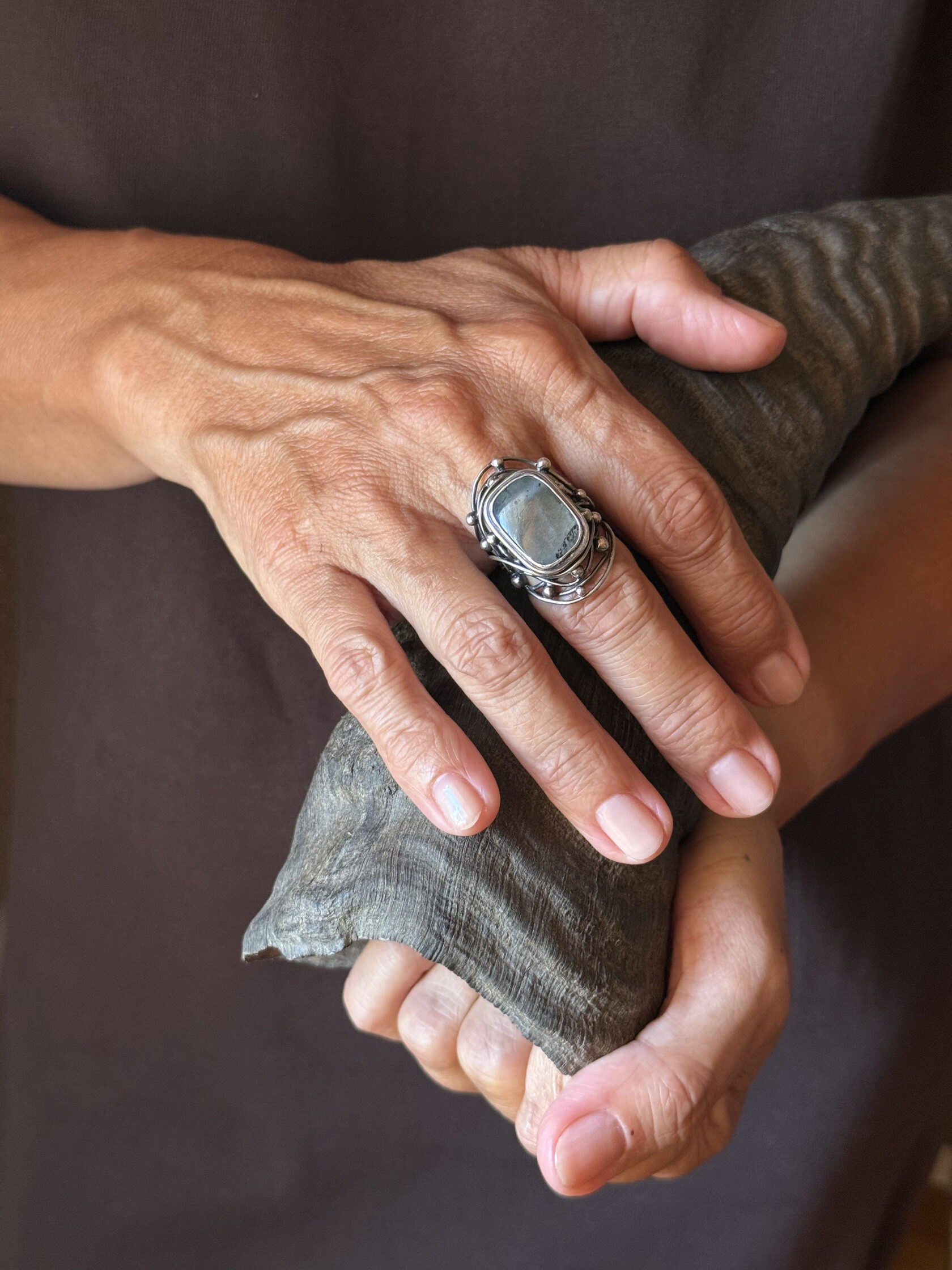
Roses, branching, dense floral structure and growth can support a dark-romantic language. The NP Studio page for Simply Roses explicitly describes a dense Gothic character / Gothic tint, while Branches provides a more organic branching example. For the separate language of living form, see What Is Biomorphic Jewelry?.
But floral ≠ Gothic. Botanical motifs also belong to other historical languages. Art Nouveau, for example, has its own turn-of-the-century context, flowing line and characteristic treatment of natural form. A shared motif does not make the styles synonymous.
Architectural memory can support a neo-Gothic reading through masonry, vertical divisions, frame-like structure, depth or the feeling of a fragment of wall or small construction.
Grid Architecture is described by NP Studio through stone masonry and an ancient architectural wall. Construction works through projecting structure, relief and patina.
But Architectural Jewelry is broader. ARCHITECTURAL ≠ GOTHIC. Architectural jewelry can be modernist, geometric, Brutalist-inspired or unrelated to historical Gothic. See What Is Architectural Jewelry?.
Verticality is one of the stronger Gothic-associated signals, particularly when combined with dark surface, tension and architectural or romantic associations.
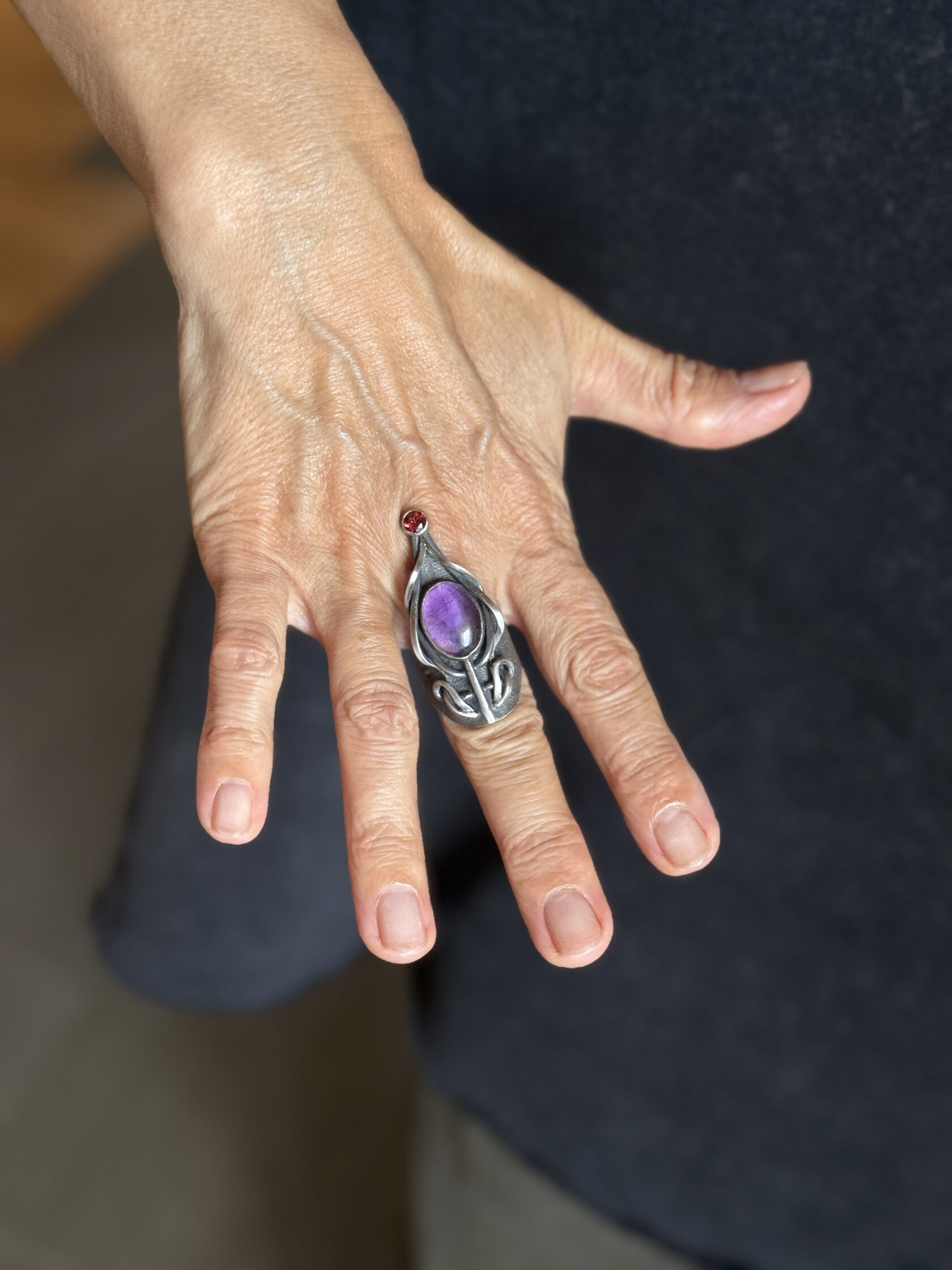
Elongated with Amethyst uses a long silhouette, intersecting elements and a jewel-like colour center built around amethyst and garnet. But Elongated Bio marks an important boundary: it is also dark, elongated and tense, yet its own context is explicitly biomechanical.
VERTICAL / DARK / TENSE ≠ AUTOMATICALLY GOTHIC.
Historical or architectural memory, verticality, tracery-like structure, dark-romantic tension and motifs working as a coherent system.
Segmentation, bindings, constructed systems and the feeling of a living mechanism. Dark metal can overlap visually with Gothic mood, but the underlying system is different.
Material weight, construction, rough surface and relationships between mass and empty space. It is a separate visual language and a separate topic.
Biomechanics is used here as a boundary example: a dark aggressive ring can be biomechanical rather than Gothic. See What Is Biomechanical Jewelry?.
Gothic draws on medieval / revival associations, architectural verticality, tracery and dark-romantic context. Art Nouveau is a distinct turn-of-the-twentieth-century historical style associated with flowing line and stylized natural form. Art Deco is another historical language, strongly associated with the 1920s–1930s, geometry, rhythm, order and machine-age imagery.
A rose does not automatically make a piece Gothic; geometry does not automatically make it Art Deco; an organic line does not automatically make it Art Nouveau. Styles are read through systems of signals and historical context. See Art Nouveau and Art Deco.
Here, neo-Gothic is used as a practical description for contemporary reinterpretation of Gothic-associated visual language rather than as a universal official jewelry taxonomy.
A neo-Gothic piece can use verticality, architectural memory, dark silver, layered structure or romantic floral density without copying a medieval object or presenting itself as an antique. This naturally sits within the broader field of contemporary jewelry.
“Russian Gothic” is used here as an authorial NP Studio name for a visual direction, not as a universally recognized historic jewelry school. The phrase does not claim a fabricated medieval Russian lineage or a distinct historical Russian Gothic jewelry tradition.
Within NP Studio, the term can describe combinations of dark silver, an old-metal feeling, dense handmade surface, vertical tension, architectural memory and restrained romantic floral language. Garnet, amethyst or labradorite can act as visual centers, but stone colour does not define the style.
Literal skull/cross symbolism is not required. Gothic-associated mood can be built through minimal or sculptural construction, surface and proportion. This is an authorial system of associations, not a historical category.
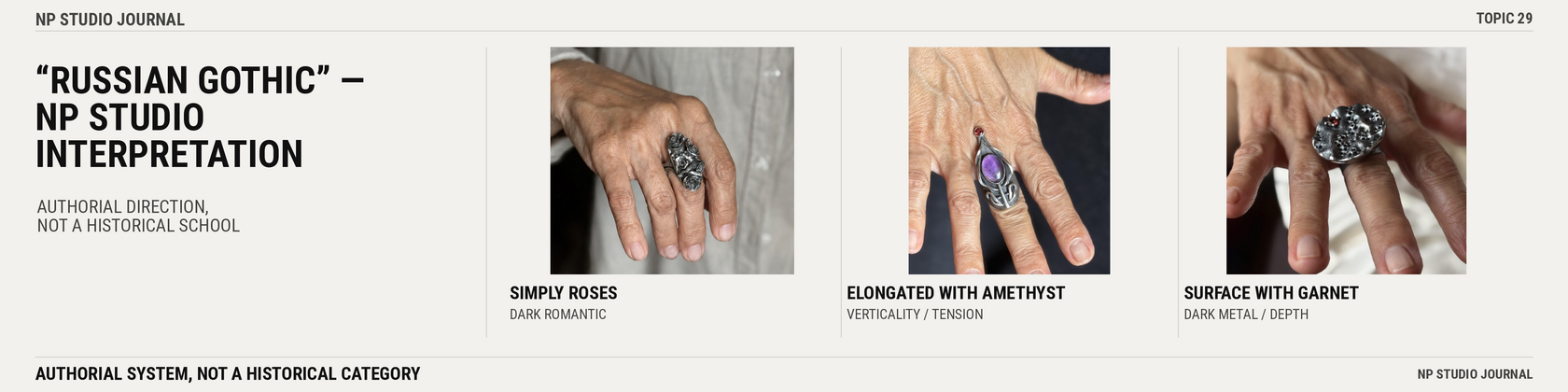
This is not a catalogue of “ten Gothic rings.” It is a set of different visual arguments, including deliberate boundary examples. Each work is useful because of a specific signal and because of what that signal does not prove.
Visual signal: dense romantic floral structure and a Gothic tint
Does not prove: that the work is Gothic Revival
Visual signal: verticality, elongated silhouette and tension
Does not prove: that elongation automatically means Gothic
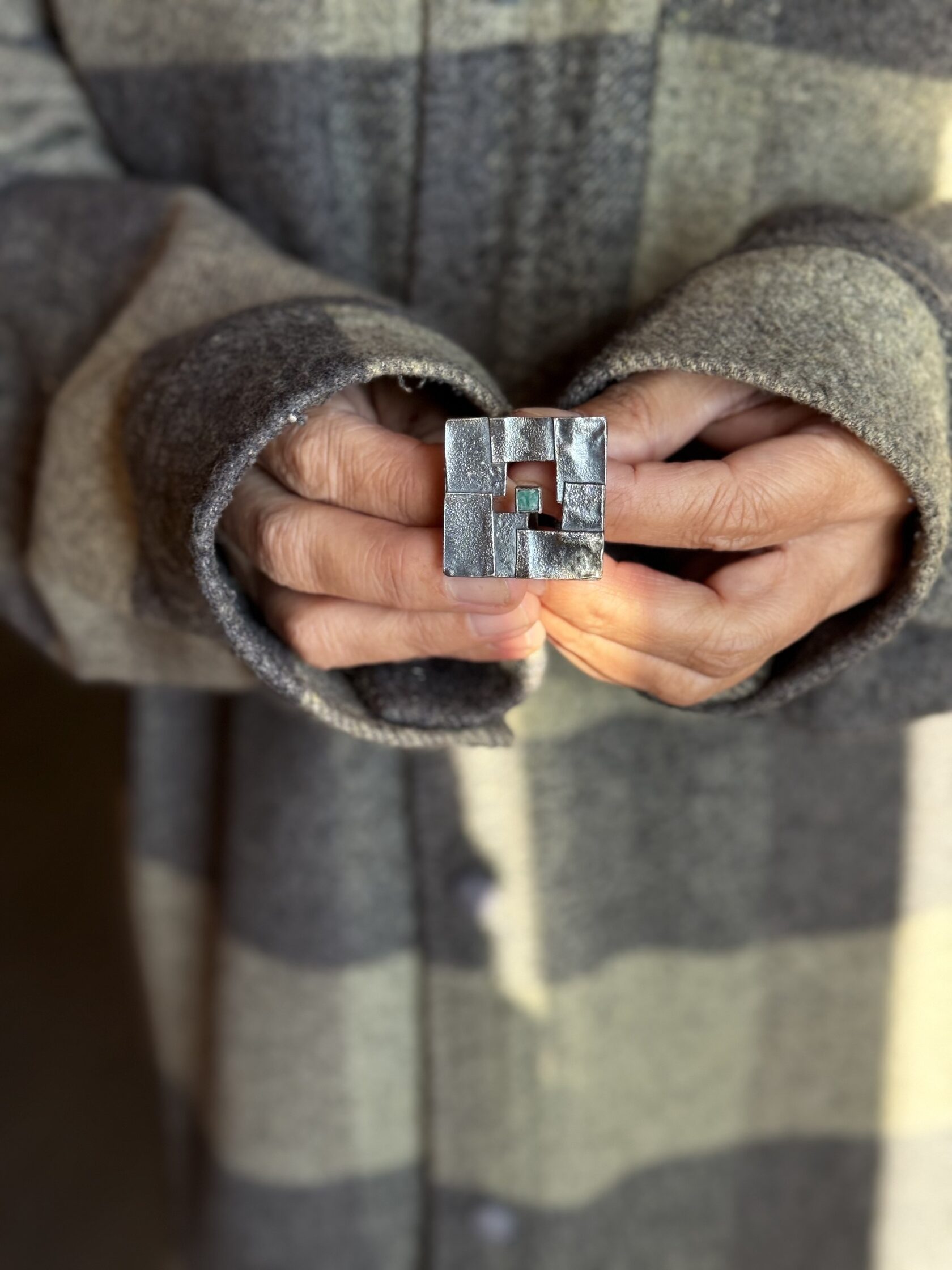
Visual signal: masonry and old-wall architectural association
Does not prove: that architectural form is automatically Gothic
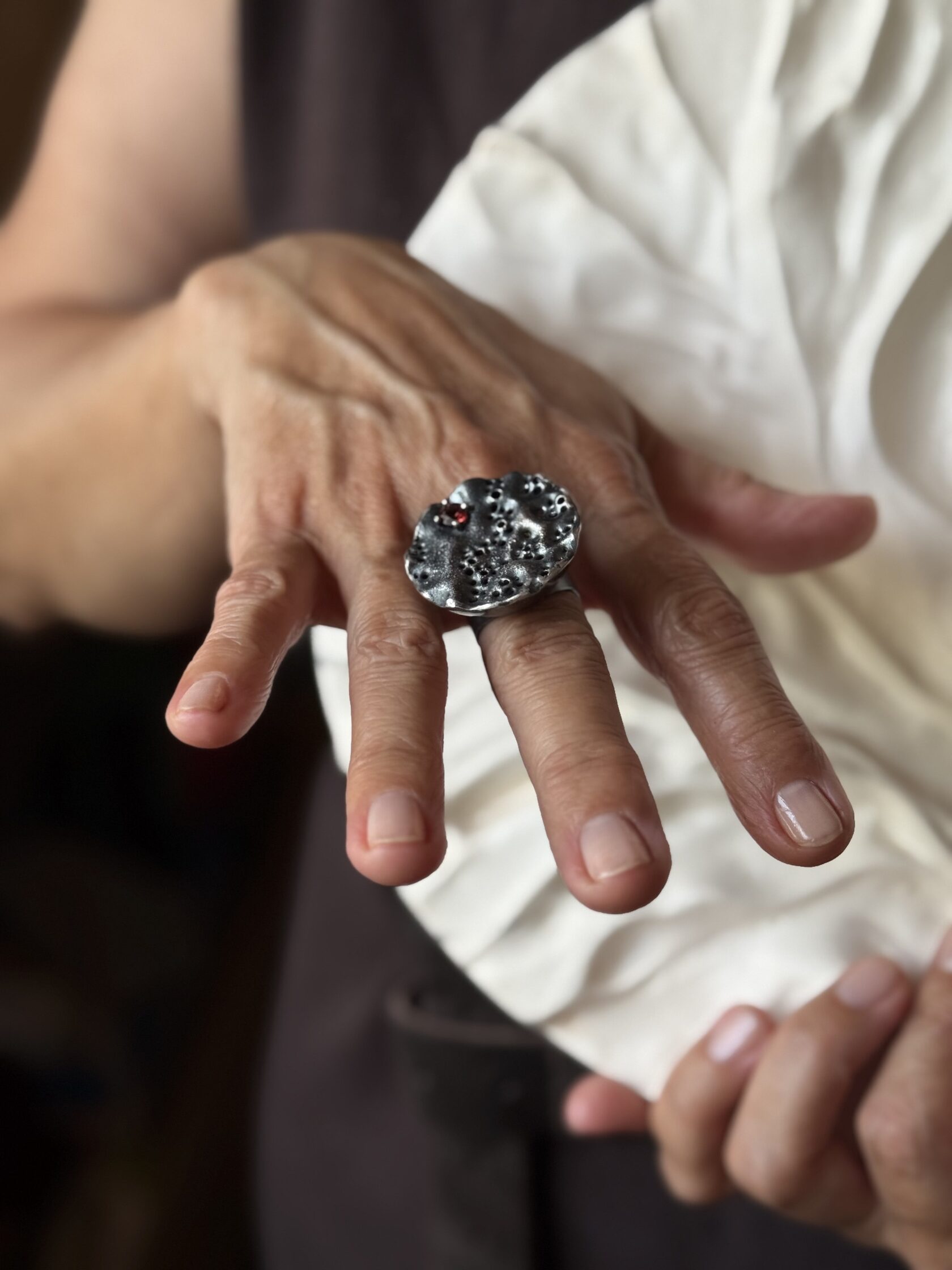
Visual signal: dark patina, deep relief and garnet
Does not prove: that black or dark metal automatically means Gothic
Visual signal: branching growth and dark-romantic organic structure
Does not prove: that any botanical motif is Gothic
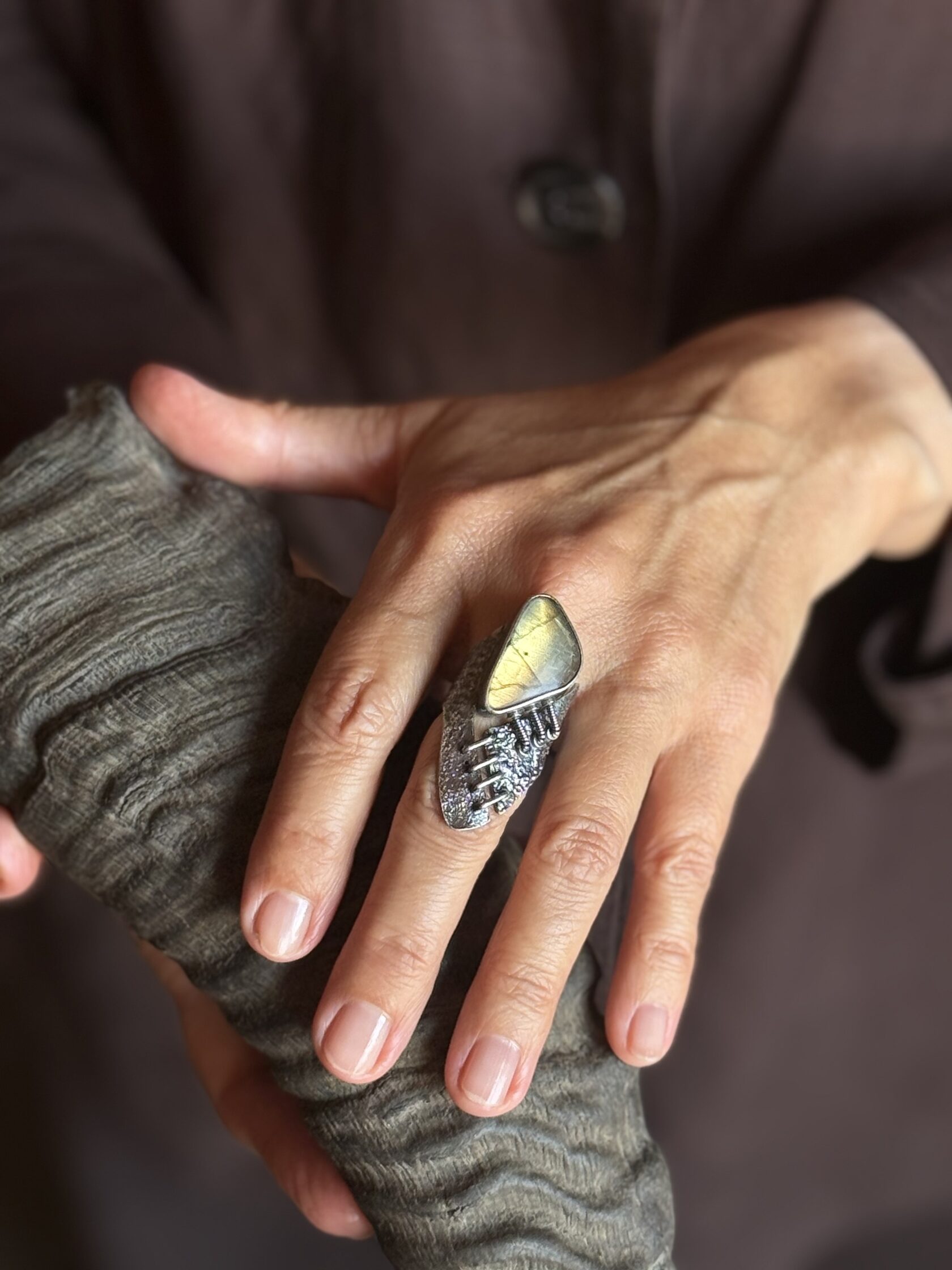
Visual signal: dark vertical tension
Does not prove: that biomechanical form is automatically Gothic
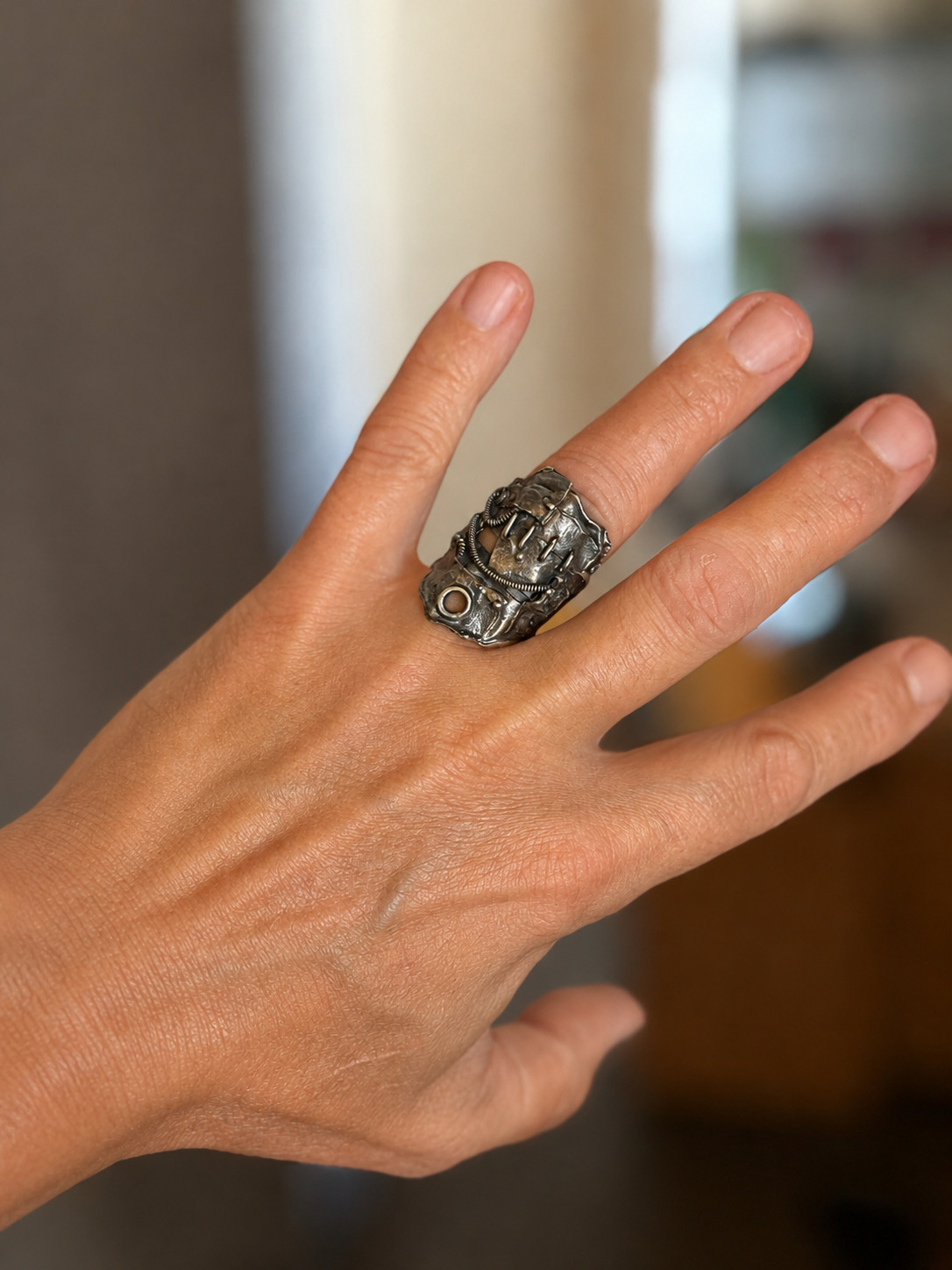
Visual signal: dark metal and aggressive constructed complexity
Does not prove: that darkness + metal = Gothic
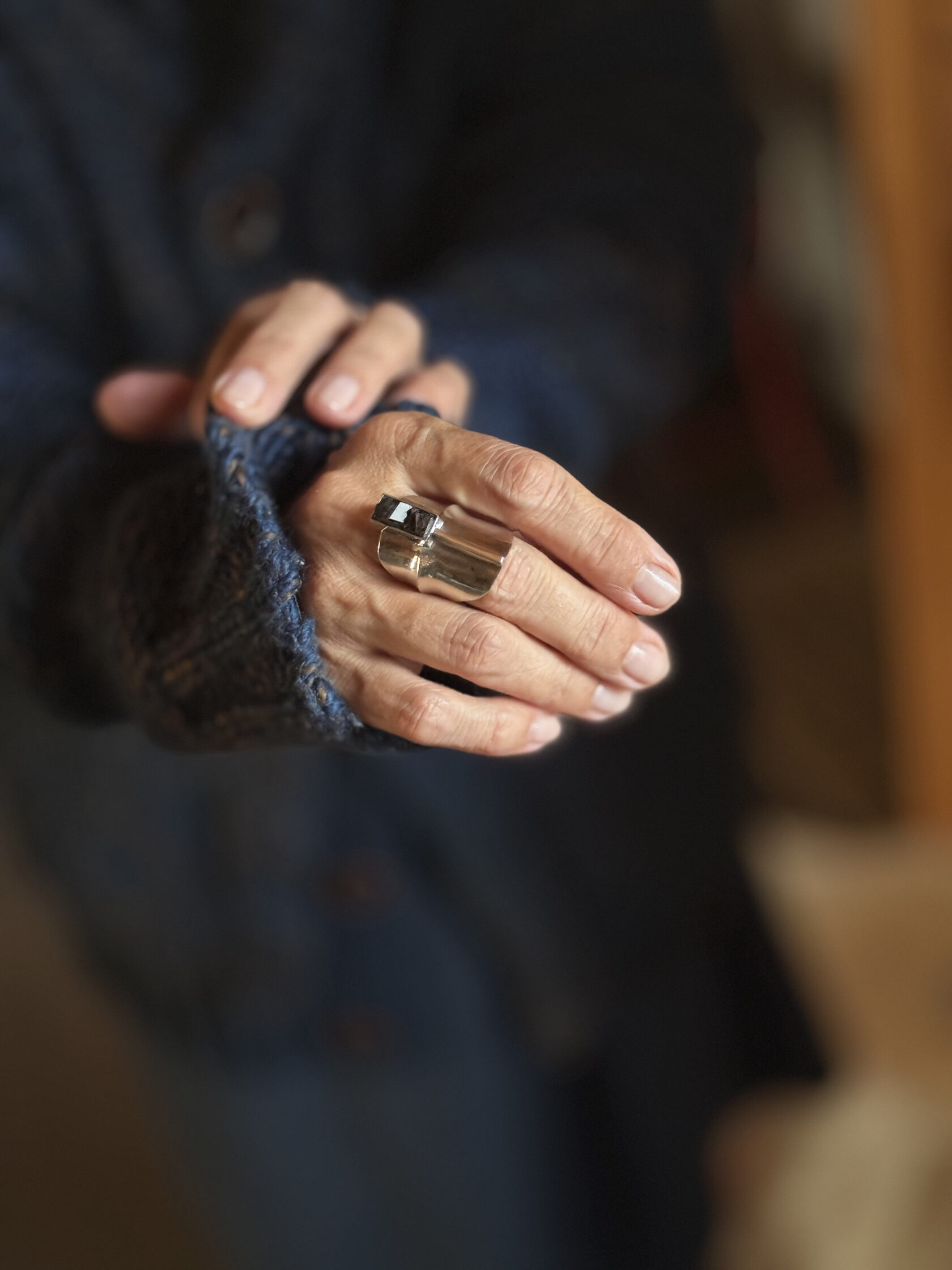
Visual signal: black garnet and strict folded geometry
Does not prove: that stone colour defines style
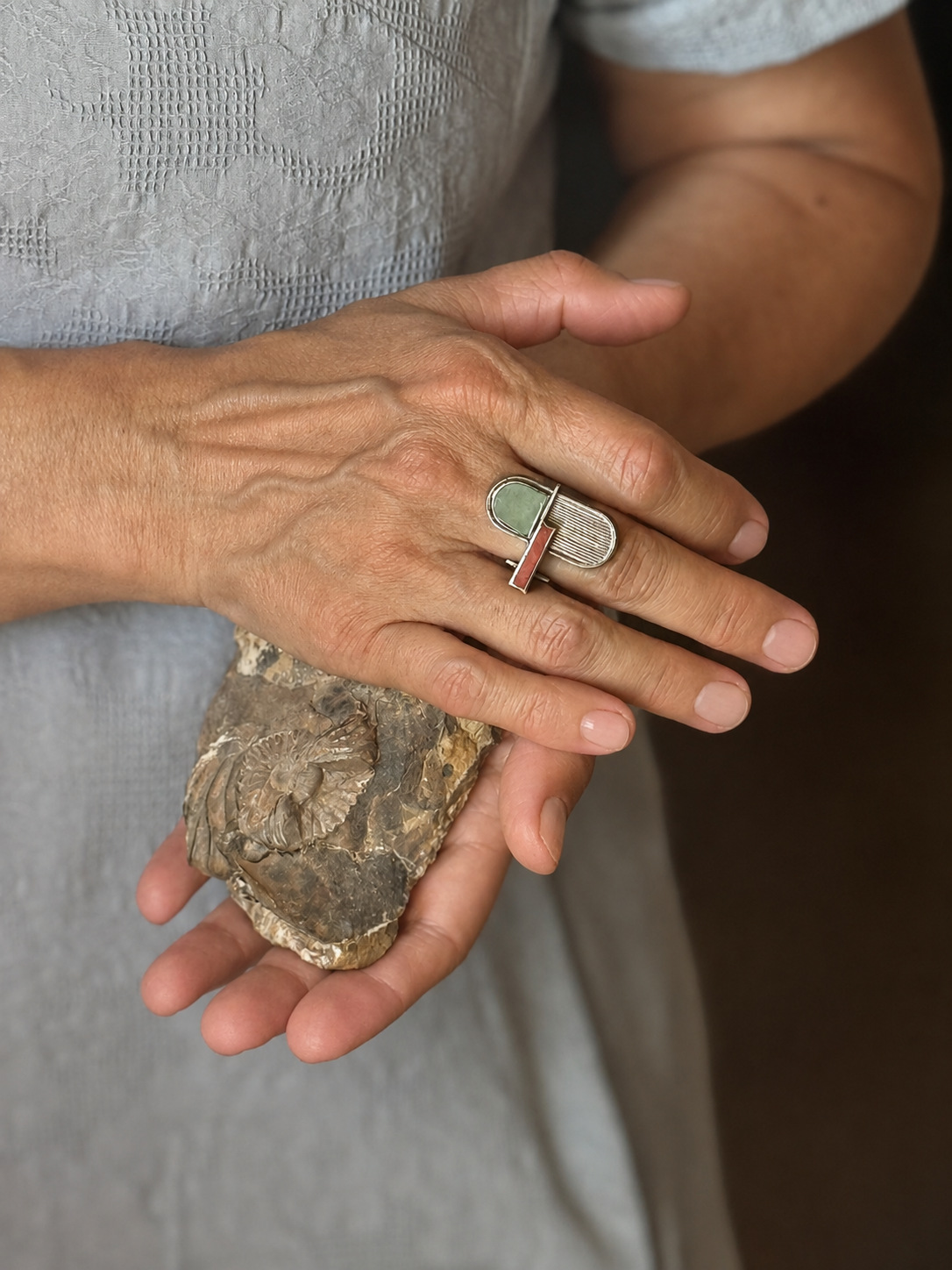
Visual signal: projecting architectural structure and patina
Does not prove: that architectural = Gothic

Visual signal: black minimal cubic geometry
Does not prove: the explicit counterexample: BLACK ≠ GOTHIC
If the entire attribution depends on the word “black,” the evidence for Gothic is weak.
Gothic jewelry is more useful as a visual and contextual system than as a checklist. Medieval Gothic, Gothic Revival, modern goth and neo-Gothic are connected, but they are not the same thing.
Blackened metal, garnet, a rose, a cross, a thorn or an elongated form can strengthen a Gothic reading—but only in relation to form, structure, historical memory and the overall character of the object.
One black ring is not Gothic by default.
It is a broad modern description for jewelry that can draw on Gothic-associated historical, architectural, romantic or subcultural signals. It is not one rigid formula and not simply black metal.
Jewelry and decorative objects existed within the wider medieval Gothic artistic context, but the modern label “Gothic jewelry” should not be mechanically applied to every medieval object.
It refers to later jewelry that deliberately returned to medieval Gothic forms. The Met, for example, explicitly describes a ca. 1830 ironwork necklace with a tracery cross as Gothic-revival jewelry.
Gothic Revival is tied to the historical revival of medieval Gothic forms, especially in the nineteenth century. Modern goth is a much later subcultural and styling context.
Here, neo-Gothic means a contemporary reinterpretation of Gothic-associated form and atmosphere rather than an attempt to present a new object as historical.
No. Dark patina can contribute to Gothic mood, but dark silver also appears in minimal, biomechanical, architectural and other visual languages.
No. They can appear, but Gothic character can also come from architecture, verticality, tracery-like structure, romantic density, surface and contrast.
Gothic draws on Gothic / Revival history and an architectural-romantic system; Art Nouveau is a distinct turn-of-the-century historical style; Brutalist reading is more closely associated with mass, material, void and raw construction.
It is an authorial name for a visual direction combining dark silver, old-metal feeling, dense surface, vertical tension, architectural memory and restrained romantic language. It is not a historic school.
Simply Roses, Elongated with Amethyst, Surface with Garnet and Branches are the clearest examples for this reading. Other works in the article are used as architectural, biomechanical or black-geometry boundary cases.
