Golden Four Sectors
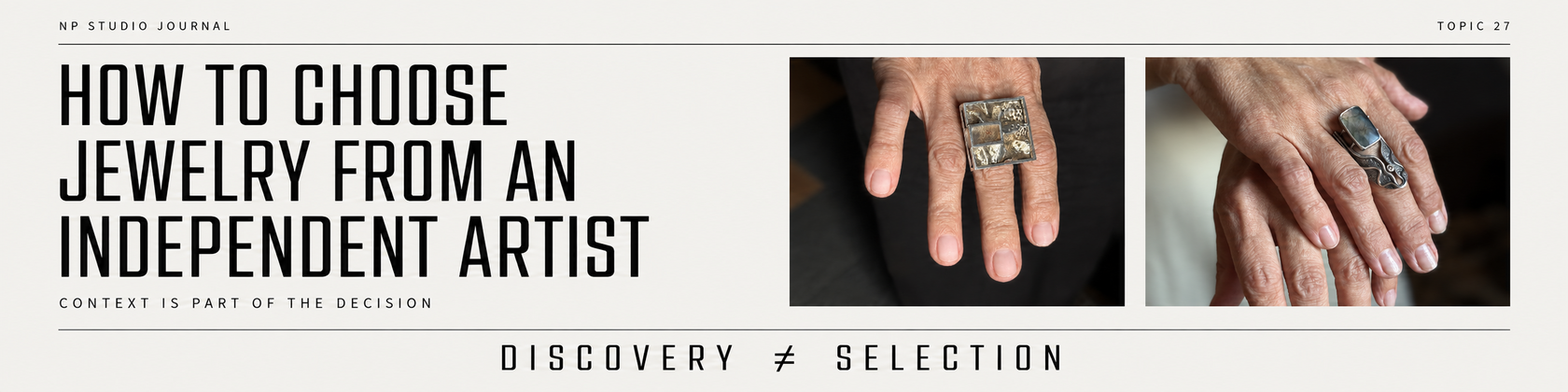
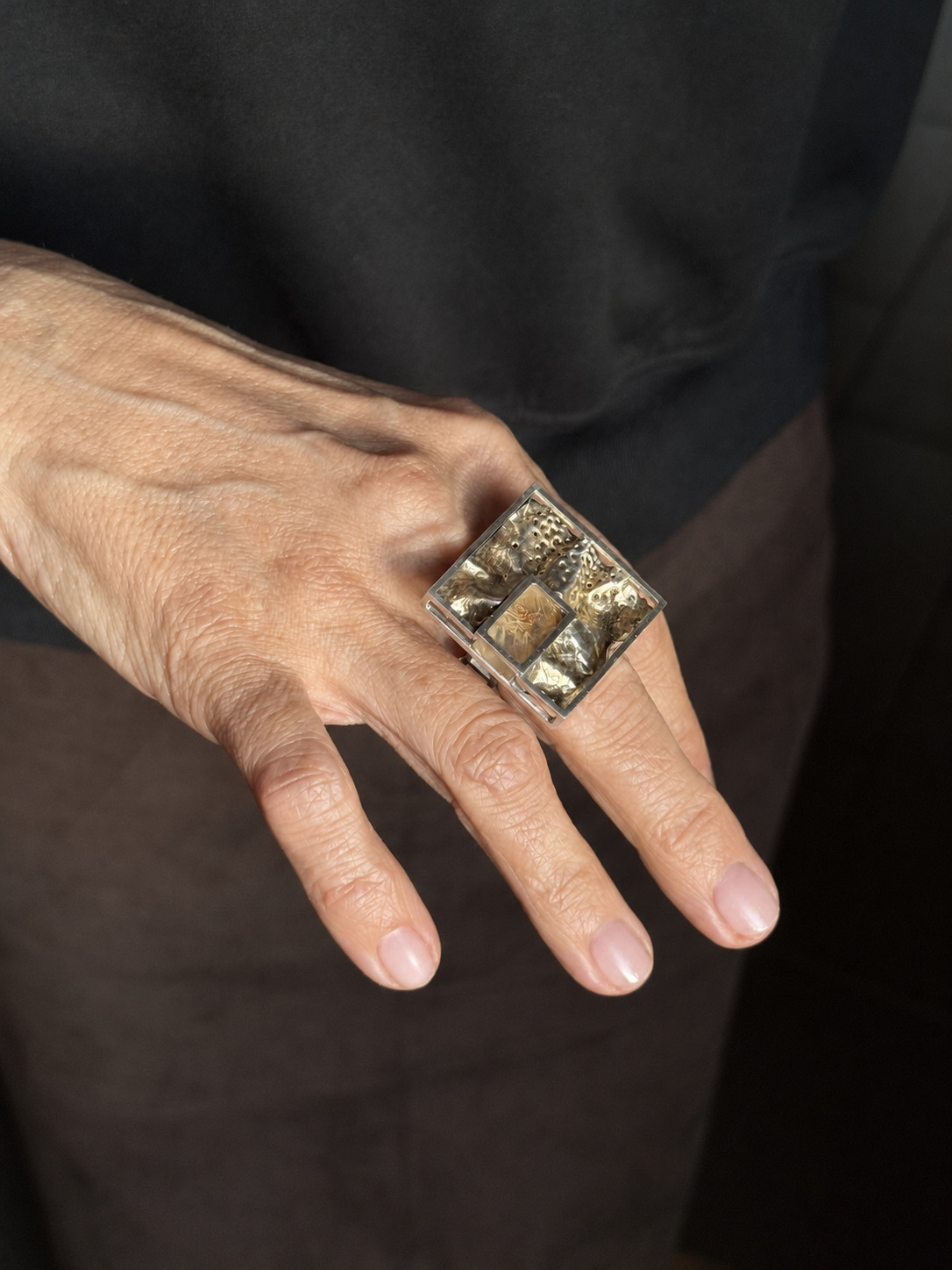
The Work page states sterling silver, natural rutile quartz, approximately 18 g, prototype status, a 19,000 ₽ price guide and the surface character. This is an example of specifications adding context beyond one image.
NP STUDIO / JOURNAL / HOW TO CHOOSE
Independent authorship is not a quality badge by itself. A strong image can communicate the character of a piece, but choosing well requires a wider context: the maker’s broader body of work, the object’s actual specifications, its scale on the body, its status and the terms of purchase.
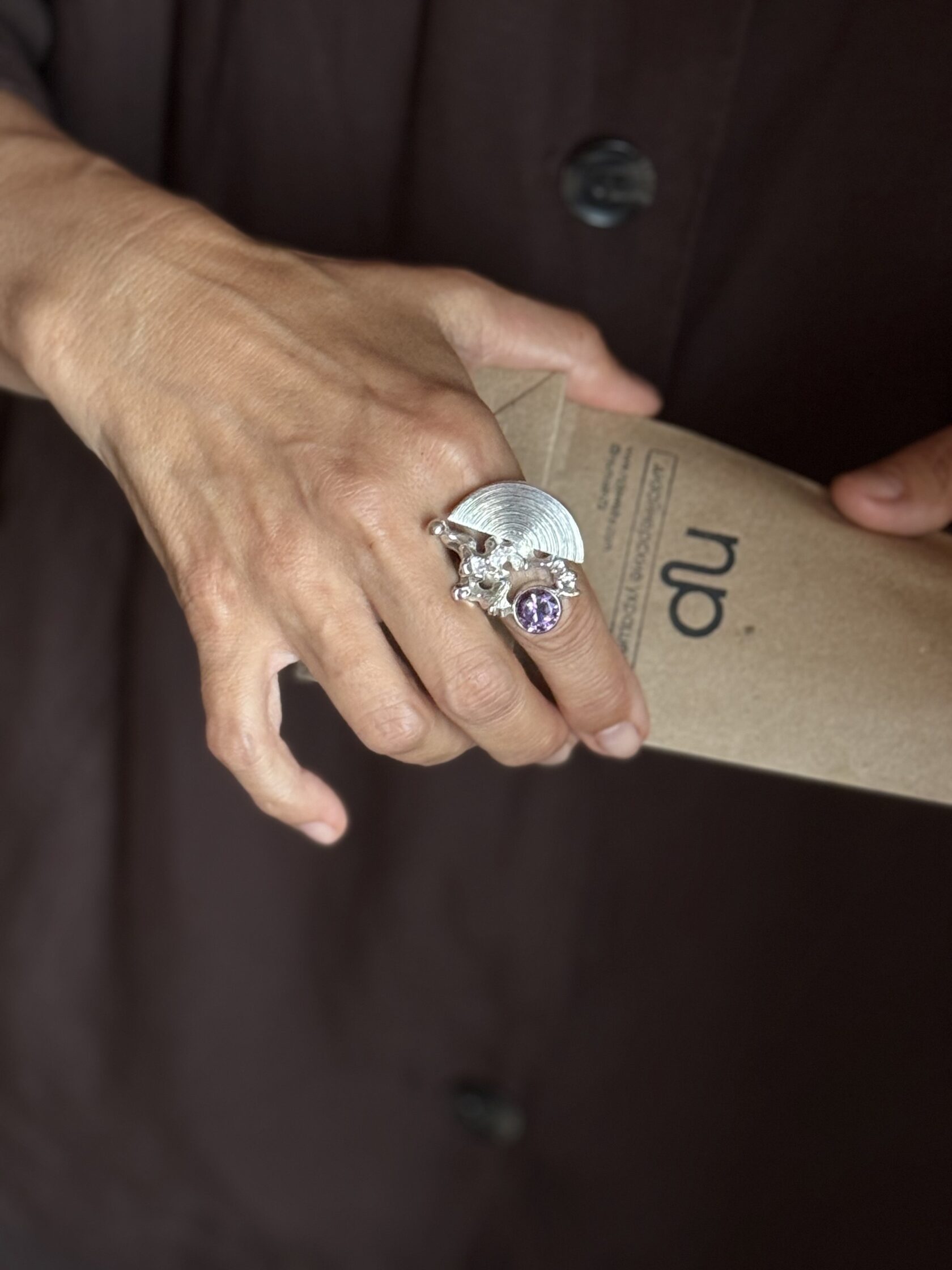
Choose the specific piece in the context of the maker’s practice — who made it, what it is made from, how large it is, how it is constructed and worn, what its status is, and what exactly is included in the purchase.
When choosing jewelry from an independent artist, look beyond a single compelling image. Review several works by the maker, check whether materials, stones, size, weight or scale, piece status and purchase terms are described clearly, and consider whether the piece suits how you intend to wear it. Handmade, one-of-a-kind and independent are useful descriptions, but none of them automatically guarantees quality, value or personal fit.
Independent artist, handmade, artisan, one-of-a-kind and custom describe different aspects of a piece or practice. None of these labels automatically proves quality, originality, durability, value or suitability for the wearer.
The first decision is still simple: do I genuinely respond to this specific object? Once you have found an artist, switch from discovery to evaluation. If the question is where to find makers in the first place, see Where to Find Unique Jewelry from Independent Artists .
One-of-a-kind and custom also describe different categories rather than quality levels; that boundary is covered separately in Topic №26 .
One photograph can be enough to attract attention, but it tells you little about the broader practice. Review several works, archive pages or collections: what forms recur, how materials and surfaces change, whether the maker works in several directions, and how the specific piece relates to the rest.
Consistency does not mean every object should look identical. A maker can have multiple directions. A body of work provides context for understanding the piece; it does not prove originality or quality by itself.
Useful context includes a named maker or studio, an About page or biography, an own site or clearly identified representing gallery, attributed work pages and a contact path. These signals do not prove identity on their own, but they help establish a traceable maker context and a route for questions.
When a gallery or reseller is involved, distinguish between the artist who made the work, the party representing or selling it, and the source of the object information.
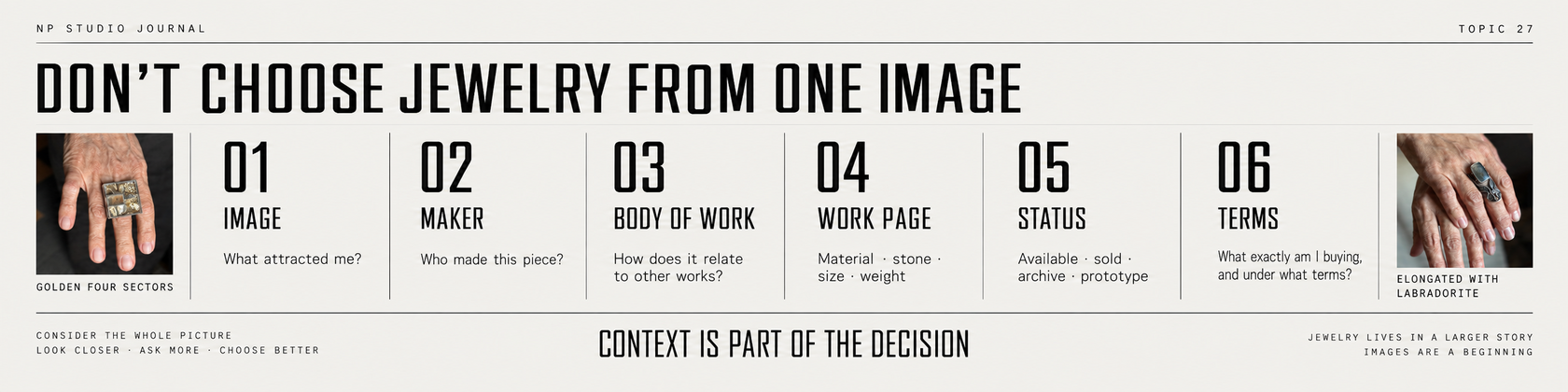
For an existing piece, useful information may include object type, material, metal fineness when applicable, stone or inlay, whether a stone is natural, lab-grown or imitation when relevant, size, dimensions, weight where meaningful, surface or finish, status, price or price guide, and whether the photographs show the exact available object.
If the material is silver, a hallmark or one photograph should not replace a clear description. For the separate authenticity question, see How to Tell If Silver Is Real .
The FTC Jewelry Guides, in U.S. consumer context, emphasize truthful representation of jewelry characteristics including metallic content and other attributes. This is useful as an information-quality reference rather than a universal rule for every jurisdiction.
The Work page states sterling silver, natural rutile quartz, approximately 18 g, prototype status, a 19,000 ₽ price guide and the surface character. This is an example of specifications adding context beyond one image.
If size, weight, stone description, status or final price is unclear, ask the maker or seller rather than inferring it from photographs.
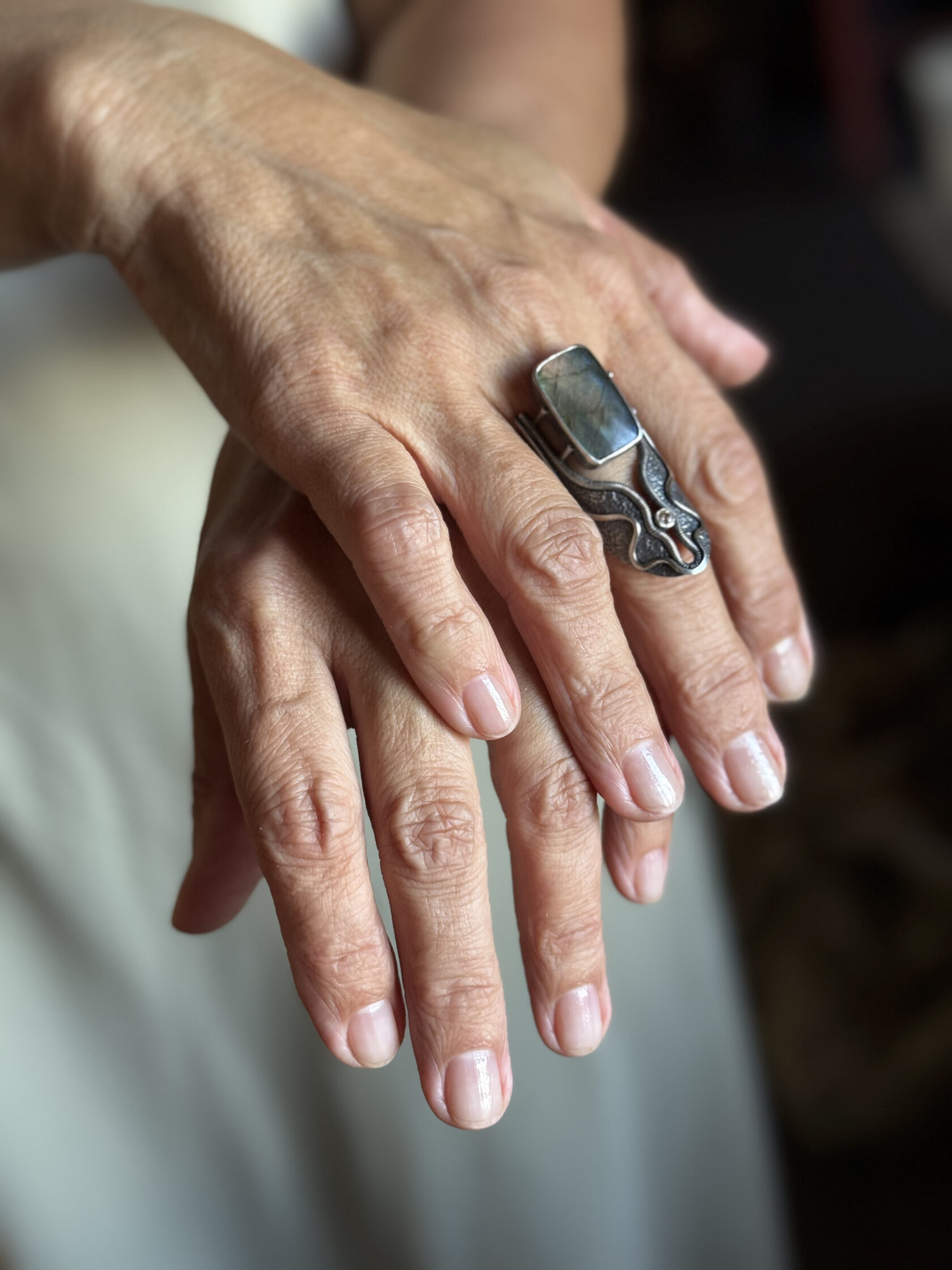
For sculptural rings, real dimensions can matter as much as material. Check ring size, shank width, length and width of the upper section, projection above the finger, weight and worn photographs. Consider whether you expect daily or occasional wear and whether protruding components may interact with clothing or routine movement.
Wearability is user-specific. The same dimensions or weight can feel appropriate to one person and excessive to another, so measurements help establish scale but do not guarantee comfort.
Elongated with Labradorite has an upper section approximately 45 mm long, size 17.5 and a weight of 12.2 g including stones; its Work page makes proportion central to the design.
Hammer marks, matte or irregular texture, patina variation, asymmetry and visible handwork can be part of the artistic language. Construction quality is a different question. Insecure stone setting, sharp snagging burrs, weak joints, cracks in load-bearing areas or deformation affecting fit may require closer inspection.
Do not diagnose workmanship from one photograph. Ask the maker when something is unclear, and inspect the piece in person when possible and relevant. The fuller buyer-facing distinction is covered in Why Handmade Jewelry Has Tool Marks and Irregularities .
GIA Quality Assurance Benchmarks provide technical context for considering setting, assembly and finish; they are not a ranking of artistic merit.
A Work page is not automatically an inventory page. Available / ready may mean the pictured object can be purchased; sold means that exact object is no longer available; archive can show the maker’s history; prototype may point toward a related future piece but does not mean the exact prototype is for sale.
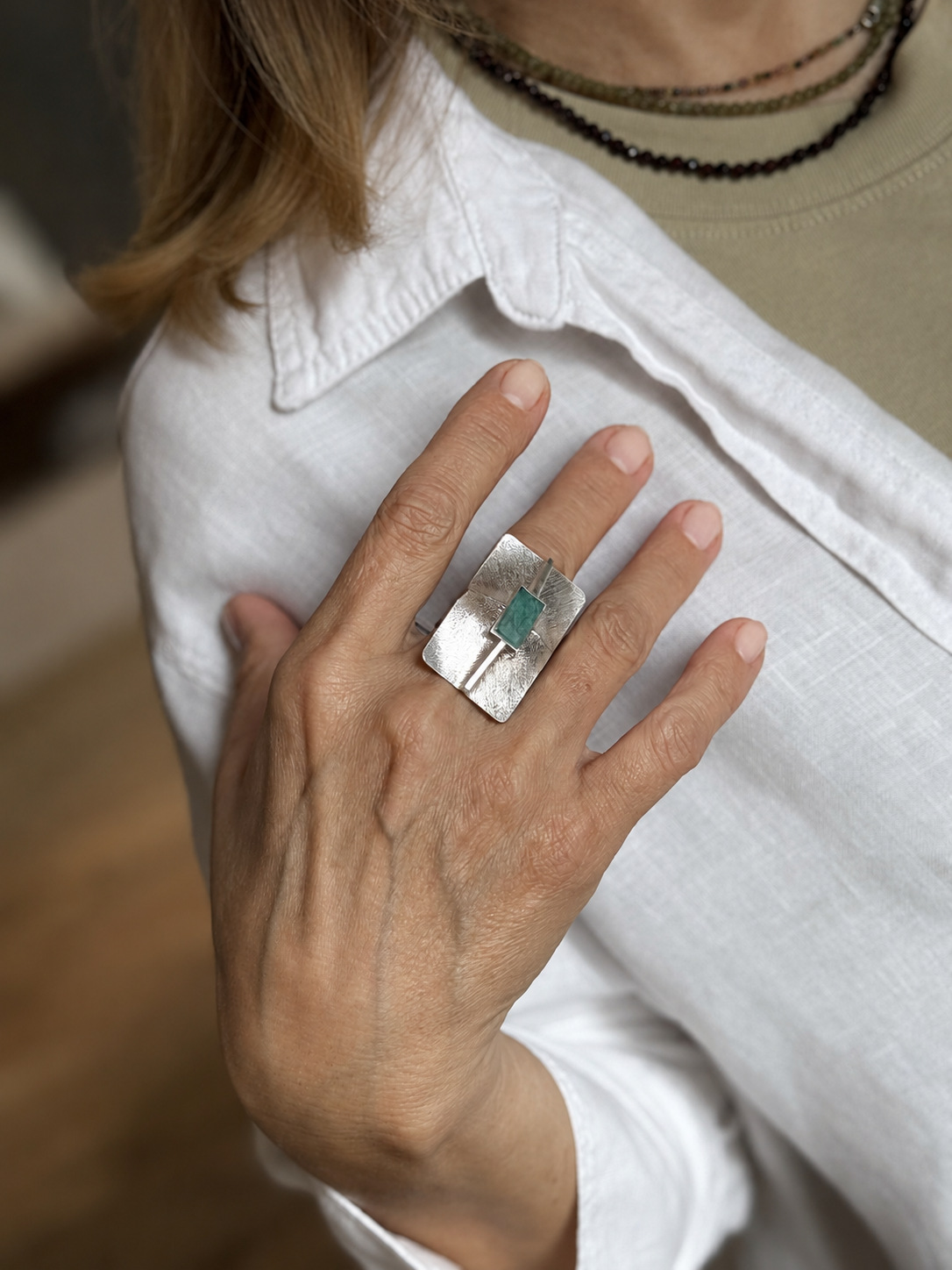
Picture 4 is explicitly an archival prototype: a related work can be made, but an exact copy is not intended. Ring with Coral is likewise an archival prototype from which a related new ring can be discussed.
NP Studio’s Terms of Order distinguish ready-made works, archive pieces, prototypes and custom directions, and state that publication on the site does not automatically mean the exact piece is available.
Before paying, understand whether you are buying the pictured object or commissioning a new piece, the final price, payment method, shipping and tracking, applicable duties or taxes where relevant, return or exchange terms, repair or resizing possibilities, and how to contact the seller if the piece differs materially from the agreed description.
Terms vary by seller, jurisdiction and transaction type, so there is no single universal return rule for independent artists. The goal is to understand the specific transaction before payment.
Useful records include the artist name, studio or gallery, work title, materials, year if provided, size and dimensions, purchase date, price and currency, receipt or invoice, photographs, a saved copy of the work description, and relevant correspondence.
This does not mean every purchase needs museum-level provenance. It is simply useful for care, insurance or appraisal, resale, gifting, collection records and future reference.
Art Jewelry Forum’s guide to cataloguing a jewelry collection similarly recommends recording artist identity, object and material details, purchase information, documents and images.
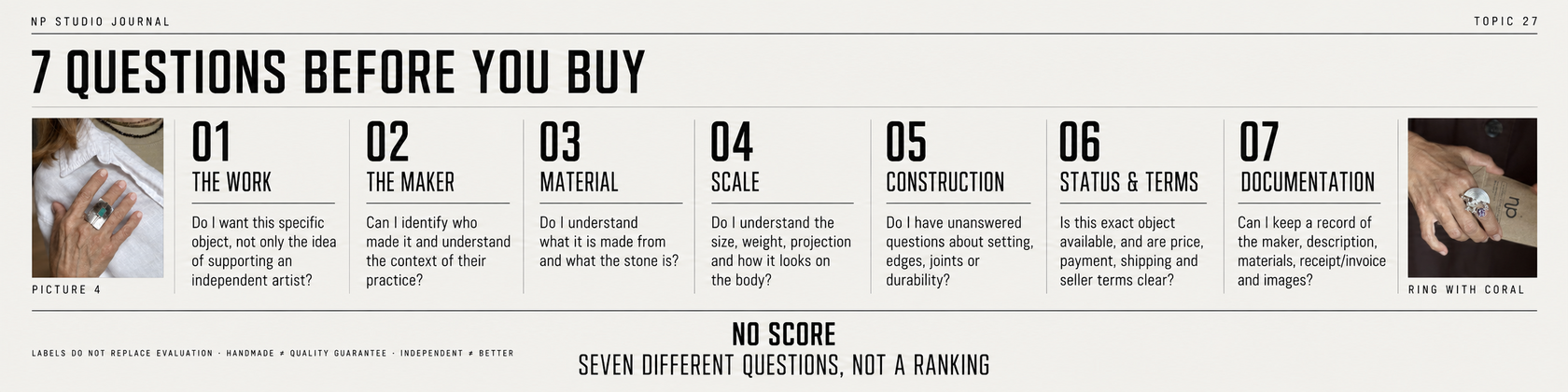
These are seven different questions, not a ranking system. One unanswered point may simply mean you should ask before buying.
NP Studio is used here as one practical example, not as a universal model for independent artists. A route through the site can look like this:
A Work page gives object information, Collections gives context among related pieces, About provides the maker/practice context, and Terms explains the transaction framework. Custom matters only when the buyer wants a new related work rather than an existing object.
| Signal | What it helps you understand | What it does not prove |
|---|---|---|
| Named maker / About page | Authorship and practice context | Not proof of quality |
| Multiple works / archive | Body of practice and evolution | Not proof of originality |
| Clear material details | How the object is described | Not proof of value |
| Dimensions / weight / worn photo | Scale and practical fit context | Not a comfort guarantee |
| Status: available / sold / archive / prototype | What can actually be bought or discussed | Not a quality judgment |
| Terms / contact | Transaction clarity and communication path | Not artistic merit |
| Close photos / workmanship information | Construction questions you can evaluate or ask about | Not a substitute for physical inspection when needed |
Evaluate the specific piece, maker context, materials, dimensions and wearability, construction, piece status, purchase terms and documentation.
It is useful. Several works and archive pages provide context for the practice, but they do not automatically prove quality or originality.
No. Handmade describes a production method; construction quality still needs to be considered separately.
No. Singular status is not a ranking of quality, value or suitability for the wearer.
Material, fineness when applicable, stone, size, dimensions, weight where meaningful, finish, status, price and whether the photographs show the exact available object.
Photographs can hide scale. Real measurements help you understand fit, projection and whether the piece suits your intended way of wearing it.
Separate visual language from function. Texture can be intentional, while questions about stone security, sharp edges, joints or cracks may need closer inspection.
Archive can indicate a historical work; prototype can indicate a direction for a related piece. Neither label automatically means the pictured object is available or repeatable exactly.
Confirm the exact object or commission, final price, payment, shipping, tracking, applicable duties or taxes, return terms and repair or resizing options.
Keep the maker name, work title, materials, dimensions, purchase date and price, receipt or invoice, photographs, work description and relevant correspondence.
