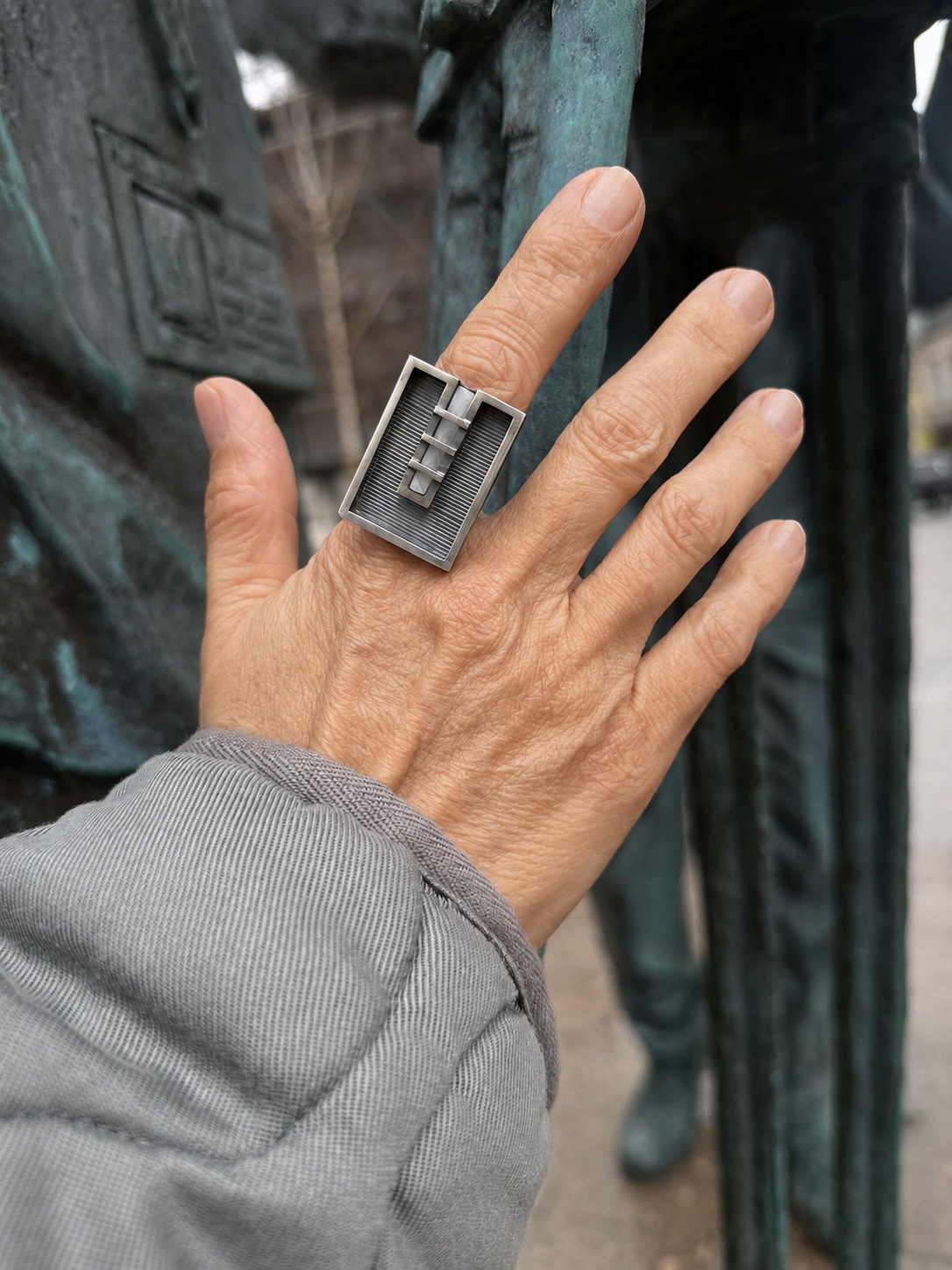
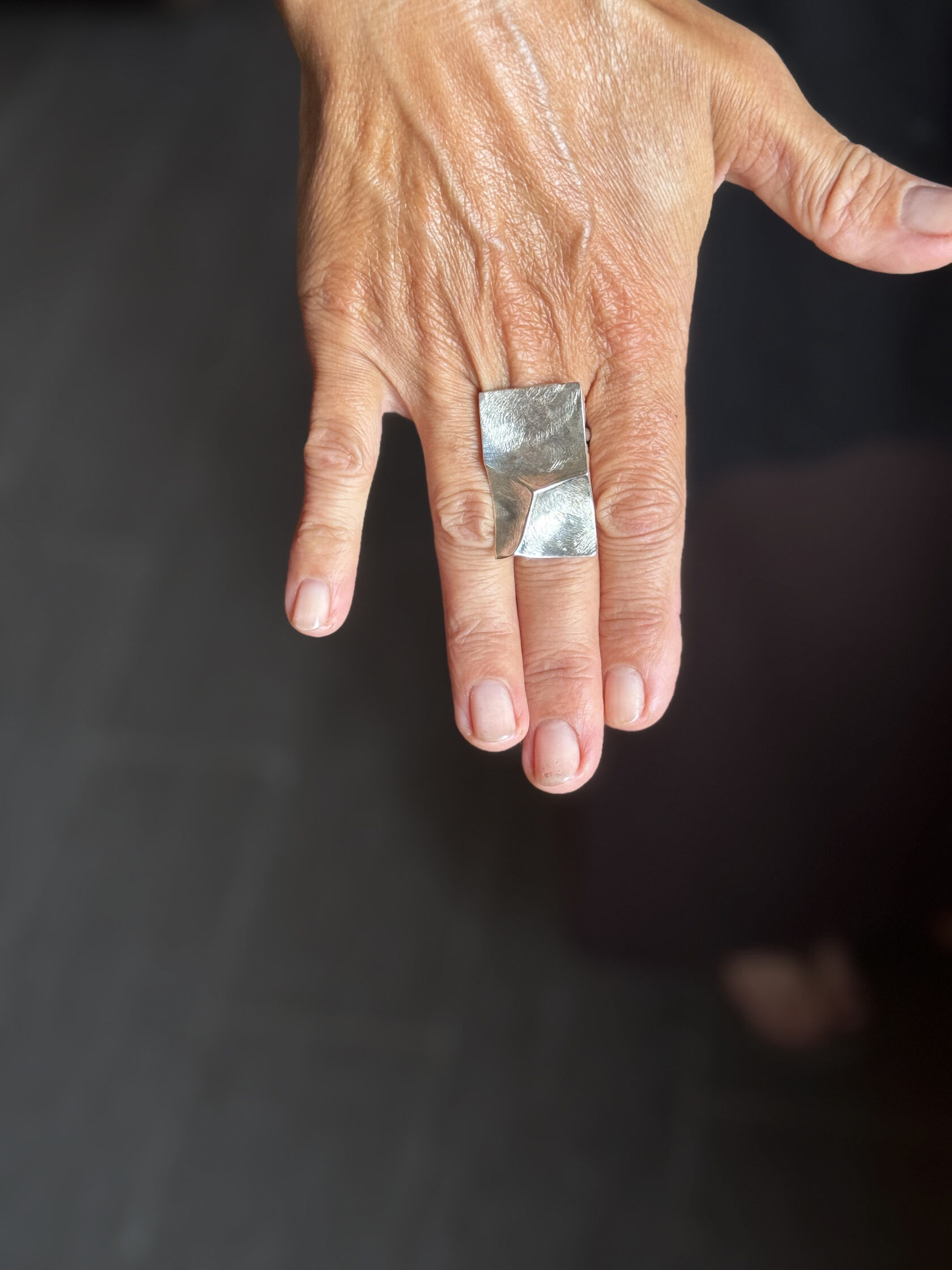
 Picture Ring 2Sterling silver · milky quartz · substantial architectural composition
NP STUDIO / JOURNAL / EARRINGS
Drop vs Dangle Earrings: What’s the Difference?
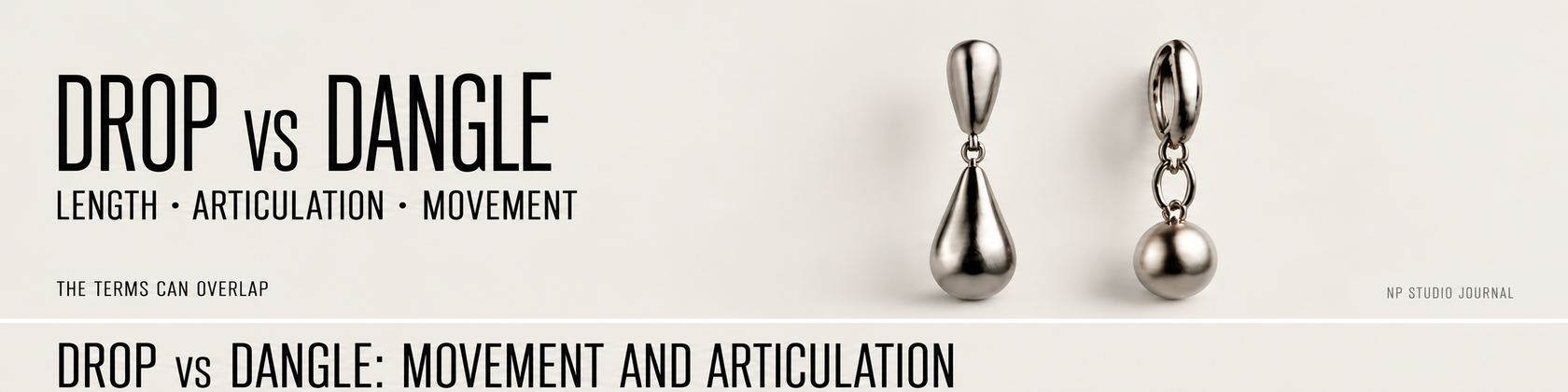
Drop and dangle earrings often overlap in store categories, which is why the terms are regularly confused. In practice, it is more useful to look at length, articulation and visible movement than to rely on the label alone.
Direct answer
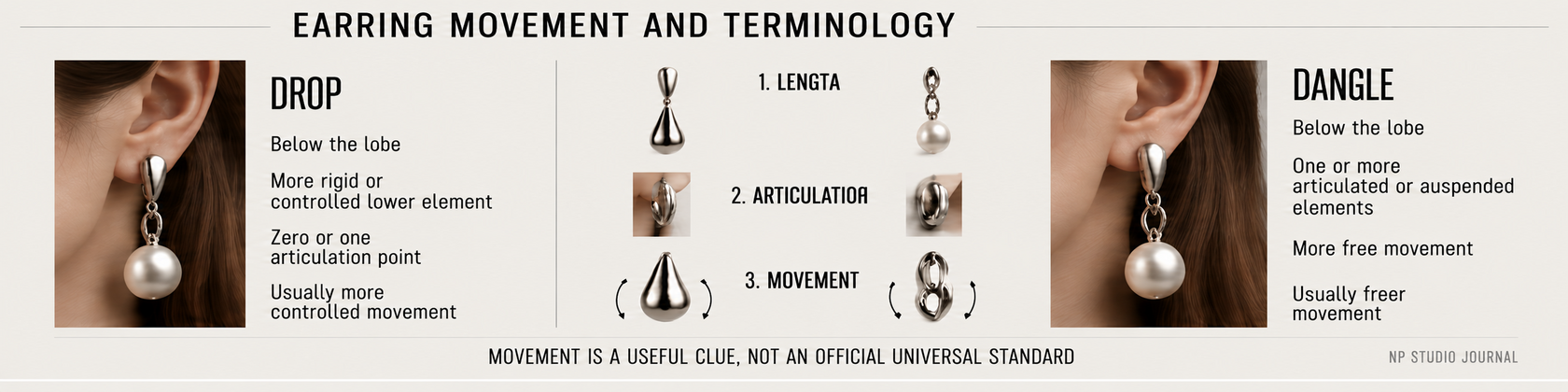
In practical usage, drop earrings usually extend below the lobe while the lower element remains relatively fixed or has limited movement. Dangle earrings more often use freely suspended or articulated elements and move more visibly with the wearer. This is not a strict universal classification: retailers may combine the terms or use them differently, so actual construction, length and articulation matter more than the label alone.
These are real NP Studio works. They are not examples of drop or dangle earrings; they introduce the studio’s visual language through form, surface, scale and the sense of movement implied by construction.
Picture Ring 2Sterling silver · milky quartz · substantial architectural composition  Blue Stone in a FrameSterling silver · blue stone · frame, folded surface and graphic lines
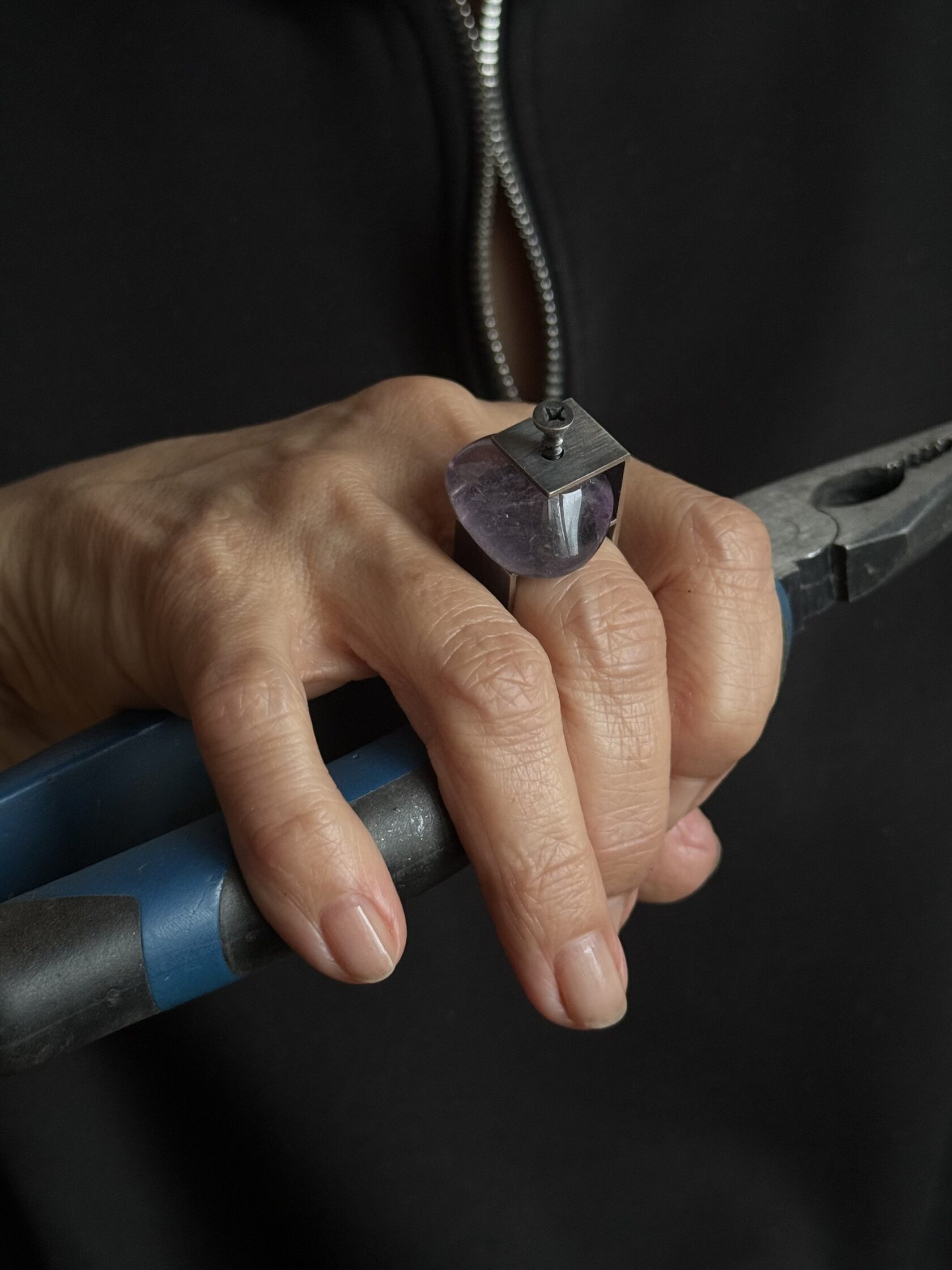 Amethyst with a ScrewSterling silver · amethyst · sculptural mechanical detail
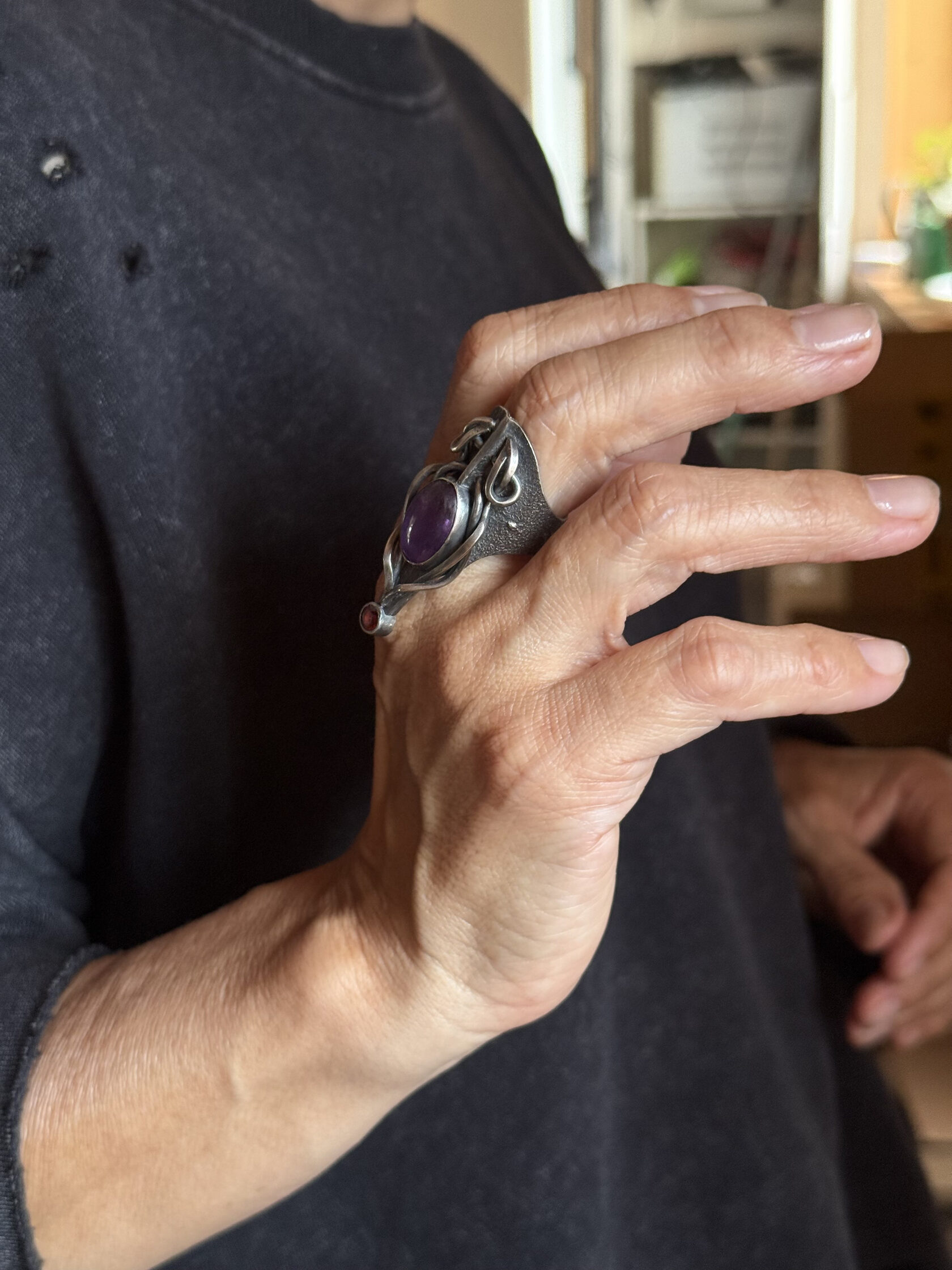 Elongated with AmethystSterling silver · amethyst and garnet · fire texture and intersecting lines

Why the terms overlap
The confusion exists because drop and dangle are not part of one universally fixed global taxonomy. They are practical descriptive labels used by retailers, catalogs and customers, and different sellers may sort very similar earrings into different groups.
That is why careful language matters here: not “always” and not “never,” but “usually” and “commonly.” The label is useful as a clue, but it does not replace the actual construction of the earring.
What is usually called a drop earring
Drop earrings usually extend below the lobe, but the lower element tends to behave in a more controlled way. It may look visually fixed, more integrated into one vertical form, or only moderately mobile.
It is important that “drop” does not mean zero movement. It usually suggests a more controlled lower element compared with a more freely articulated dangle construction.
What is usually called a dangle earring
Dangle earrings more often rely on freely suspended or articulated elements. Because of that, they tend to move more visibly with the wearer and often feel more animated on the body.
They are often longer, but length is not the universal definition. Two earrings of similar length can still differ primarily by articulation and the way the lower section moves.
The clearest practical difference: movement and articulation
Usually one more controlled lower element, less freedom of motion and a more integrated visual behavior.
Usually one or more articulated suspended elements, greater freedom and more visible movement.
The degree of articulation is often the most useful practical clue. One link or several moving connections can change the behavior of an earring more decisively than an abstract length measurement.
Length is a clue, not a rigid rule
Length helps, but it does not create a strict boundary. Dangle earrings are often longer, yet there is no universal millimeter or centimeter threshold after which a drop automatically becomes a dangle.
It is more useful to read overall length together with construction: does the earring have one calmer lower volume, or several freely suspended parts that behave like a chain or multi-link structure?
Construction examples
- Rigid drop: one lower form suspended from the top, with more controlled movement.
- Fixed bar + lower element: a more rigid upper section with a lower part that may still allow limited movement.
- One articulated joint: one point of articulation already adds freedom, but it does not automatically turn the earring into a dangle.
- Chain: chain-based suspension usually moves the piece further toward the dangle side of the spectrum.
- Multi-link dangle: several articulated links increase the sense of freer motion.
These are neutral construction schematics, not NP Studio products.
Closure does not define drop vs dangle
CLOSURE ≠ CATEGORY. Hook, stud with suspension or another fastening system does not determine whether an earring is a drop or dangle. What matters more is how the lower section behaves and how many articulated connections it uses.
Closure taxonomy is a separate subject and is better treated independently from the drop/dangle distinction.
For related earring forms and constructions, see Huggie vs Hoop Earrings: What’s the Difference? and Stud Earrings: Design, Fit and Construction.
Weight and balance
A longer or more mobile earring is not automatically heavier. Weight depends on material, section thickness, density of the lower volume, stones and the overall construction of the piece.
Likewise, a compact drop can still be quite heavy if it uses solid metal or a large stone. That is why actual weight per earring, when available, is more useful than assumptions based on silhouette alone.
Why retailer labels can disagree
Retail taxonomy is designed for practical catalog organization rather than theoretical purity. One seller may call a piece a drop because of its more controlled silhouette, while another may call it a dangle because it includes one articulated element.
That does not necessarily mean one of them is wrong. More often, it shows that the terms themselves overlap and describe a range of related constructions.
For the broader map of earring categories, see Types of Earrings. You may also find it useful to read How to Choose Jewelry from an Independent Artist and What Is Contemporary Jewelry?.
What to check before buying
- Overall length. This helps you understand scale on the ear.
- Moving versus rigid sections. Check which parts are fixed and which parts are freely articulated.
- Number of articulated connections. One link and a multi-link construction behave differently.
- Weight per earring. If available, this is more useful than any guess based on photos.
- Closure as a separate property. Important for use, but not the drop/dangle definition.
- Material. Metal, stones and finish affect mass, balance and the character of the object.
- Exposure of stones or lower elements. Projecting details can influence everyday wear.
- Whether the product photos reveal movement. A static front view can hide behavior better than an on-ear or angled image.
Drop vs dangle comparison
| Feature | Drop | Dangle |
|---|---|---|
| Position below the lobe | Usually extends below the lobe as a more integrated shape. | Also extends below the lobe, but more often behaves more freely. |
| Typical articulation | Often zero or one more limited articulation point. | Often one or several freer articulated connections. |
| Typical movement | Usually more controlled. | Usually freer and more visible. |
| Typical length | Can be short or medium; length alone does not define it. | Often medium or long, but with no rigid threshold. |
| Visual behavior | More often reads as a more unified silhouette. | More often reads as livelier and more mobile. |
| Closure | Does not define the category. | Does not define the category. |
Important: terms may overlap — construction matters more than the label.
NP Studio: movement, line and balance
Even when discussing basic typology, the character of a piece is not determined by the category label alone. Line, mass, articulation, balance and surface can completely alter how an object feels on the body.
That is why author-made jewelry asks you to look beyond the label and notice how the form is organized, how it moves, where the mass sits and how material interacts with body and space.
Related Journal
FAQ
1. What is the difference between drop and dangle earrings?
In practical usage, drop earrings usually hang below the lobe with a more controlled lower element, while dangle earrings more often use freely suspended or articulated parts and show more visible movement.
2. Are dangle earrings always longer than drop earrings?
No. Dangles are often longer, but length alone does not define the category. Articulation and movement are more useful clues.
3. Do drop earrings stay completely still?
No. A drop earring can move slightly, especially if it has one small articulated section. The difference is usually about more controlled movement, not zero movement.
4. Can a drop earring have a moving element?
Yes. A single moving lower element does not automatically make it a dangle if the overall construction still behaves in a more controlled way.
5. Why do some retailers group drop and dangle together?
Because these are descriptive retail categories rather than one rigid universal taxonomy. Different sellers may organize similar products differently.
6. Does the closure determine whether an earring is a drop or dangle?
No. Closure is a separate product property. The category depends more on length, construction, articulation and movement.
7. Which type usually moves more when worn?
Dangle earrings usually show more movement because they more often use freer or multi-part suspended elements.
8. Are dangle earrings always heavier?
No. More length or more movement does not automatically mean greater weight. Weight depends on material, section, stones and construction.
9. How is the length of a hanging earring measured?
It is usually described as the total length from the highest point of the earring to the lowest point. If possible, check whether the seller means full length or only the hanging section.
10. How can you tell a drop from a dangle in a photo?
Look for one more fixed lower element versus multiple freely articulated parts. It also helps to see whether the product photos suggest movement instead of only a static front view.
NP STUDIO / SELECTED WORKS
Two more real studio works
These are not examples of drop or dangle earrings. They are two more real NP Studio works shown after the terminology section to return the page to the studio’s visual language.

NEXT / WORKS
Explore Works
The archive shows different surfaces, stones, scales and ways NP Studio works with sterling silver.
View WorksNEXT / CUSTOM
Discuss a custom piece
If you have a specific idea, reference or desired character of form, a short description is enough to start the conversation.
Discuss Custom