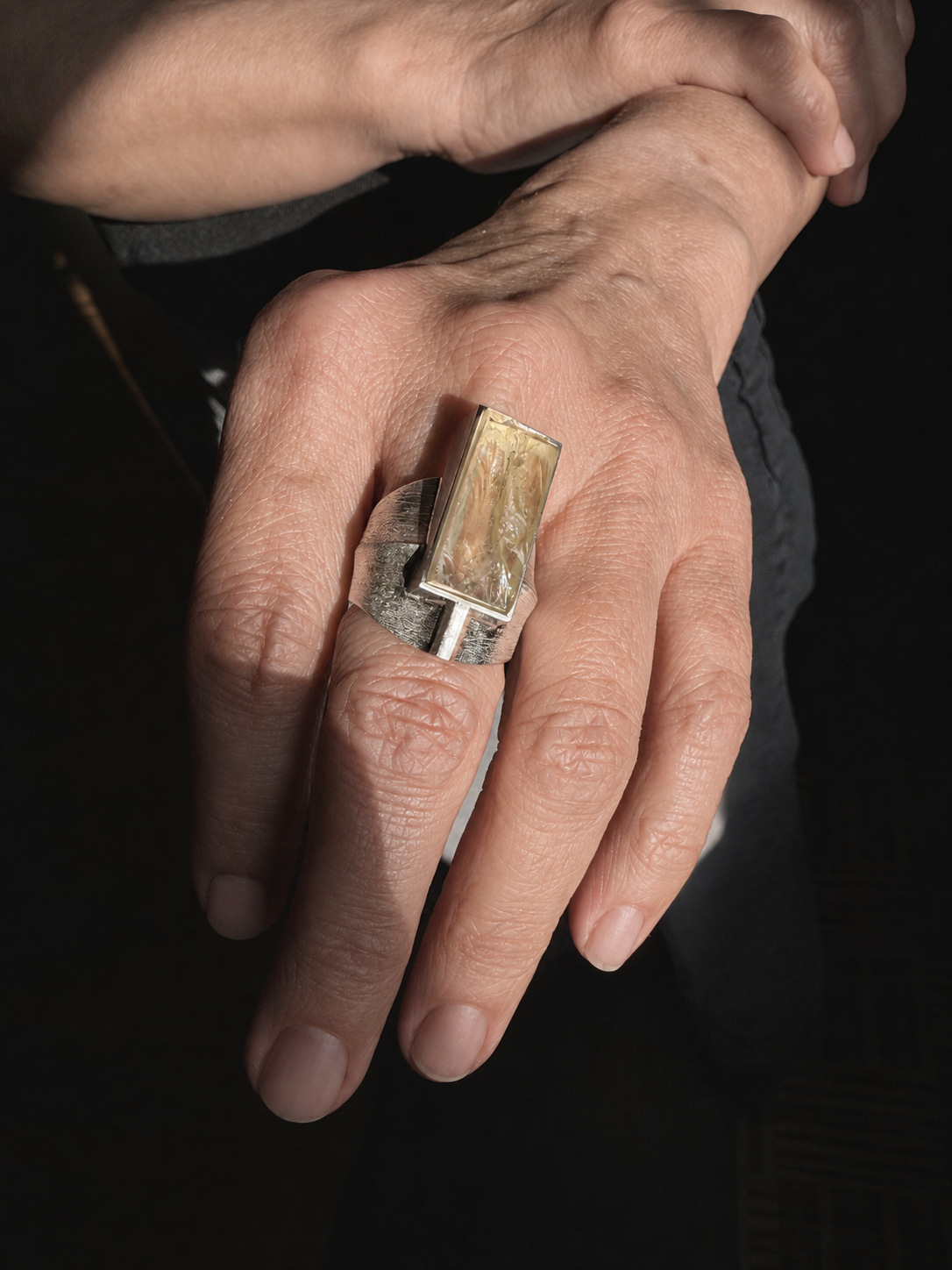
 Raw CitrineSterling silver · natural citrine · matte shimmering surface
NP STUDIO / JOURNAL / EARRINGS
Huggie vs Hoop Earrings: What’s the Difference?
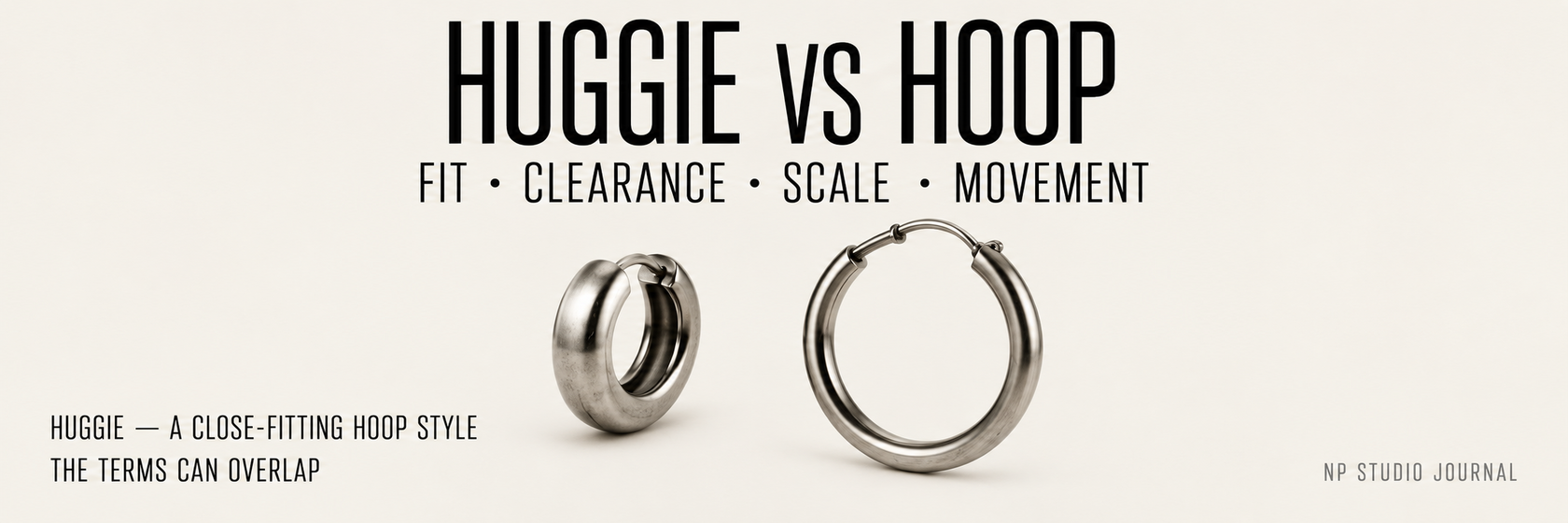
Huggies and hoops share the same ring-like logic, but “huggie” is commonly used for a more compact hoop that sits close to the earlobe with limited visible clearance. Hoop is the broader category and covers a much wider range of scale and fit.
Direct answer
A huggie is commonly used for a compact, close-fitting hoop style: it forms a small arc or ring and sits close to the earlobe. Hoop is the broader category and can include much larger designs with more visible space below the lobe. There is no universal millimeter cutoff; actual clearance, relative diameter, movement and fit are more useful than one fixed number.
These are real NP Studio works. They are not examples of huggie or hoop earrings; they introduce the studio’s visual language through form, surface, scale and construction.
Raw CitrineSterling silver · natural citrine · matte shimmering surface 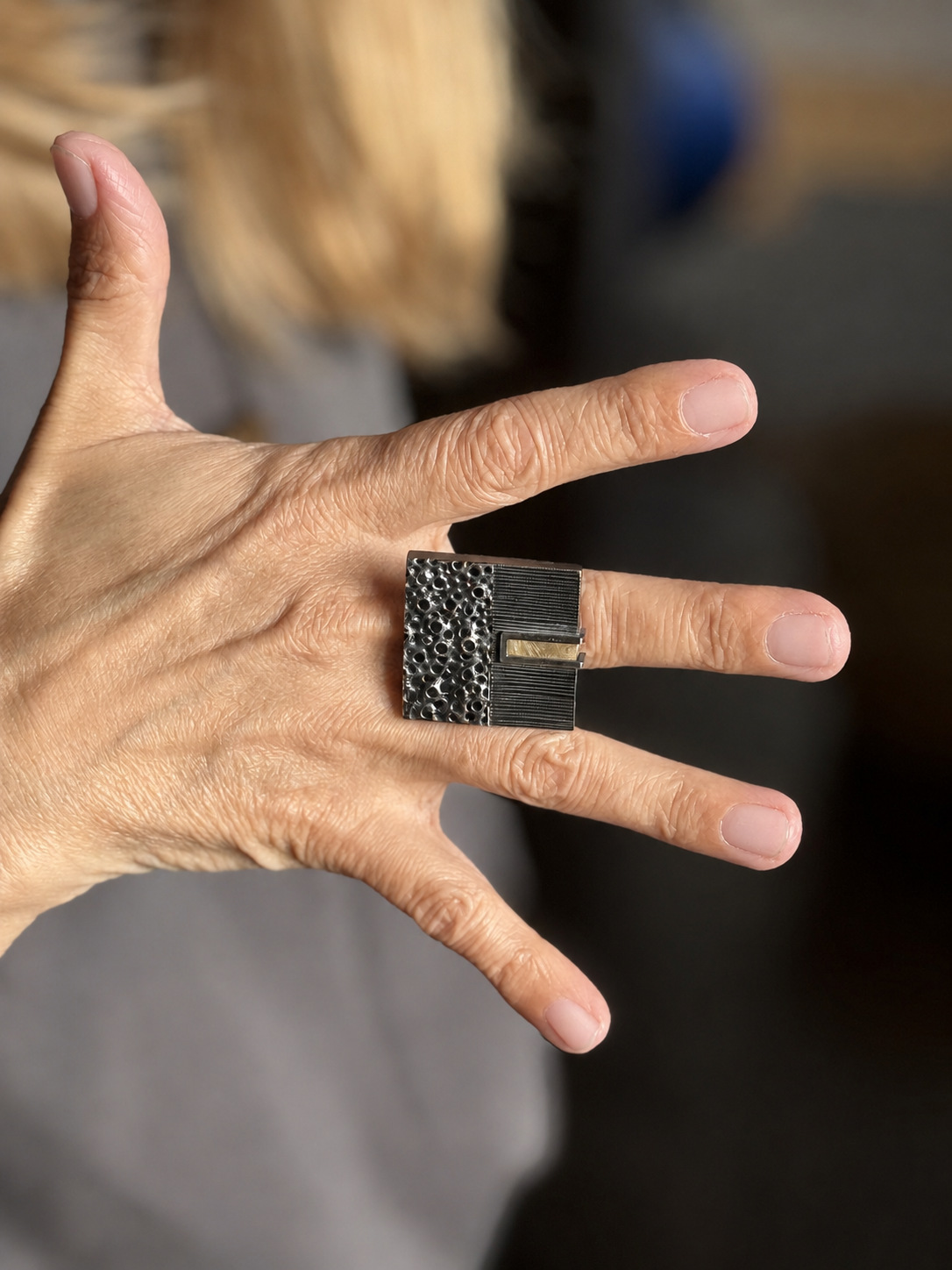 Picture Ring 1Sterling silver · rutile quartz · rectangular composition
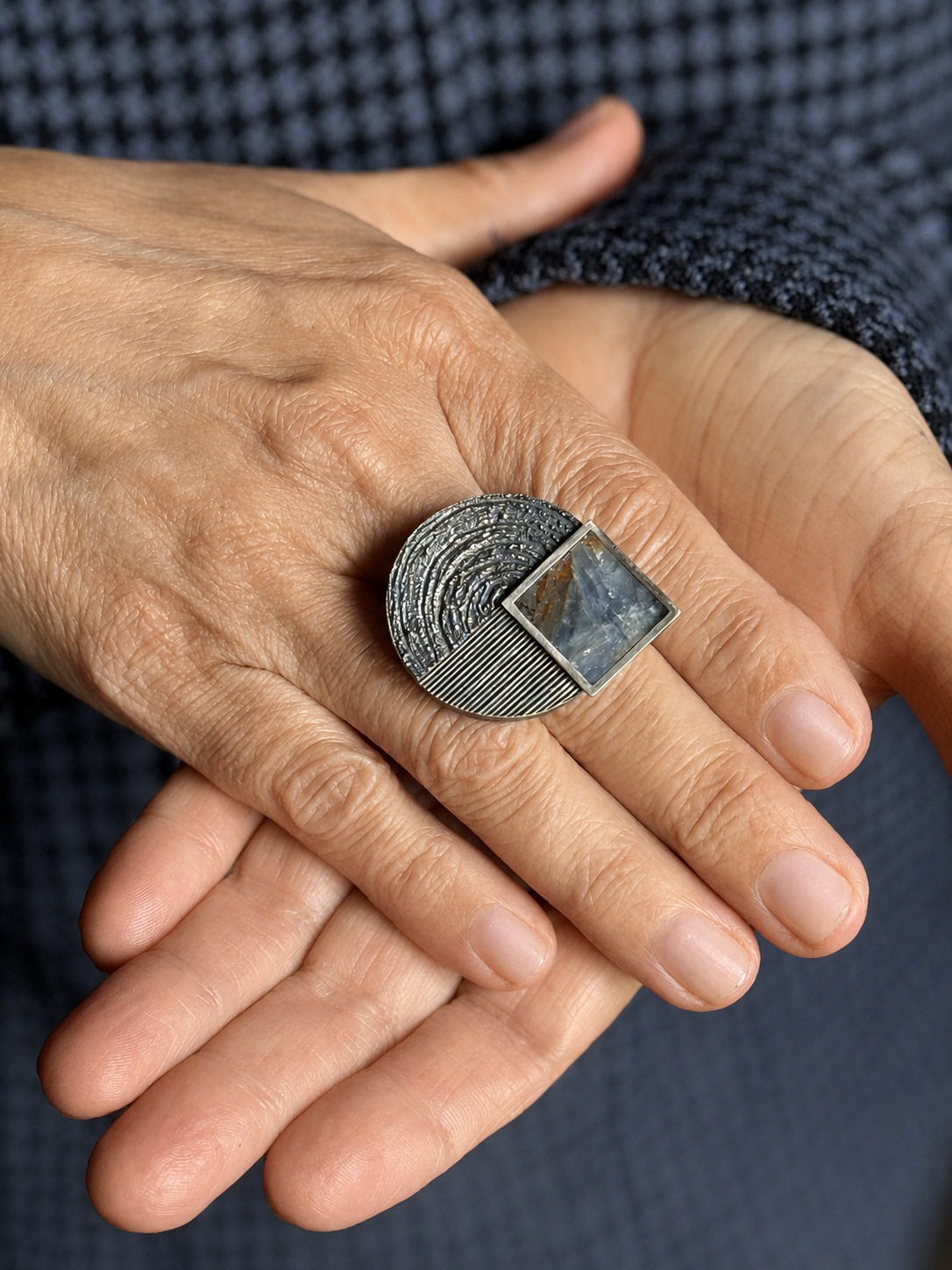 Picture Ring with KyaniteSterling silver · kyanite · fire-textured lava-like surface
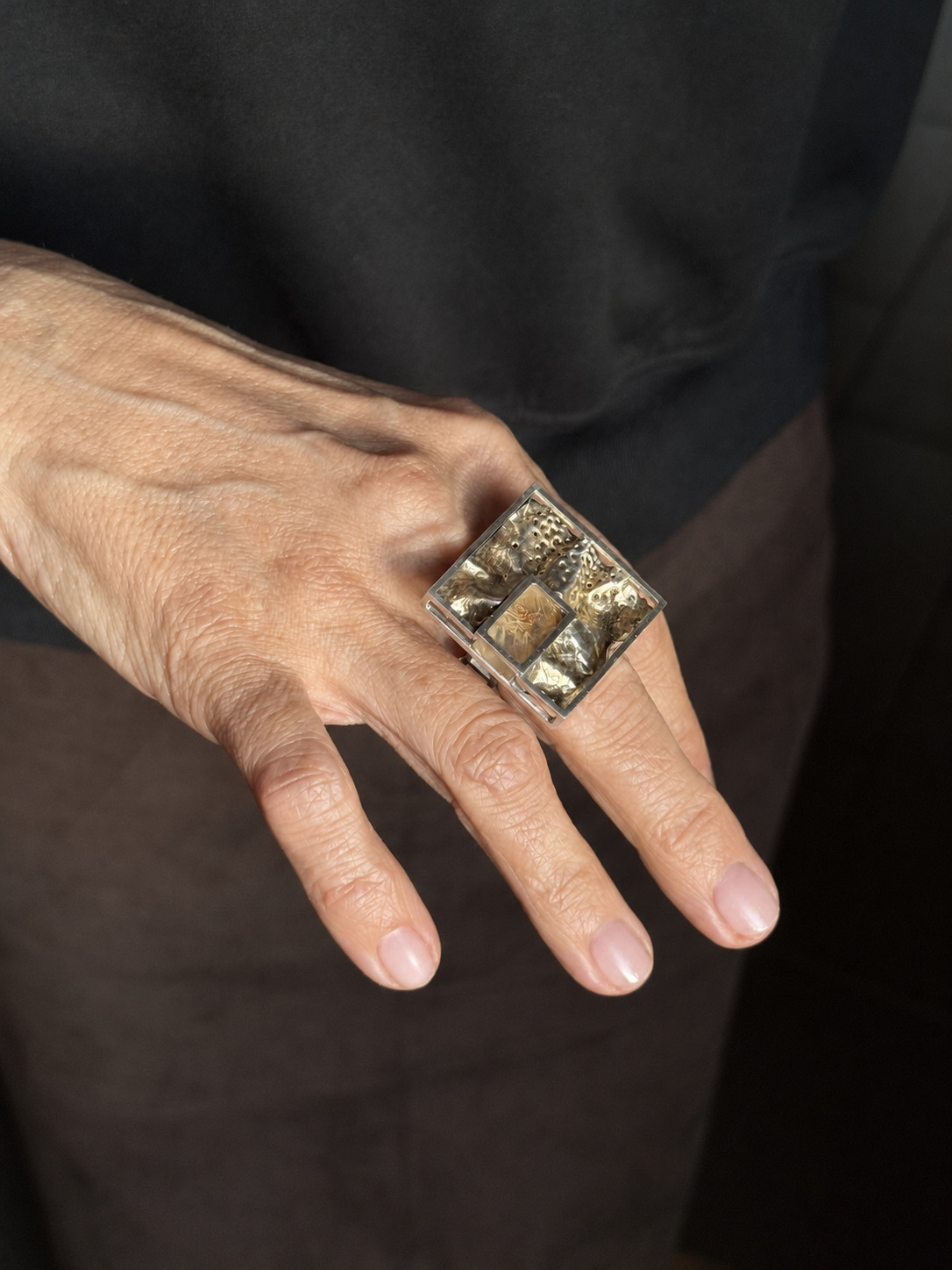 Golden Four SectorsSterling silver · rutile quartz · architectural frame and texture
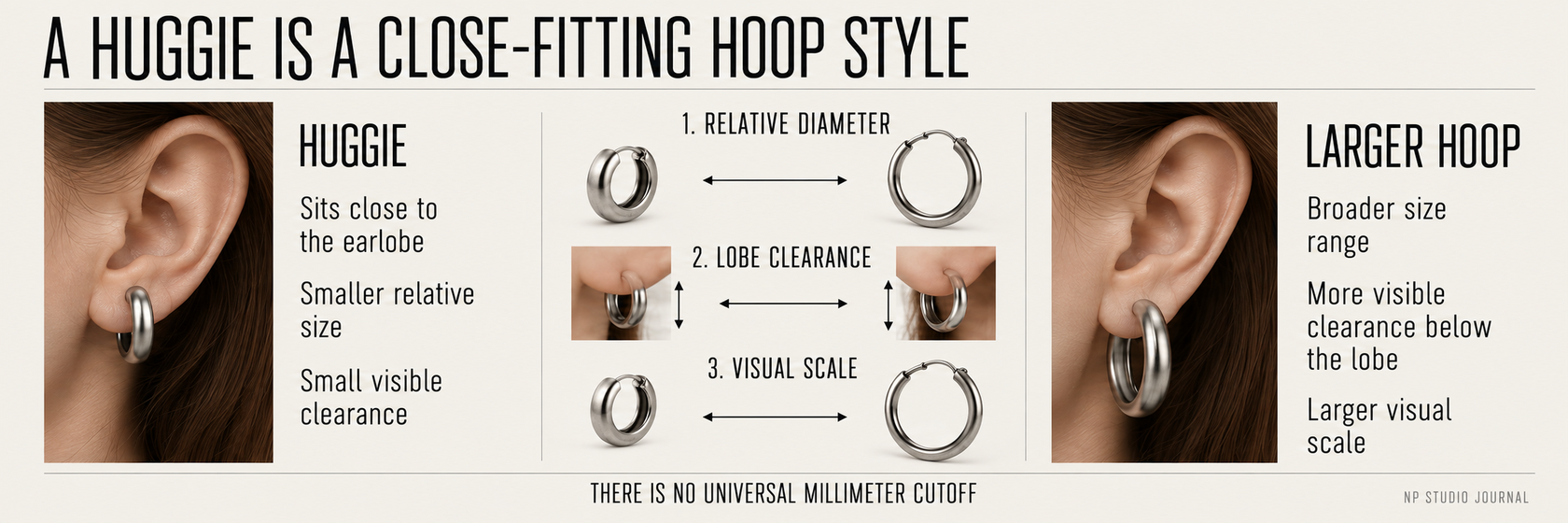
In short: a huggie is a close-fitting hoop style
In common jewelry and retail usage, a huggie usually means a compact hoop that sits close to the earlobe. It is a useful description of relative fit rather than a statutory category with one fixed size definition.
That is why it makes sense to understand a huggie as a close-fitting style inside the broader hoop family: the ring-like geometry remains, but visible clearance and scale are usually reduced.
What is a hoop earring?
Hoop is a broad family of earrings with ring-like or near-ring geometry. The size can range from very compact to very large, and the form does not have to be a perfect circle.
HOOP ≠ PERFECT CIRCLE. Oval or geometric ring-like forms can still function as hoops when the overall construction remains recognizably hoop-based.
For the broader taxonomy, see Types of Earrings: Studs, Hoops, Huggies, Drops and More. For related comparisons, see Drop vs Dangle Earrings: What’s the Difference? and Stud Earrings: Design, Fit and Construction.
What is a huggie?
A huggie is not simply “the smallest earring,” and it does not have to be minimal. The more useful feature is relative close-fitting geometry: it hugs the lobe more closely than a freer hoop does.
That is why one fixed millimeter number does not work as a universal boundary. The same nominal size can create different clearance on different ears, depending on lobe thickness and actual product geometry.
The clearest practical difference: lobe clearance
Usually limited visible clearance and a sense that the ring is closely organized around the lobe.
A broader fit range, from almost close-fitting to clearly open space below the lobe.
This is a relative comparison. A product photo alone may not tell you the category reliably unless scale and actual on-ear fit are also visible.
Diameter and visual scale
Diameter is useful when the seller provides real measurements, but it is important to know what was measured: inner diameter, outer dimension or simply a generic size label.
A smaller outer diameter often correlates with close-fitting geometry, but SMALL HOOP ≠ AUTOMATICALLY HUGGIE. If the visible clearance is larger, the piece may behave visually like a small conventional hoop.
Movement
Larger hoops often show more visible movement because more of the form projects away from the lobe. But this is not guaranteed.
Movement depends on mass, section thickness, hoop geometry, balance and attachment. A compact huggie often reads as calmer, but the word “huggie” itself is not a technical guarantee of low movement.
Closure does not define the category
CLOSURE ≠ CATEGORY. Click, hinge, latch or another fastening mechanism is a separate property. Similar closure systems can appear on both close-fitting huggies and larger hoops.
To distinguish the categories, start with relative fit, clearance and scale; treat the closure as an additional construction detail.
Weight and comfort
A huggie is not automatically lighter or more comfortable than a larger hoop. A compact earring can still be thick, solid, gemstone-set or visually heavy.
Actual comfort depends on weight per earring, section thickness, balance, finish, attachment and ear anatomy. Category size is not a substitute for the real specifications of a particular piece.
Can a huggie be chunky or gemstone-set?
Yes. Huggie describes close-to-lobe hoop logic rather than minimalism. A huggie can be smooth, wide, sculptural, textured or set with gemstones.
The same applies to style: “huggie” tells you something about fit, but very little about the artistic language of the object.
What to check before buying
- Inner clearance or inner diameter. If provided, it can be more useful than a generic size label.
- Outer dimensions. These help establish visual scale.
- Weight per earring. When available, this is more useful than assuming “small = light.”
- Actual on-ear clearance. On-ear imagery can show the relative fit.
- Material. This is a separate product property rather than the definition of huggie or hoop.
- Closure type. Important for use, but separate from category.
- What the measurement refers to. Check whether the seller means inner space, outer diameter or total height.

Huggie vs hoop comparison
| Feature | Huggie | Hoop |
|---|---|---|
| Fit near the lobe | Usually close-fitting and visually organized around the lobe. | Broader range from close-fitting to clearly open. |
| Relative diameter | Commonly more compact relative to the lobe. | Can be compact, medium or very large. |
| Clearance | Usually smaller and less visible. | Can be substantially larger. |
| Movement | Often visually calmer, but not always. | Larger designs often move more visibly, depending on construction. |
| Visual scale | Closer to the outline of the lobe. | Ranges from compact to statement-scale. |
| Closure | Does not define the category. | Does not define the category. |
Key point: there is no universal millimeter cutoff between a huggie and a hoop.
NP Studio: category is only the starting point
A type name describes basic construction, but an individual object is shaped further by metal thickness, scale, surface, proportion, texture and the way the form meets the body.
At NP Studio, these decisions are what turn a familiar structural idea into an author-made piece. The same ring-like logic can feel completely different in bright or patinated silver, with a rough surface, strict geometry or a more organic line.
Related Journal
FAQ
1. Are huggies a type of hoop earring?
In common market usage, a huggie is usually treated as a compact, close-fitting hoop style. Hoop is the broader ring-like family.
2. What is the difference between a huggie and a small hoop?
The useful difference is not size alone but close-to-lobe fit and limited visible clearance. A small hoop can still leave more space and behave visually like a conventional hoop.
3. Is there an exact diameter cutoff between huggies and hoops?
No universal millimeter cutoff works across all brands. Actual lobe clearance, relative diameter and fit are more useful than one fixed number.
4. Do huggies always sit flush against the lobe?
They usually sit close, but they do not have to touch the lobe around the entire curve. Ear anatomy, diameter and product geometry all affect clearance.
5. Does the closure determine whether an earring is a huggie or hoop?
No. CLOSURE ≠ CATEGORY. Click, hinge or latch mechanisms can appear across hoop variants; the category is driven more by fit and overall geometry.
6. Are hoop earrings always perfectly round?
No. Hoop is a broad ring-like family and can include circular, oval or geometric forms. HOOP ≠ PERFECT CIRCLE.
7. Which usually moves more: a huggie or a larger hoop?
Larger hoops often show more visible movement, but that is not guaranteed. Mass, geometry and attachment all affect movement.
8. Are huggies always lighter than regular hoops?
No. Compact diameter does not guarantee low weight. Section thickness, metal, gemstones and overall mass can make a huggie relatively heavy.
9. Can a huggie be chunky or gemstone-set?
Yes. A close-fitting hoop can be thick, sculptural or gemstone-set. Huggie describes relative fit and hoop logic, not minimalism.
10. What measurements and details should you check before buying huggies?
Check inner clearance or inner diameter if provided, outer dimensions, weight per earring, actual on-ear clearance, material and closure as a separate property.
NP STUDIO / SELECTED WORKS
Two more real studio works
These are not examples of huggie or hoop earrings. They are two more real NP Studio works shown after the comparison to return the page to the studio’s visual language.
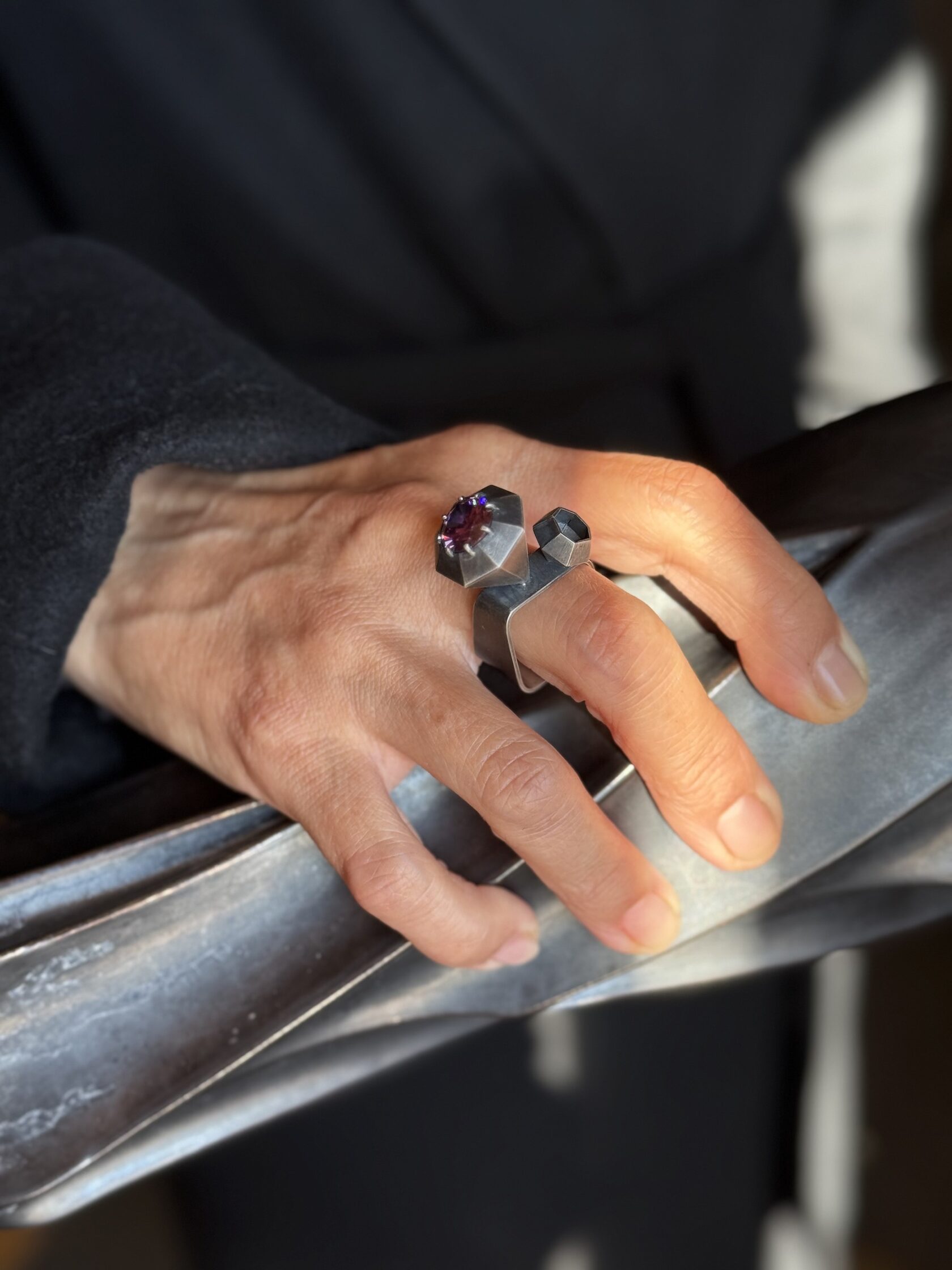
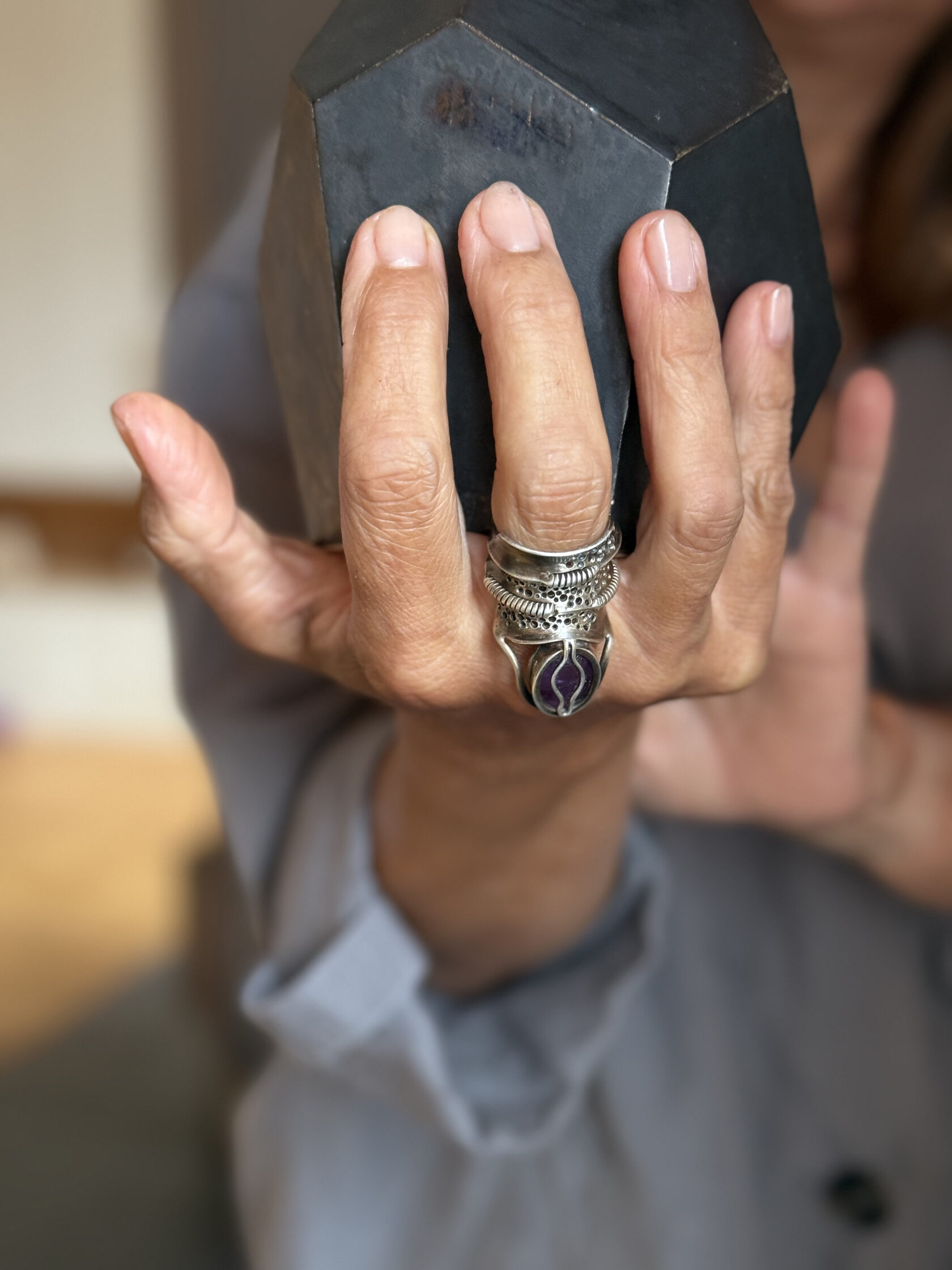
NEXT / WORKS
Explore Works
The archive shows different surfaces, stones, scales and ways NP Studio works with sterling silver.
View WorksNEXT / CUSTOM
Discuss a custom piece
If you have a specific idea, reference or desired character of form, a short description is enough to start the conversation.
Discuss Custom