Silhouette and mass
Elongated, broad, tall or compact. This is the overall gesture before details.

NP STUDIO / JOURNAL / CUSTOM RING PRE-ORDER
You do not need to design a custom ring down to the last line before contacting a jeweler. A better starting point is direction: what you respond to in a reference, how the ring will be worn, which parameters really matter, and whether you are comfortable with a handmade piece becoming a new independent version rather than a mechanical copy.
Before ordering a custom ring, define the boundaries of the project rather than trying to design every detail yourself: what you like in the reference, how the ring will be worn, and how important the stone, size, budget and timing are. Handmade work develops through the making process, so a good commission starts with direction and realistic expectations rather than a demand for an exact copy.
A client does not need to do the jeweler's design work before the first message. A sketch can be useful when the idea is already clear, but it is not required. NP Studio's Custom Work page allows a project to begin with an earlier work, a stone, a form, a mood, a collection or a single detail.
“I do not have a finished design” is not the same as “I do not know what I want.” You may already know that the ring should feel dark rather than bright, compact rather than projecting, architectural rather than soft, or that a particular stone must be central. That is enough to establish direction.
The less you try to solve technical construction in advance, the more room the maker has to respond to material and proportion. Internal structure, assembly and secondary dimensions are usually better resolved after priorities are clear.
Do not design the ring for the jeweler. Explain what must matter in the finished piece.
“I want something like this” is broad, but it can become useful very quickly. Look at the reference and separate the impression into qualities. You may not want the whole ring at all; you may be responding to the mass, stone position, dark surface, asymmetry or architectural line.
This prevents the project from becoming “copy everything.” One or two essential qualities can remain while the rest adapts to a new stone, ring size and way of wearing the piece.
Elongated, broad, tall or compact. This is the overall gesture before details.
Matte, dark, smooth, fire-worked, compressed or linear. Surface can carry much of the character.
Main centre, offset accent, structural part or small colour signal. Mineral name is only one variable.
Symmetry or offset balance, open or closed shank, strict geometry, roughness or restraint.
In handmade work, exact repetition is often neither technically realistic nor especially useful. A new stone has a different shape. A different finger size changes proportions. A surface produced by deformation, heat or hand tools responds differently. Construction may also need to change when height, width or stone placement changes.
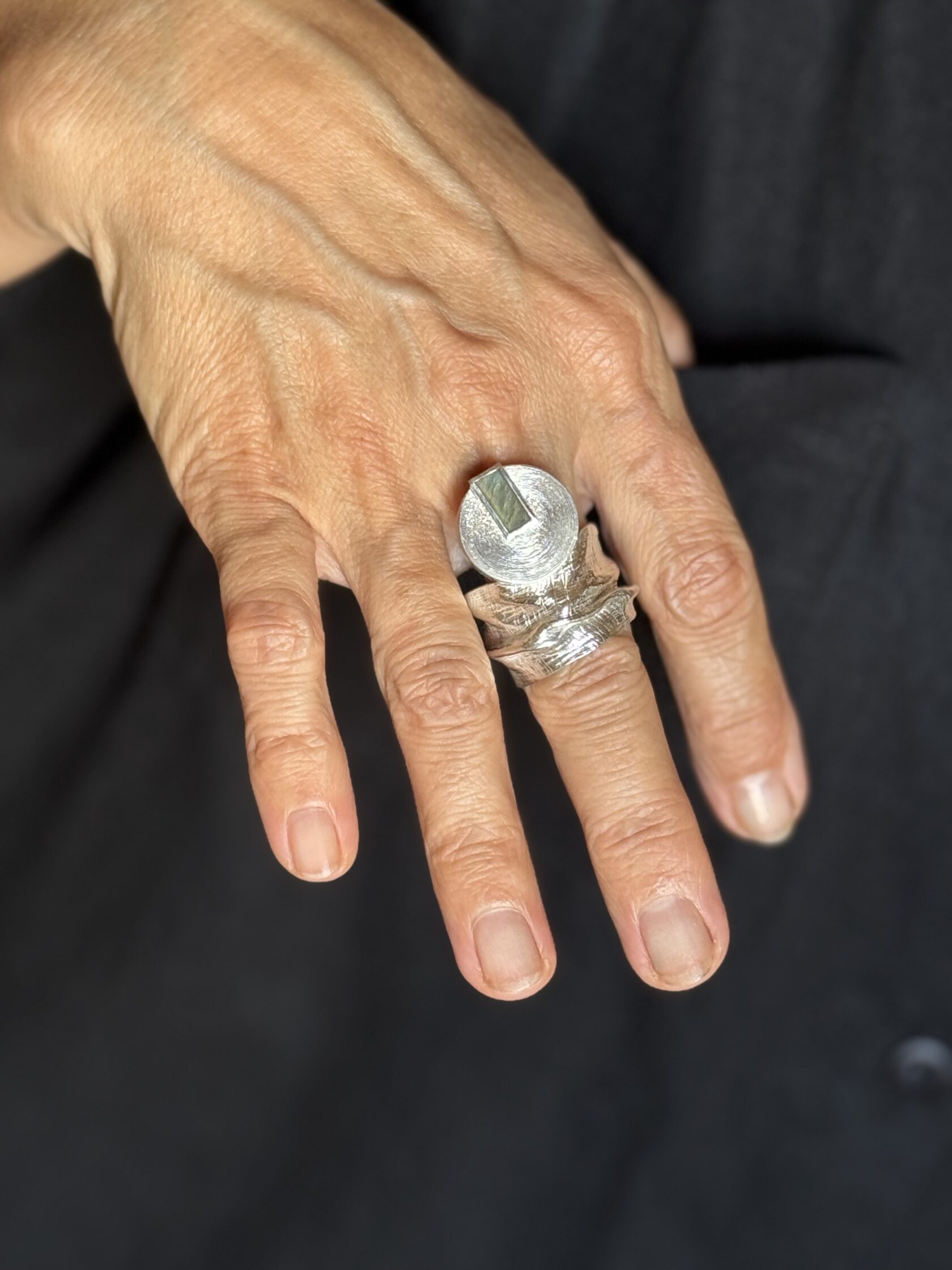
Transparent Geometry makes this visible. Its matte crumpled shank is created through embossing and mechanical compression. The overall character can remain, but the direction of deformation cannot be predicted exactly and the surface pattern differs from version to version.
A better brief describes direction: keep the compressed matte surface, small cylindrical stone accent and tension between simple geometry and deformation, but allow the new piece to form its own pattern. For the broader custom process, see What Is Custom Jewelry and How Does It Work?.
Before ordering, decide whether the ring is expected to be worn frequently or occasionally. This does not dictate style, but it affects how much projection, mass and openness are practical. Someone who works actively with their hands may prefer a more contained form; another wearer may value maximum sculptural presence.
Dominant versus non-dominant hand can matter too. A projecting object may feel different on the hand used constantly for handling things. This is a practical variable, not a fashion rule.
You do not need to choose the construction yourself. It is enough to say whether the ring should be as everyday as possible or whether a taller, more object-like form is acceptable.
Accurate size matters because the ring is built for a real hand. A wide band feels tighter than a narrow one, and a size change can affect not only circumference but proportions of the top, spacing between parts and the balance of the whole object.
An open, closed, flat or half-round shank creates different construction conditions. Size is therefore one of the project parameters, not a number that can always be substituted at the very end without consequences.
Measuring instructions belong elsewhere. Use the separate ring size guide; the important pre-order point is simply that unusual and wide rings make accuracy more important.
No. A commission can start with a specific stone, but it can also begin with colour, transparency, shape, visual character or a reference. You might ask for an elongated pale stone, a dense dark insert or a small offset accent without knowing the mineral name.
If you already own a stone, show it to the jeweler and provide dimensions. If not, leave room for selection: the exact specimen may change scale and composition, especially when its form is natural or irregular.
Gemstone choice deserves its own discussion rather than becoming a long checklist here. See How to Choose a Gemstone for a Custom Ring.
Budget works best as a practical frame rather than pressure on the idea. NP Studio's current Custom Work page asks for a comfortable range because it helps define scale, weight, stone, complexity and realistic scope.
Keeping budget completely unspoken rarely creates more freedom. The maker may develop a direction whose scale later proves unsuitable. A range lets the project be shaped around realistic priorities before too much detail is fixed.
This is not the place for price tables. The separate article How Much Does a Custom Ring Cost? explains the cost drivers.
Handmade work takes time, and the actual schedule depends on construction, stone availability, scope and possible revisions. If the ring is needed for an event, trip or another fixed date, say so at the beginning.
A deadline may constrain choices. A particular stone may need sourcing, a complex construction cannot always be compressed safely, and major changes after approval can extend the timeline. Sometimes the right response to a fixed date is a simpler design or an earlier start.
For the dedicated timing discussion, see How Long Does It Take to Make a Custom Ring?.
This is one of the most useful conversations before work begins. You do not need to freeze every millimetre, but you should separate true priorities from secondary details.
For one client the stone is non-negotiable and the surface can change. For another, the dark texture and elongated composition matter while the mineral is flexible. Clear priorities reduce the chance that “a similar ring” means two different things to client and maker.
Overall dark character, a specific stone, elongated silhouette, no mirror polish, approximate scale or a principle of asymmetry.
Exact line placement, handmade surface pattern, stone orientation, a secondary detail, precise proportions or shank form.
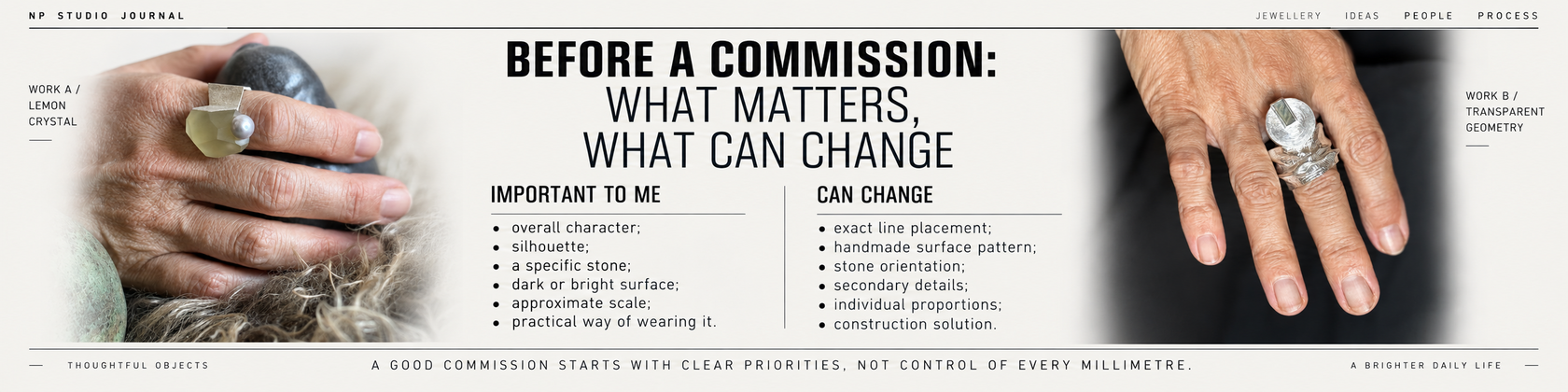
Some decisions emerge during making. That does not mean the process lacks control. The maker first establishes direction and constraints, then makes local decisions within those boundaries.
Material may suggest that one line works better than another. A specific stone may require a slight proportion change. A compressed surface may develop a useful direction that could not have been drawn exactly beforehand. Controlled variation is different from arbitrariness.
Transparent Geometry is again a useful example: compression differs each time, yet the piece is not random. Material, deformation principle, matte surface, cylindrical element and overall structural character remain controlled.
A photograph shows a result but not always which parts can transfer into a new commission. It helps to separate the work into structure, surface, stone and the status of the original piece.
Structure means mass, width, height, top position and shank type. Surface means lines, patina, fire texture, compressed or matte finish. Stone means the specific mineral, shape, placement and scale. Status means prototype, sold piece, or a page that explicitly describes how a related commission can differ.
On NP Studio work pages, the Repeat / Custom Order section is especially useful because it explains what can remain from the original direction and what may change. That is more informative than treating every archival photograph as a promise of exact duplication.
These works show different reasons a new version can change. None is “more custom” than another; the source of variation is simply different.
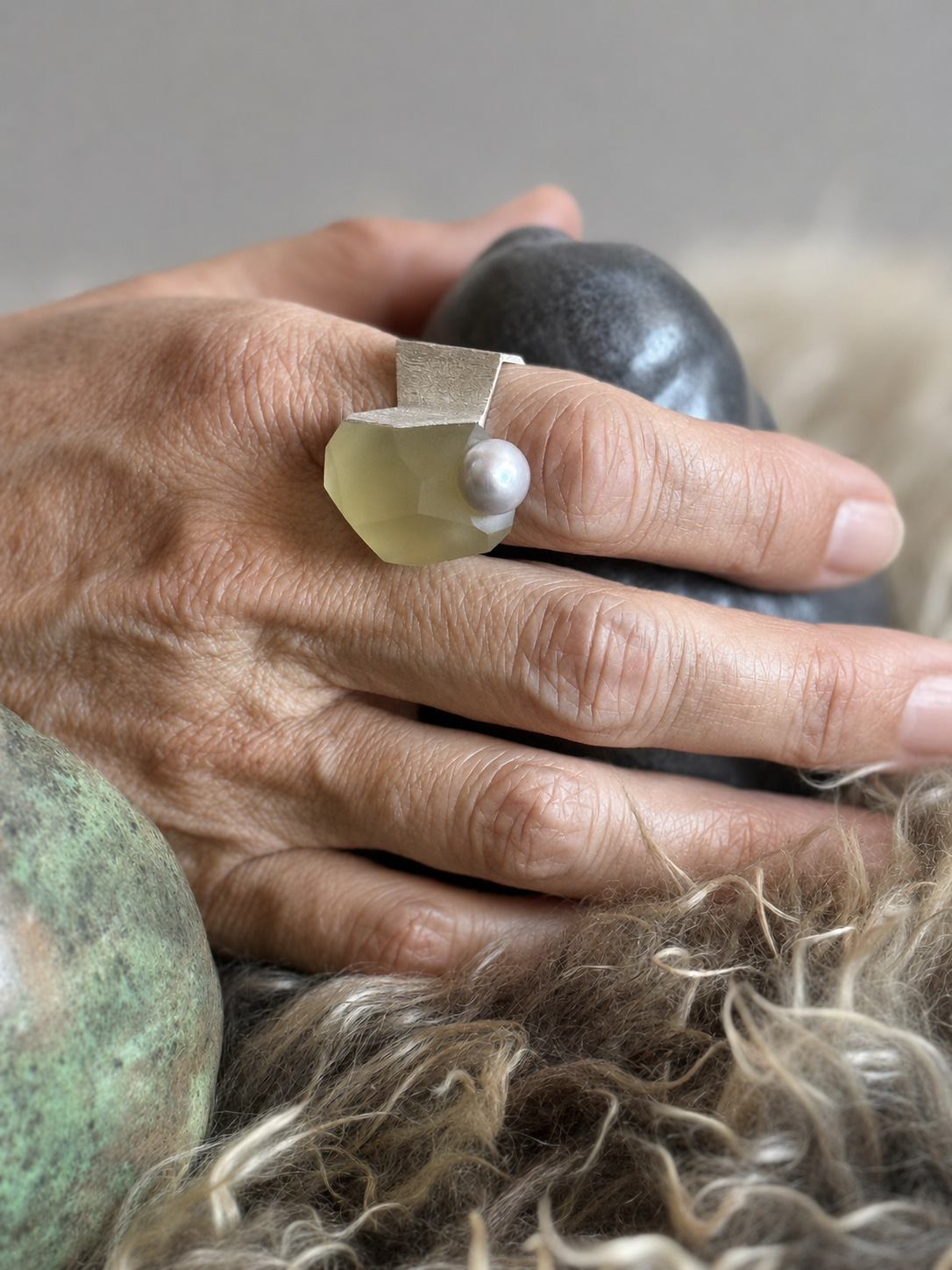
The citrine was cut by hand and has an irregular individual form, so an exact replica is impossible. A related composition can use another citrine or stone, a pearl in another shade or a different balance between elements.
The crumpled matte shank is created through embossing and mechanical compression. The principle can be repeated, but the direction of deformation and exact surface pattern differ each time.
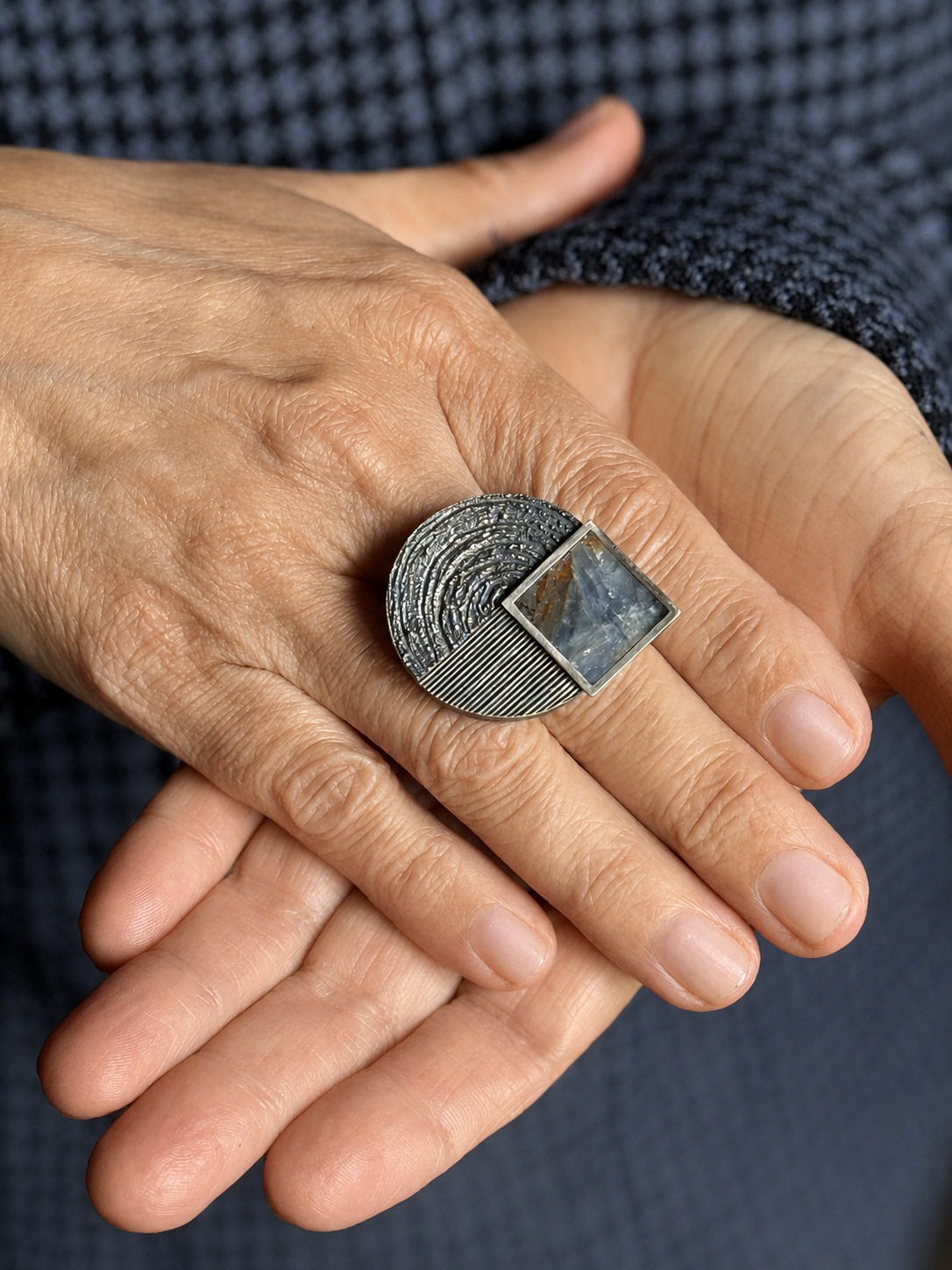
The sold prototype can become a direction: keep a substantial stone, textured surface and picture-like composition while changing stone, size, proportions, elements or shank form.
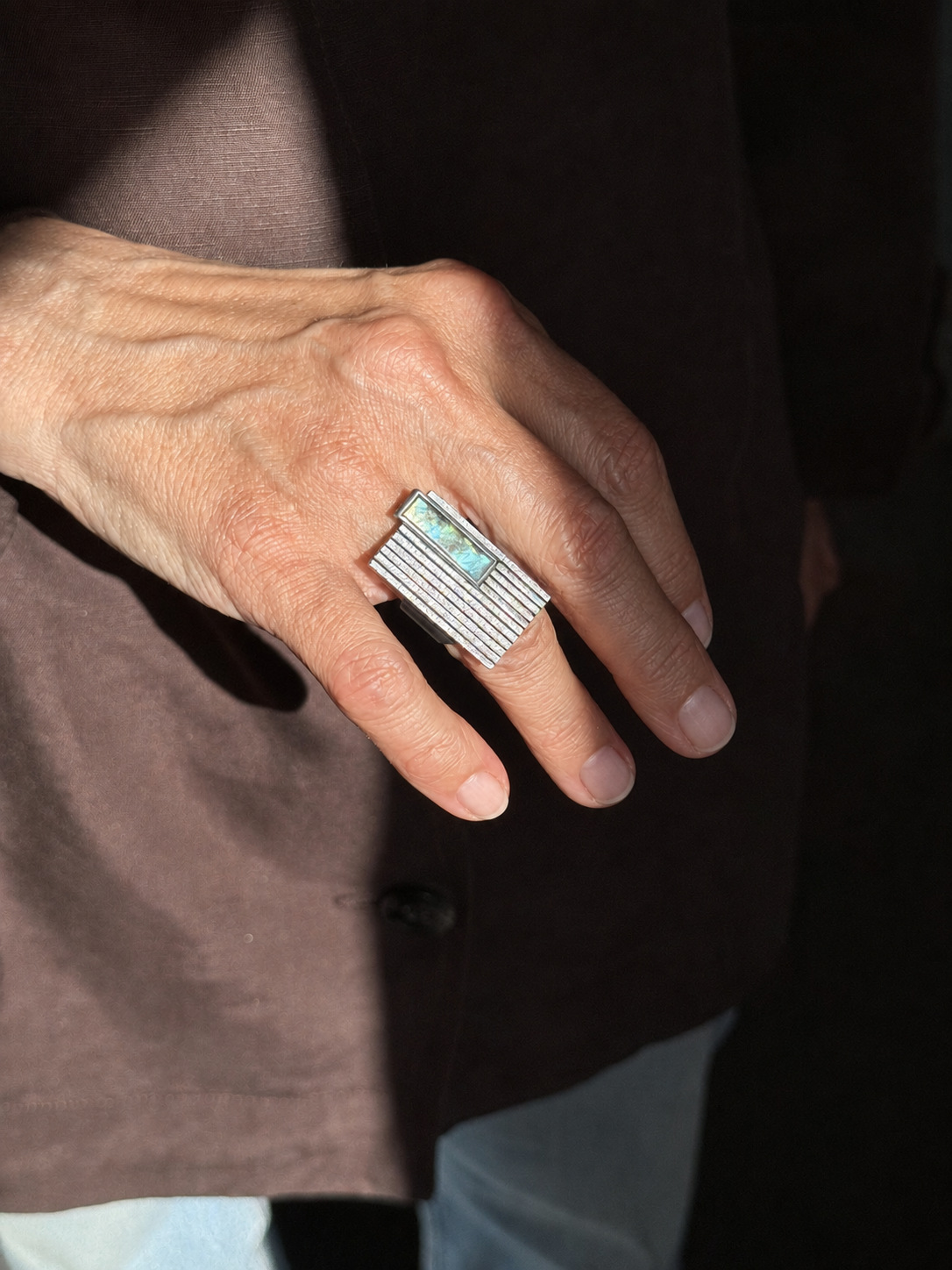
The character comes from rectangular lines, patina and an offset stone. A new version can change proportions, gemstone, strip texture and shank construction while preserving that linear language.

You do not need every line approved before fabrication starts. But client and maker should share the same understanding of the direction, practical limits, approximate scope, non-negotiable elements and realistic amount of variation.
This is not the later detailed information checklist a jeweler may need. The issue here is expectations. If the client expects a copy while the maker understands the task as a related independent piece, the disagreement exists before any metal is cut. If both understand what should remain and what can develop, the commission begins much more clearly.
You do not need to send a multi-page technical brief. One link and a short statement of priority can be enough.
From there, size, budget, timing and the truly fixed elements can be clarified. NP Studio's Custom Work page also states that one link and a short description are enough for the first conversation.
Total freedom and a rigid technical specification are not the only options. You can fix several anchor points and leave secondary decisions to the maker. For example, keep a dark matte surface, an elongated silhouette and an approximate stone scale without approving the position of every line.
This is especially useful when material responds to pressure, heat or hand tools. The project keeps a clear direction without pretending that every physical result can be fully drawn before making begins.
Before ordering a custom ring, it is more useful to define boundaries than to design every detail yourself. What do you respond to in the reference? How will the ring be worn? What cannot change? How important are the exact stone, size, budget and date?
The rest can develop with the maker. A good brief contains enough clarity for expectations to align and enough room for material, stone and hand process to produce a new object instead of mechanically copying an earlier one.
A strong pre-order brief is not a completed blueprint. It is a clear direction, realistic constraints and an understanding that the finished ring will be its own work.
No. A direction is enough: what you like in a reference, the character and scale you want, and which parameters truly matter. A sketch can help, but it is not required.
Yes, a photograph can be used as a reference. It is better to discuss which qualities should remain and which can change in the new independent version.
A new stone, different size, handmade surface and construction requirements can change the result. Some processes also cannot reproduce the exact same texture mechanically.
No. You can begin with colour, transparency, form, visual character or one or two reference works and select the exact stone later.
Accurate size matters, especially for wide or unusual rings. It is better to resolve size before fabrication rather than treat it as a final-stage substitution.
Yes. A comfortable range helps define realistic scale, weight, stone and complexity without forcing every detail to be fixed in advance.
At the beginning. Timing can depend on complexity, stone availability and project changes, so a fixed date should influence the direction from the start.
Say exactly that. A surface, stone placement, line, proportion or overall mood can be enough to start a new commission.
