POPULAR ≠ MOST DURABLE
Popularity does not make a gemstone the most durable option for your specific ring and wear pattern.
NP STUDIO / JOURNAL / GEMSTONES / EVERYDAY RING
If a ring is going to be worn frequently, the decision should not be based on one Mohs number. Gemstone durability depends on a combination of hardness, toughness and stability. Cleavage, stone shape, setting, ring profile and the wearer’s lifestyle also matter.
The best gemstones for everyday rings generally combine adequate hardness with good toughness and stability under normal wear. Mohs hardness alone is not enough: cleavage, stone shape, setting, profile and the wearer’s actual habits also affect how well a stone performs in a ring.
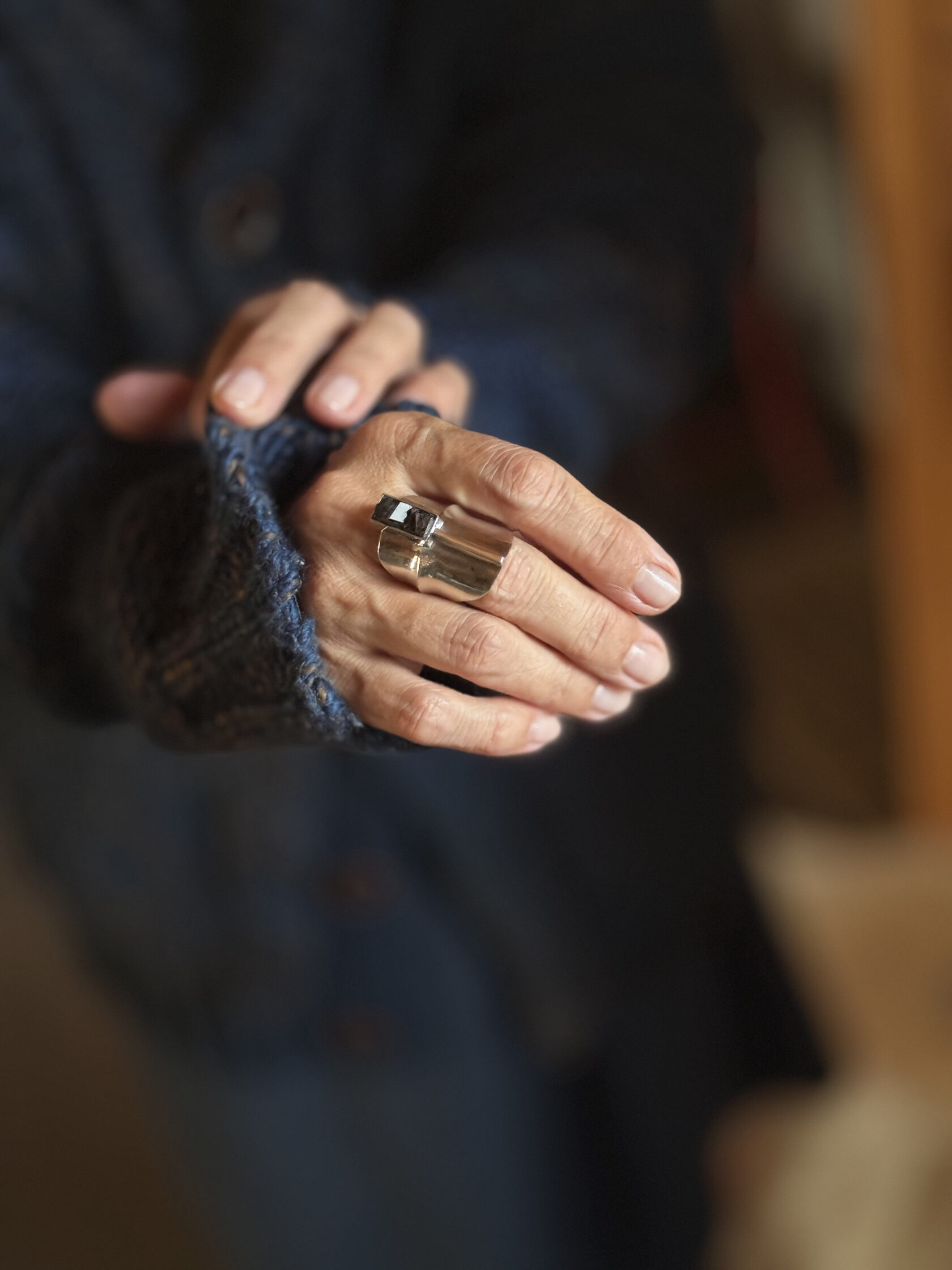
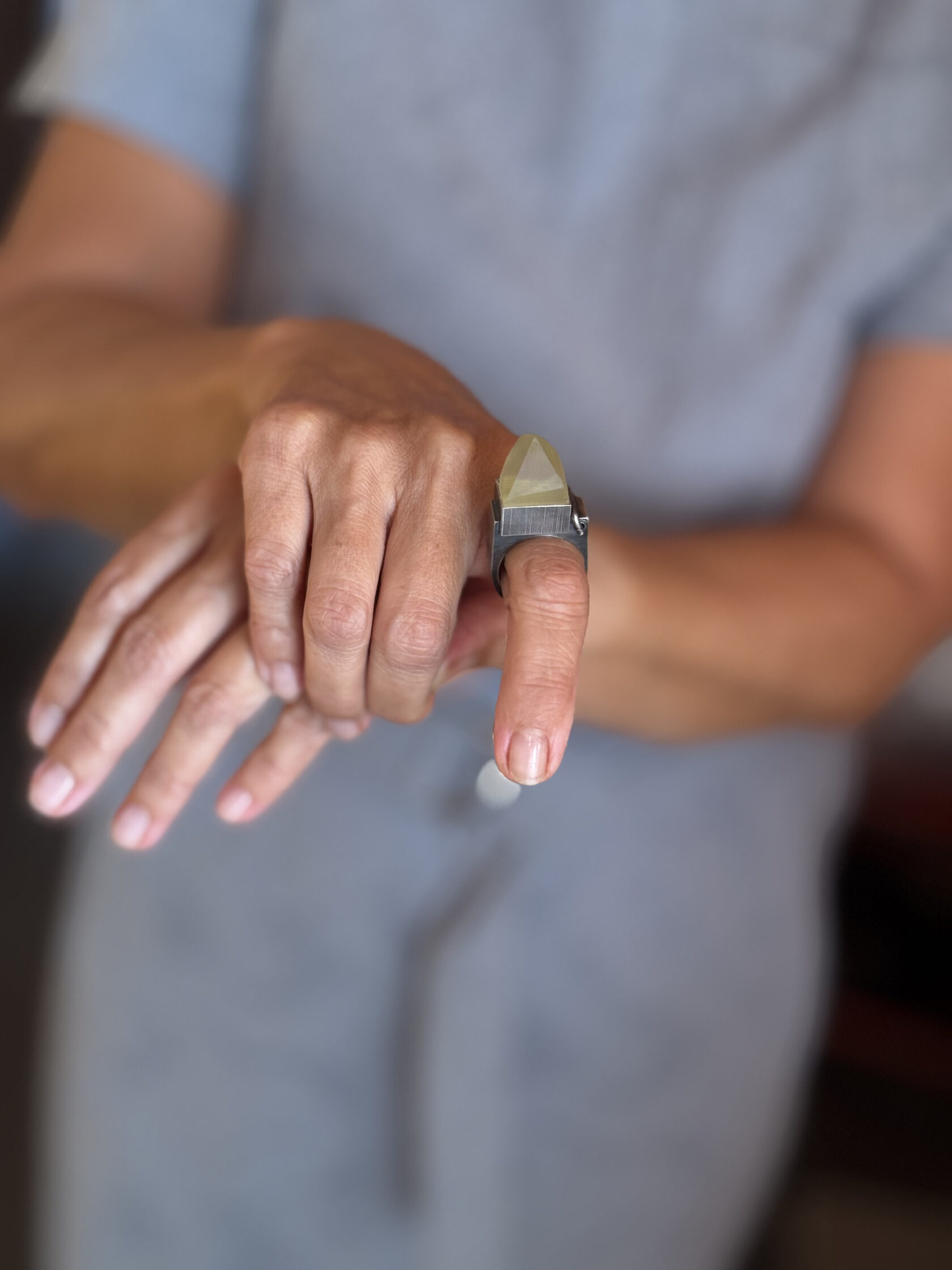
Office wear, city life, sports, household work, manual tasks and workshop use create very different exposure. Water, cosmetics, chemicals and the habit of never removing a ring also change the real durability question.
EVERYDAY WEAR ≠ SAME ACTIVITY LEVEL FOR EVERY PERSON. The useful question is not only “is this gemstone suitable for an everyday ring?” but “is it suitable for the way I actually wear rings?”.
LIFESTYLE MATTERS. If you remove a ring for sports, gardening or rough manual work, more gemstones become realistic options. If you plan to wear it almost continuously, stone properties, profile and setting matter more.
There is no single perfect gemstone for everyone. There are better or worse matches between a specific stone, a specific design and a specific wearer.
Hardness is resistance to scratching and abrasion. Toughness is resistance to breaking, chipping and impact damage. Stability is resistance to heat, light, chemicals and environmental exposure. Cleavage describes structural directions along which a mineral may split more readily.
HARDNESS ≠ TOUGHNESS ≠ STABILITY. These are different properties. Cleavage matters, but CLEAVAGE ≠ STABILITY: it does not replace stability in the durability model.
HIGHER MOHS ≠ AUTOMATICALLY BETTER RING STONE. High hardness helps against scratching, but it does not automatically guarantee resistance to impact, temperature or chemicals. For a focused comparison, see Gemstone Hardness for Rings: Hardness vs Toughness vs Cleavage.

Popularity does not make a gemstone the most durable option for your specific ring and wear pattern.
A softer gemstone can still work when design and wear habits respect its limits.
Protective metal can reduce edge exposure, but it cannot change the gemstone’s physical properties.
Species and variety are only the beginning. The condition of the individual stone matters too: inclusions, fractures, treatments, thickness, girdle, shape, corners, ring height, profile and setting can all change practical wear.
SETTING MATTERS. STONE SHAPE MATTERS. Neither can be separated from the wearer’s lifestyle.
This is not a winner ranking. The table compares combinations of properties and the context in which a stone often works well for frequent wear.
| Stone / group | Hardness | Toughness / cleavage | Stability | Everyday-wear context | Design notes |
|---|---|---|---|---|---|
| Diamond | 10 Mohs | High overall toughness, but chips and cleavage-related damage remain possible | Very high in normal wear; extreme heat still deserves caution | Often well suited to daily wear, but never indestructible | Pay attention to exposed corners, cut shape and height |
| Ruby / sapphire | 9 Mohs | Excellent toughness, no cleavage | Stable under normal wear and resistant to heat, light and common chemicals | Among the calmest frequent-wear choices | Corundum can still chip under an unlucky hard blow |
| Spinel | 8 Mohs | Good toughness | Stable to light and chemicals; high heat can fade some colors | Often a strong ring choice | Specific stone condition and corner exposure still matter |
| Chrysoberyl / alexandrite | About 8.5 Mohs | Excellent toughness, no cleavage | Stable under normal wearing conditions | A strong candidate for everyday rings | Evaluate the individual stone, not just the species name |
| Quartz / amethyst | 7 Mohs | Good toughness | Sudden temperature changes can cause fracture; intense light can fade some amethyst color and certain chemicals can damage it | Can work well for frequent wear with reasonable care | Lower profile and realistic expectations about scratching help |
| Garnet | Usually about 6.5–7.5 Mohs depending on variety | Fair to good toughness; varies across the garnet group | Generally stable to light and chemicals | Many garnets work well in rings with normal care | Do not transfer conclusions from one garnet variety to all others |

These are not “bad ring stones.” They simply ask for more deliberate design, care and wear expectations.
| Stone / group | Hardness | Toughness / cleavage | Stability | Everyday-wear context | Design notes |
|---|---|---|---|---|---|
| Opal | About 5–6.5 Mohs | Very poor to fair toughness | High heat and sudden temperature changes can cause crazing or fracture; some chemicals are harmful | Wearable in rings, but with more care | Lower profile and reduced exposure are usually more practical |
| Turquoise | About 5–6 Mohs | Fair to good toughness | High heat can discolor or damage the surface; chemicals, cosmetics, skin oils and perspiration can also affect color | Possible for frequent wear, but requires more attention | Protective geometry and careful contact with the environment matter |
| Labradorite | About 6–6.5 Mohs | Pronounced / perfect cleavage | Not especially heat sensitive in general, but treatments and individual condition still affect care | Labradorite can be used in rings, but active everyday wear requires more consideration than with more durable stones | Protected edges, lower profile and realistic wear expectations are particularly important |
| Kyanite | Hardness varies significantly by direction | Perfect cleavage, brittle | Heat can affect the color of some stones; included stones need careful cleaning | Possible in rings, but usually better with protective design and considered wear | Avoid unnecessary corner exposure and mechanical stress |
SOFTER STONE ≠ IMPOSSIBLE FOR A RING. The question is not prohibition; it is whether the design and wear pattern match the stone.
Sharp corners, elongated points, thin edges and high profiles usually increase accidental-impact risk. Cabochons often have fewer exposed vulnerable points than sharp faceted outlines, but CABOCHON ≠ AUTOMATICALLY SAFER: thickness, height and placement still matter.
A bezel, metal rim and low profile can reduce edge and corner exposure. But PROTECTIVE SETTING ≠ INDESTRUCTIBLE STONE.
For the trade-off between protection and openness, see Bezel vs Prong Setting.
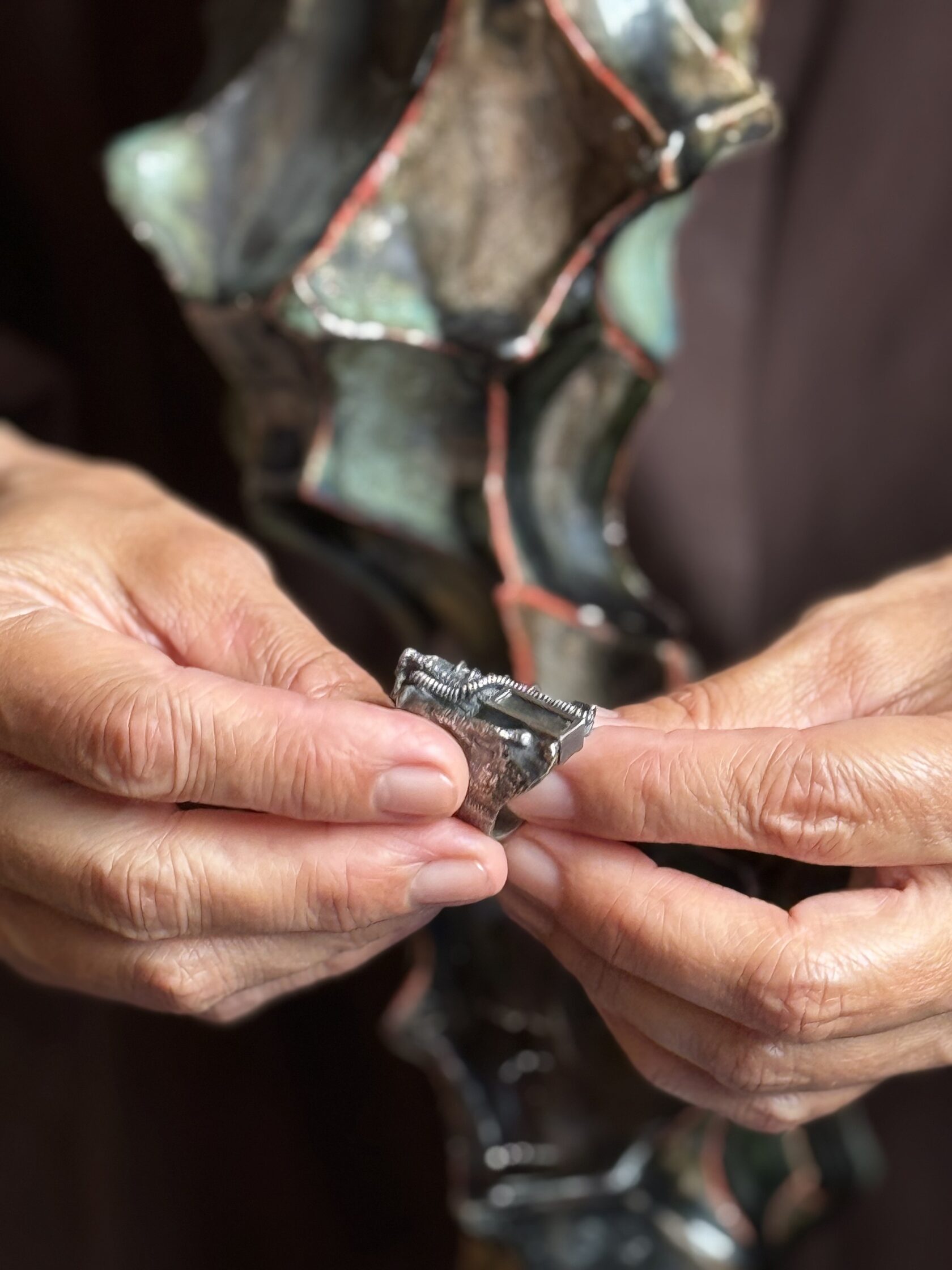
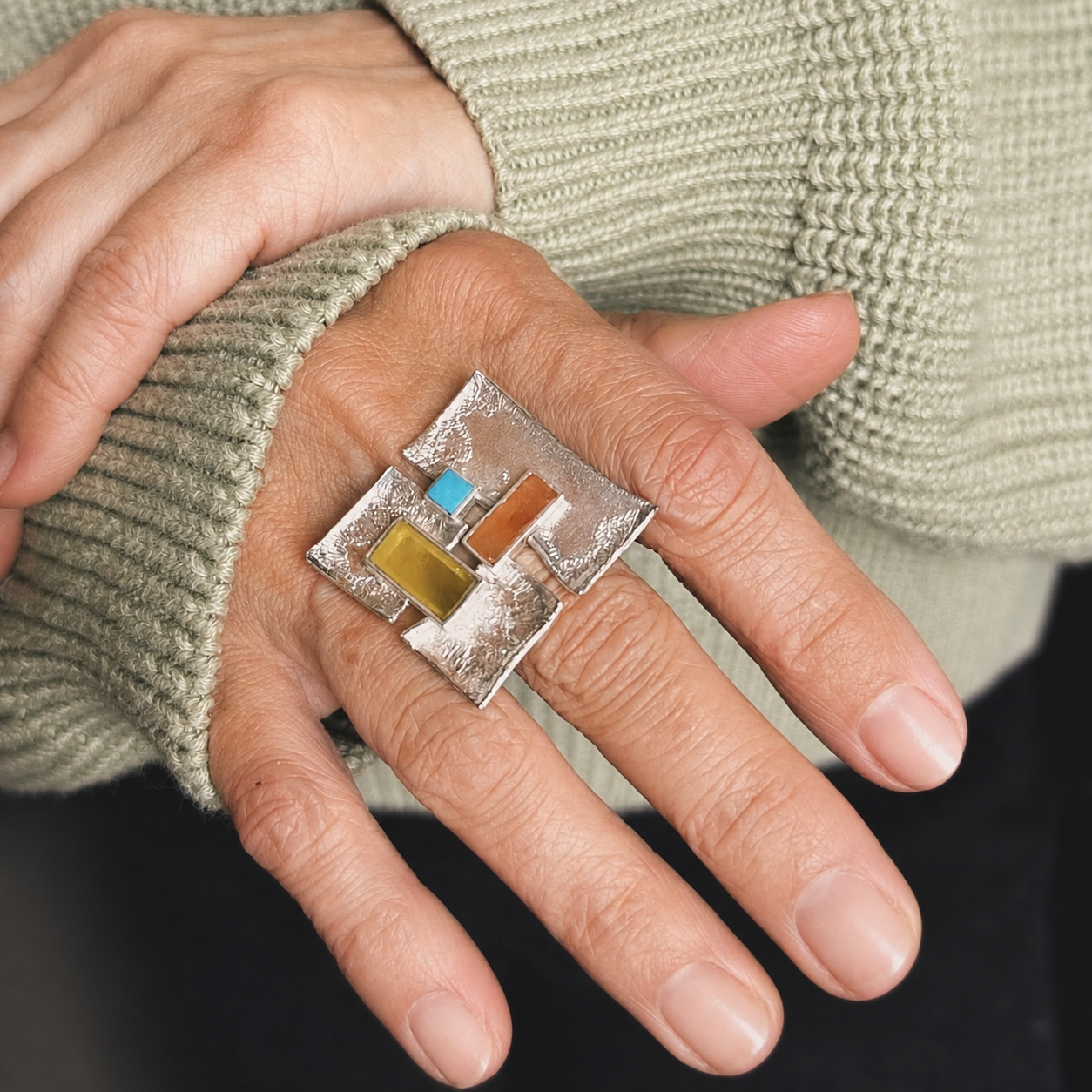
These real works illustrate construction and exposure. They do not allow mineral durability of a particular stone to be inferred from photography alone.
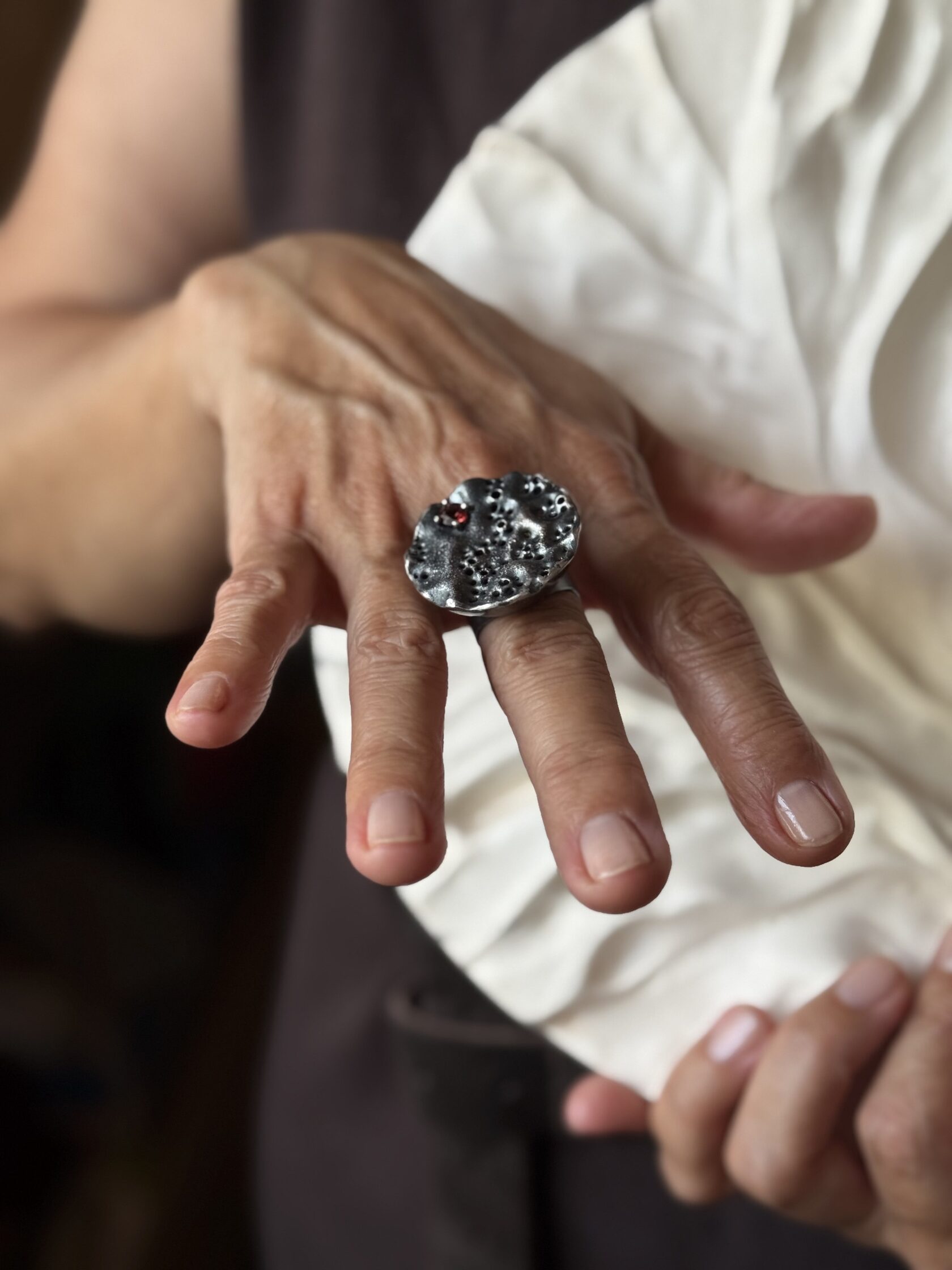
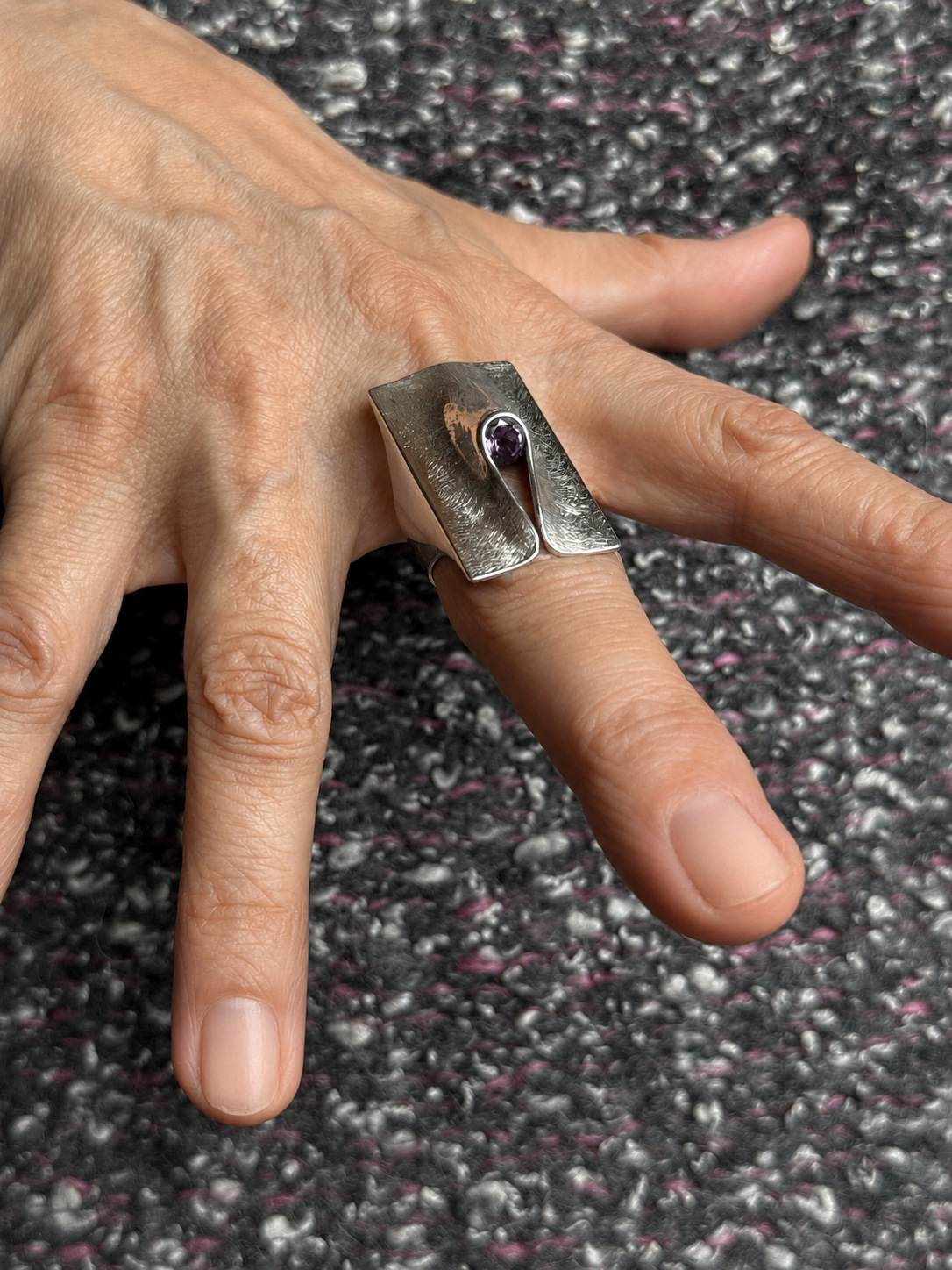
A small garnet sits within a broader mass of silver rather than rising as a very tall isolated centre stone. The composition shows how metal geometry can reduce edge exposure.
This does not prove the durability of that individual garnet from a photograph. It illustrates construction.
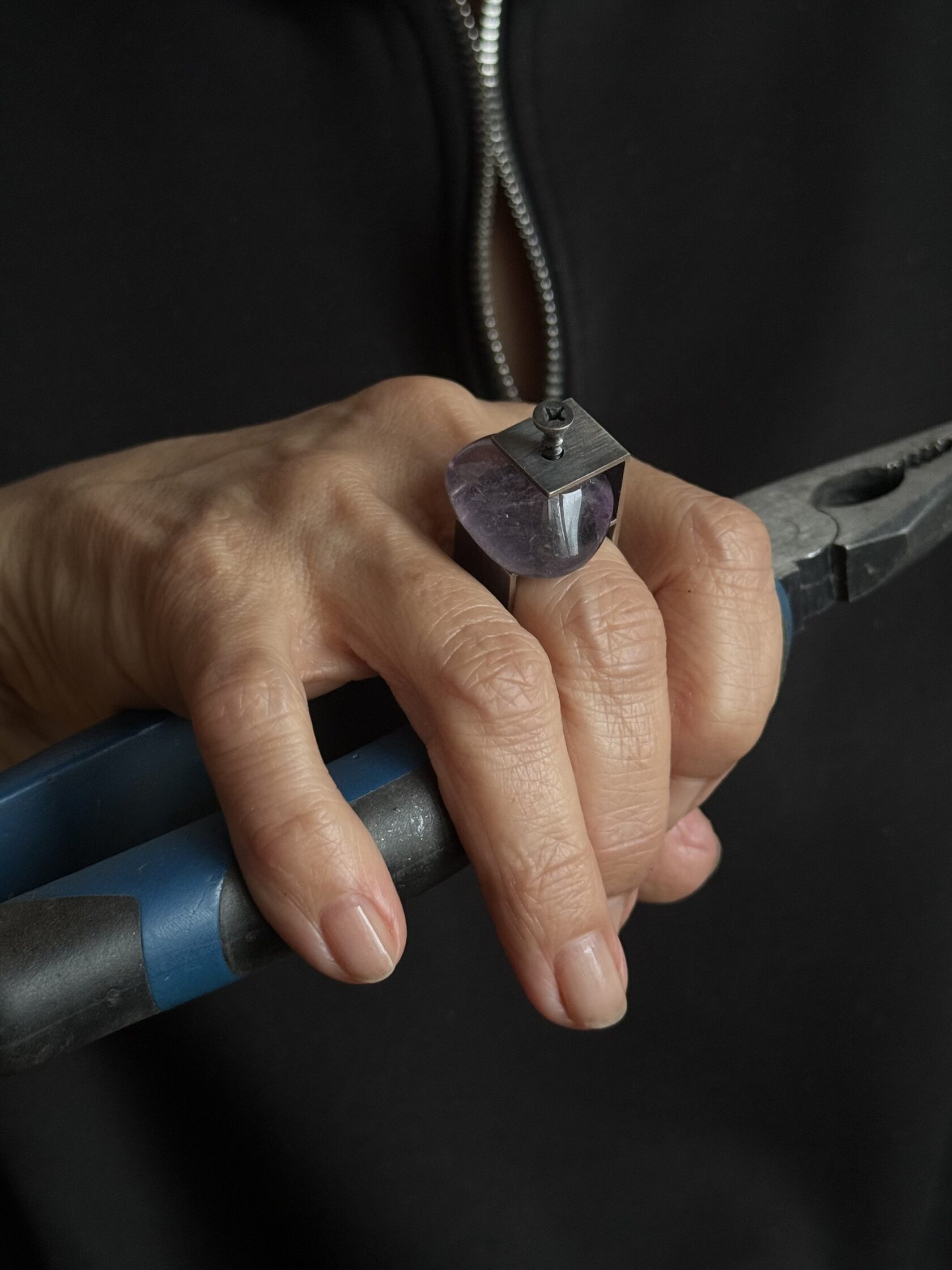
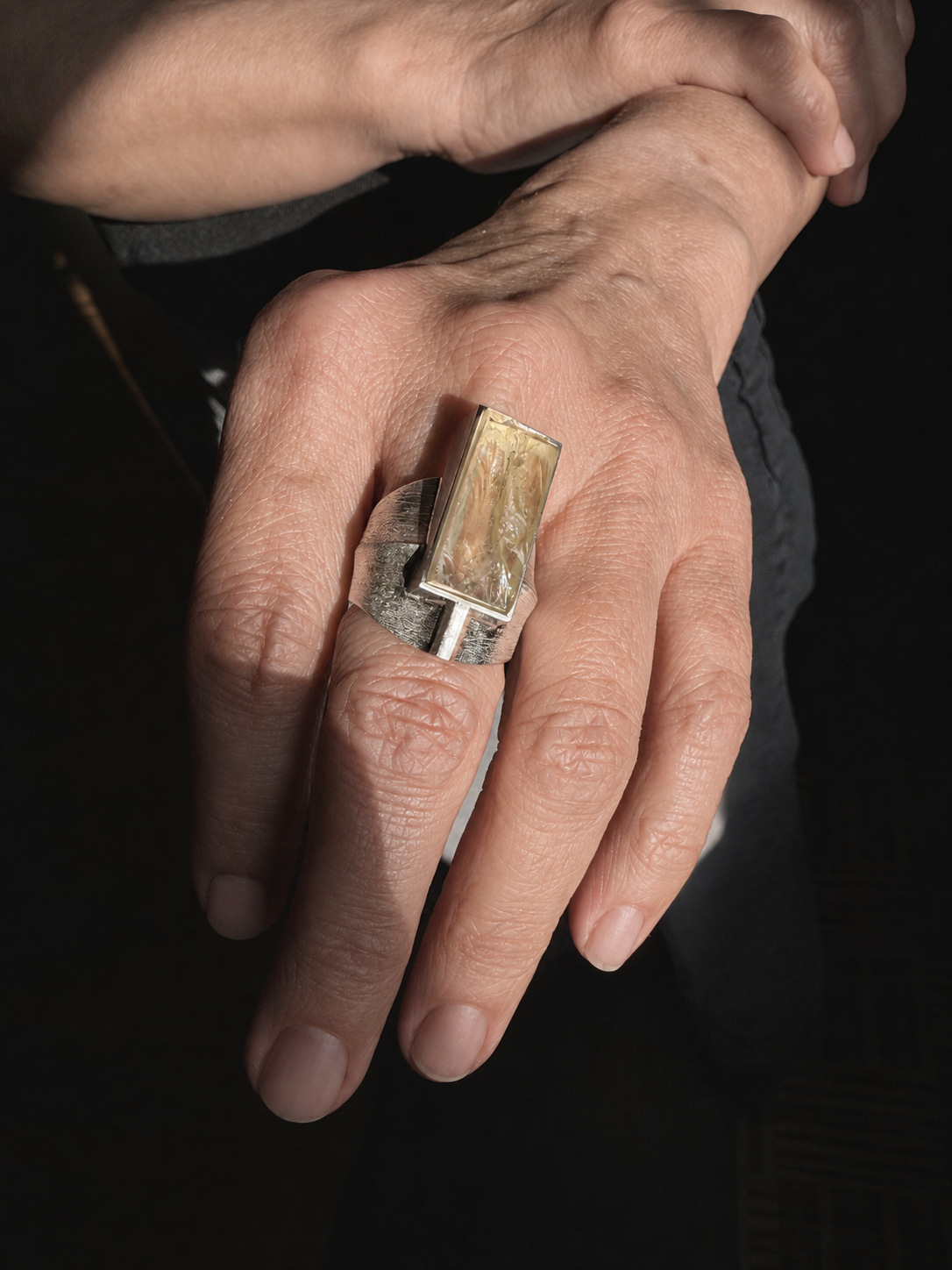
Here the gemstone is more visually exposed and the ring is built around the relationship between amethyst and the metal element. That exposure naturally suggests a more attentive wear pattern.
Again, the photograph does not tell us the durability of the individual amethyst, but it clearly shows form and exposure.
Daily without removing it, or often but with breaks?
Office, sports, household work, studio work and manual tasks create different exposure.
Are you comfortable removing the ring and following stone-specific care limits?
If it is, the design can be adapted around it rather than replacing it automatically.
A lower profile is usually easier for frequent wear.
Some people accept wear as part of the object’s life; others want a more stable appearance.
If the stone choice is still open, see How to Choose a Gemstone for a Custom Ring. If you already own the stone, see Can a Jeweler Use Your Own Gemstone in a Custom Ring?.
Diamonds, rubies, sapphires, spinels and chrysoberyl / alexandrite are often strong frequent-wear choices, but the final answer depends on the individual stone, design and lifestyle.
No. Mohs measures scratch resistance. Toughness, stability, cleavage, shape, setting and actual wear habits also matter.
Hardness is resistance to scratching. Toughness is resistance to chipping and breaking. Stability is resistance to heat, light, chemicals and environmental exposure.
Cleavage describes structural directions along which a mineral may split more easily after an unlucky blow. It is important, but it does not replace stability.
Labradorite can be used in rings, but it generally requires more considered wear than more durable everyday stones. Its hardness is around 6–6.5 Mohs and its pronounced cleavage makes protected edges, a lower profile and realistic wear expectations particularly important.
Yes, but turquoise requires more attention to high heat, chemicals, cosmetics, skin oils, perspiration and rough contact.
It can reduce edge and corner exposure, but it does not make the gemstone indestructible.
Yes. In that case profile, setting, wear habits and willingness to accept maintenance become more important.
Yes. Sharp corners, elongated points and thin edges are usually more vulnerable than compact, better-protected shapes.
Start with your real wear pattern, then choose the gemstone, shape, profile and setting as one system.
NEXT STEP / CUSTOM
A ring can be designed around your actual wear pattern rather than one simplified durability number.
Discuss a gemstone and ring designNEXT STEP / WORKS
See how different stones are used in real silver forms and ring profiles.
Explore NP Studio works