Forged Ring
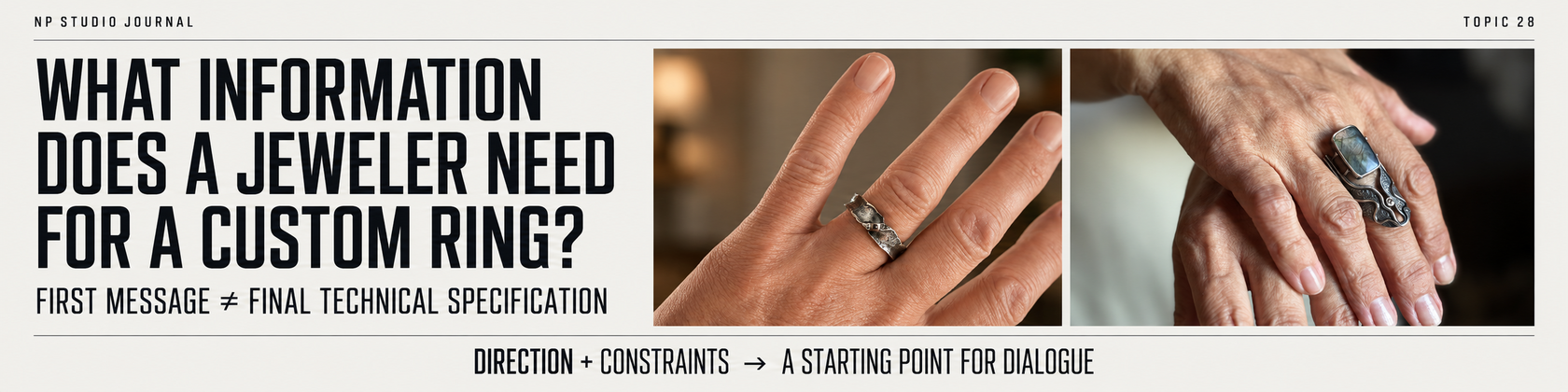
A reference can describe surface character and form rather than an exact repeat. A related commission may change size, width and surface roughness.
NP STUDIO / JOURNAL / CUSTOM RING BRIEF
A custom ring does not have to begin with a perfect drawing. For the first conversation, a jeweler usually needs to understand the direction: what kind of work you respond to, your ring size, how the piece should relate to the hand, preferred stone or color, a comfortable budget, and whether there is an important deadline.
That is enough to begin. Exact proportions, construction, stone setting, surface, weight and other technical decisions can often be developed together later.
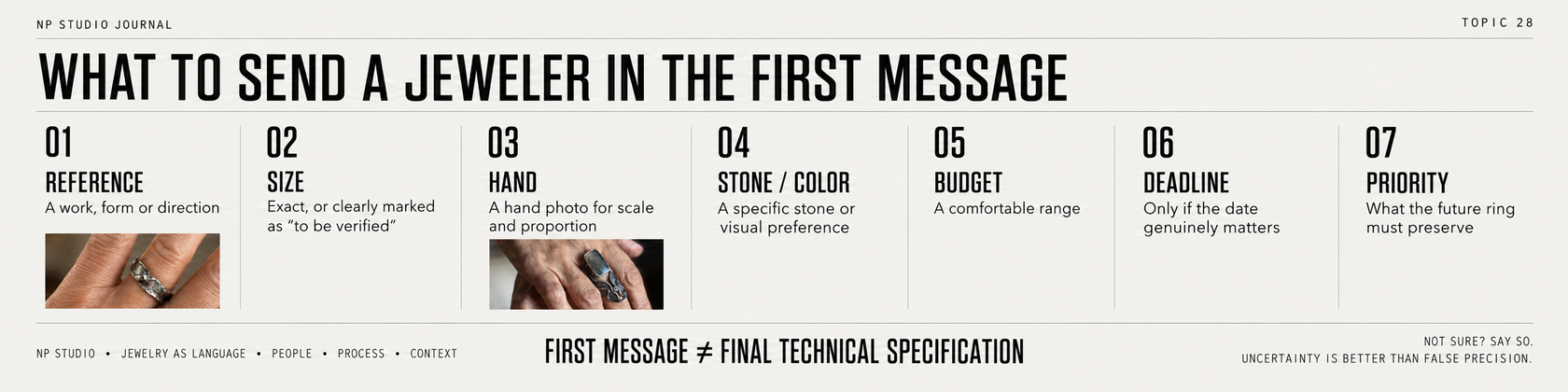
For a useful first message, send seven things: a link or image showing the direction, ring size, a hand photo if the ring is large or unusual, preferred stone/color/material, a comfortable budget range, a deadline if it matters, and a few words about what matters most. A first message is not a final technical specification.
“Beautiful” does not define a form. One person imagines a thin polished band; another imagines a heavy silver object with a large stone; another wants a long shape that changes the silhouette of the hand.
The jeweler does not need a long artistic manifesto. They need a few useful constraints that reduce guesswork. A good first message answers “what direction are we working in?” rather than “how should every technical step be executed?”
The easiest starting point is an object you already respond to. It may be a specific work by the maker, a collection, a form, a surface, a stone-and-metal relationship, a proportion, a mood or one detail you want to preserve.
A reference does not have to mean “make an exact copy.” For example, NP Studio’s Forged Ring can be a starting point because of its open form, hammer-made surface and patina. A new version can still change the size, width, degree of roughness and polishing.
Instead of only writing “I want this,” add one sentence explaining what matters in the reference. For example: “I do not need the exact form; I mainly like the rough surface and open shank.”
Ring size is one of the basic inputs. If you know it accurately, include it. If you do not, say that the size is approximate and still needs to be checked.
This matters especially for wide rings. GIA’s ring-sizing guidance treats wide rings separately because a wider band fits differently from a narrow one.
Also state the sizing system. A number alone can be ambiguous if one person means a US size and another means a Russian or European system.
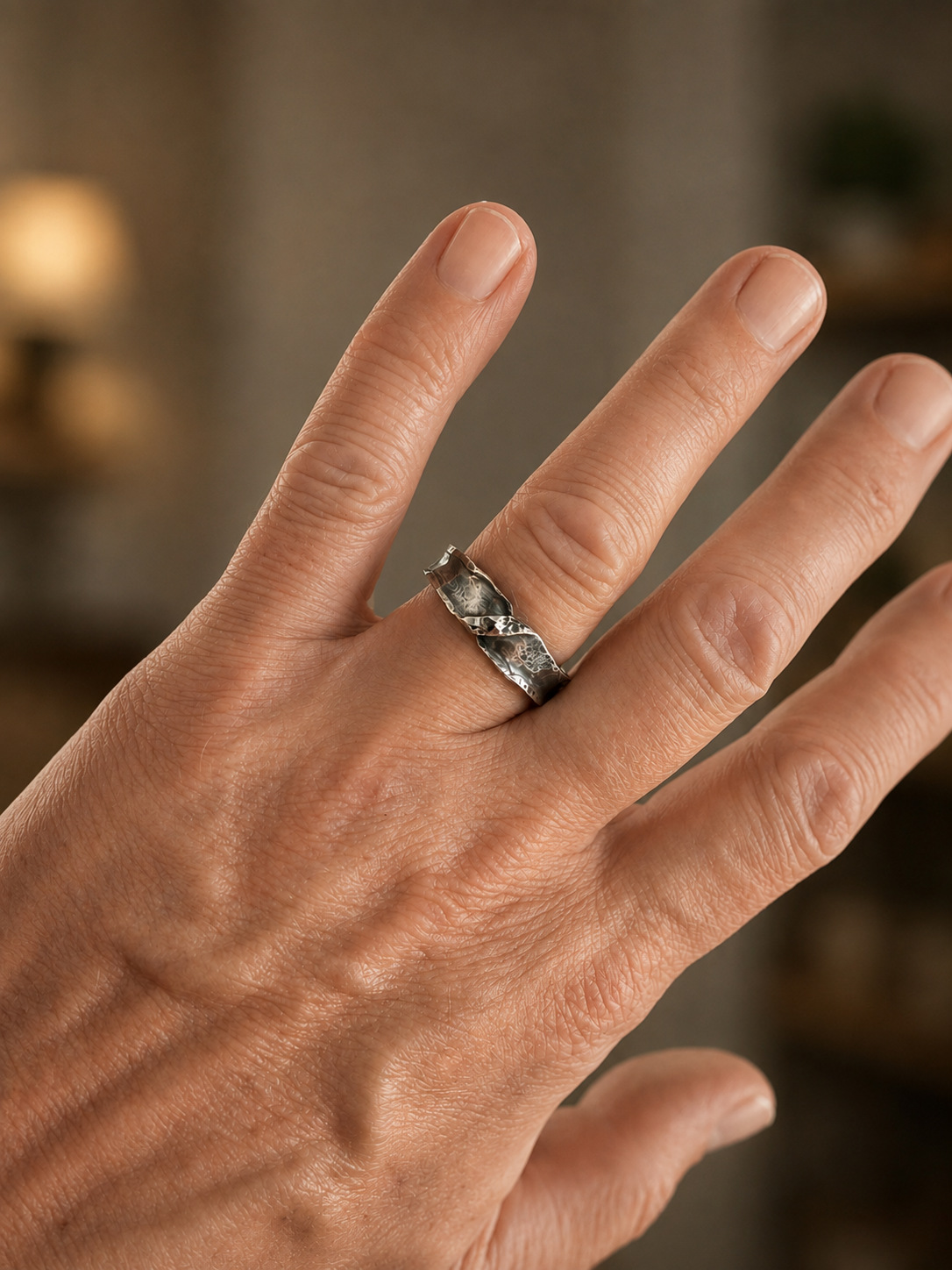
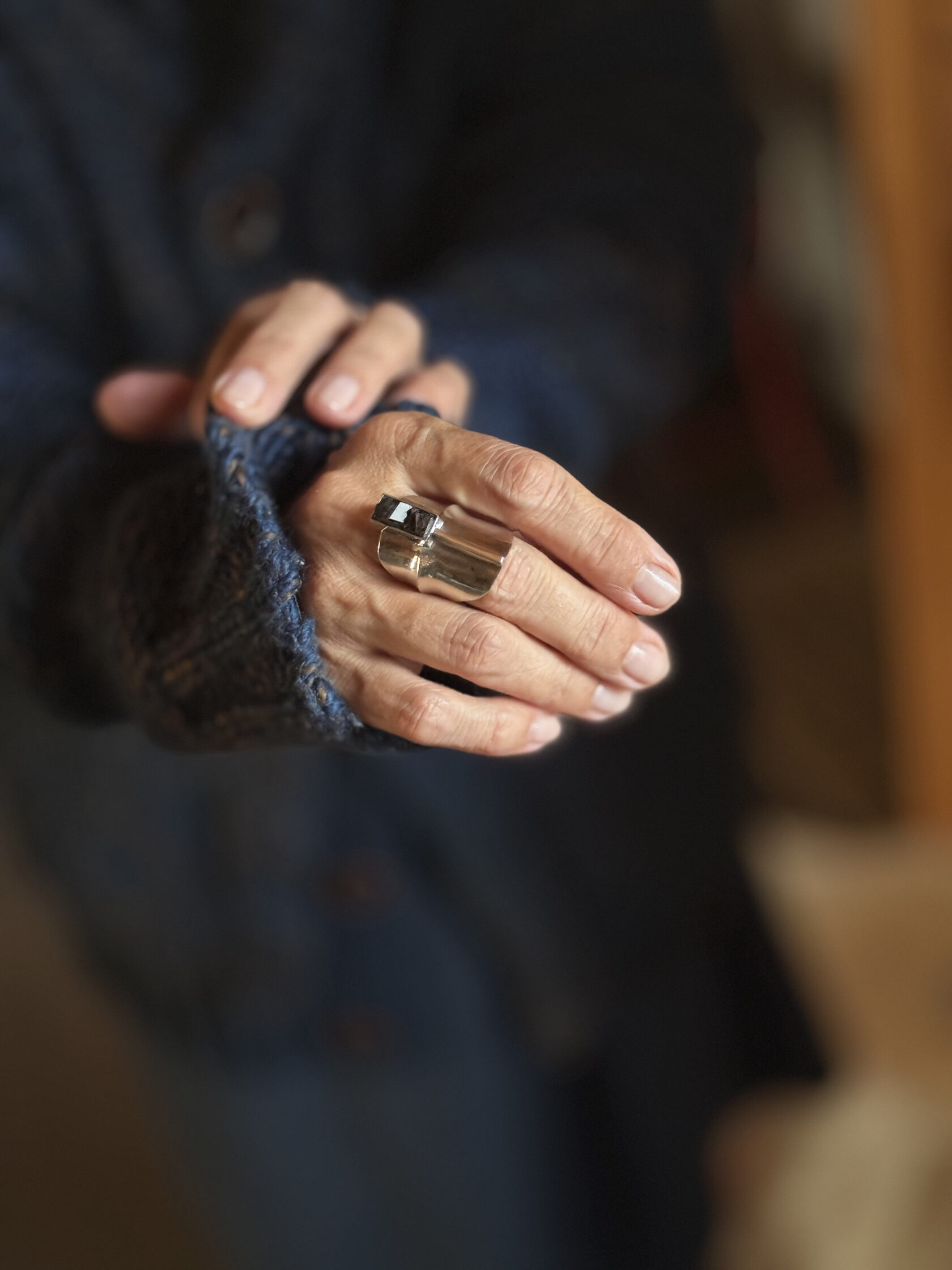
A hand photo is not necessary for every project, but it can be valuable for a large, elongated or sculptural ring. It helps the maker understand finger proportions, visual scale, top-section length, width, stone placement and how far the design may project beyond the finger.
Elongated with Labradorite has an upper section of about 45 mm. For a ring like this, proportion relative to the hand matters more than it would for a small conventional band.
A hand photo does not replace an accurate ring-size measurement. They provide different information.
If you have a specific stone in mind, say so. You can describe mineral, color, transparency, shape, rough or cut stone, and whether you want a large focal stone or a smaller accent.
If you do not know gemstone names, do not guess. “A cool grey-green translucent stone” may be more useful than an incorrect mineral name.
Also mention any material that is essential—or something you definitely do not want. A stone choice can affect more than color; it can influence setting, construction and realistic proportions. The dedicated gemstone discussion is in Topic №12.
Budget is not a test and it is not a promise to spend the maximum amount. It is a project constraint. A useful range helps the jeweler understand the realistic scale of metal, stone, construction and labor.
“Make it as cheap as possible” gives little direction. A range is more useful: “My comfortable range is around 18,000–22,000 ₽.”
If you do not yet have a number, say that you first want to understand the approximate price range. The full pricing discussion belongs to Topic №9; here, budget is simply one project input.
If the ring is needed for a specific date, mention it at the beginning: a gift, wedding, trip, anniversary or shipping deadline.
Not every project can be accelerated without changing the task. A stone may need to be sourced, a construction may need revision, or the maker may already have work in the queue. If there is no deadline, say so.
For the dedicated timing discussion, see Topic №8.
This is one of the most useful pieces of information and one of the easiest to omit. Usually one constraint matters more than the others: a particular stone, a very large top section, low weight, rough surface, everyday wear, a fixed budget or preserving one feature from an earlier piece.
When the maker knows the priority, it is easier to make decisions when requirements begin to conflict. For example, very large scale, minimal weight and high structural rigidity may require trade-offs.
A client does not need to arrive with engineering documentation. Details that can often be developed later include exact proportions, a specific stone chosen from several, patina tone, degree of polishing, placement of additional elements, setting details, thickness of individual components, final weight and fabrication sequence.
Those decisions belong to the dialogue and to the jeweler’s technical work.
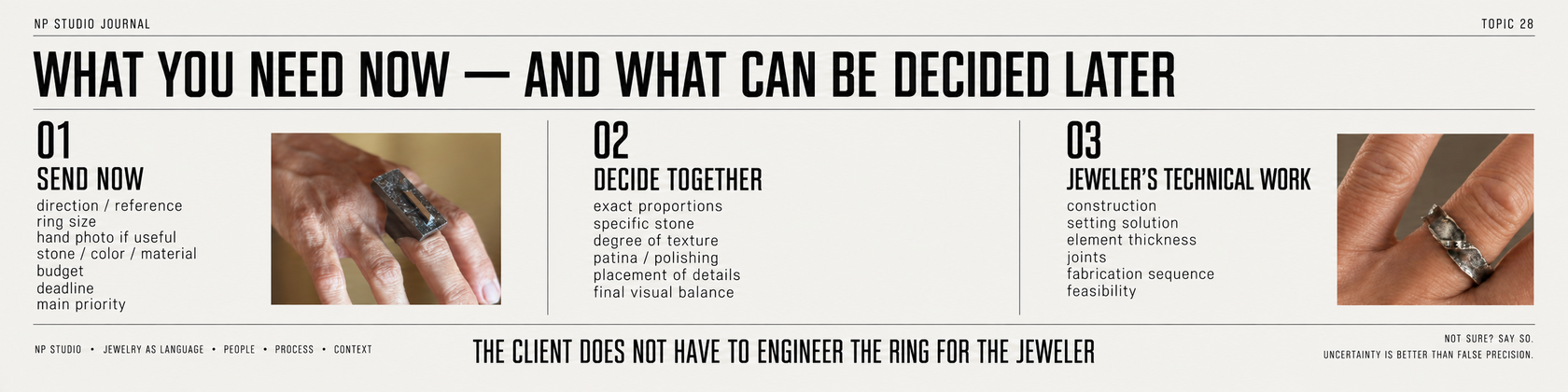
You do not necessarily need to know names of jewelry techniques, exact setting construction, sheet thickness, solder type, assembly method, exact final weight or have a professional technical drawing.
If you have technical experience and those details matter, include them. But lack of professional vocabulary should not prevent a useful first conversation.
The best option is to have the finger measured by a jeweler or use an appropriate sizing tool. GIA recommends taking the construction of the ring into account. Bands wider than about 4 mm are measured with wide-ring sizing gauges; a wide ring and a narrow shank can feel different on the same finger.
If your size is approximate: say that it is not confirmed; identify the sizing system; if possible, provide the size of a ring that already fits well; say which finger and hand will wear the new ring.
Do not hide uncertainty behind an artificially precise number.
Some information may not be available. You can send a photo of the person, photos of jewelry they already wear, approximate size from an existing ring, information about usual style and preferred colors or stones.
Separate facts from estimates. For example: “The existing ring appears to be about size 17, but I am not sure it is worn on the same finger.” That tells the jeweler how reliable the input actually is.
A large Pinterest folder can create more noise than clarity. If you have many references, label what each one means: I like the form here; I like the stone here; I like this surface; I like this scale; I definitely do not want this.
That makes it easier to understand which elements should be combined and which images only describe a mood.
The first message can be short. Before fabrication begins, however, the main parameters should be clear. The exact list depends on the jeweler and project, but it is useful to agree on object type, size, material, stone, overall design direction, approximate proportions, price, timing, payment method, delivery and what counts as the agreed result.
The FTC Jewelry Guides emphasize accurate descriptions of jewelry materials and characteristics. They are U.S. industry guidance rather than universal law, but the underlying principle is useful: metal, gemstone and other material descriptions should be specific rather than ambiguous.
For broader pre-order expectations, see Topic №14; for the overall custom process, see Topic №2.
The current NP Studio Custom page asks for a link to a work, ring size, a hand photo, preferred stone, comfortable budget and a short description. The Terms page additionally asks for a desired deadline if one is important.
This is one studio’s working method, not a universal industry standard. Another jeweler may begin with a sketch, video call, in-person fitting or stone selection.
The general principle is the same: the first stage needs enough information to define a direction, not a complete finished design.
A reference can describe surface character and form rather than an exact repeat. A related commission may change size, width and surface roughness.
Here hand proportions and ring size matter especially. Its upper section is about 45 mm long, so the design visibly works with the line of the fingers.
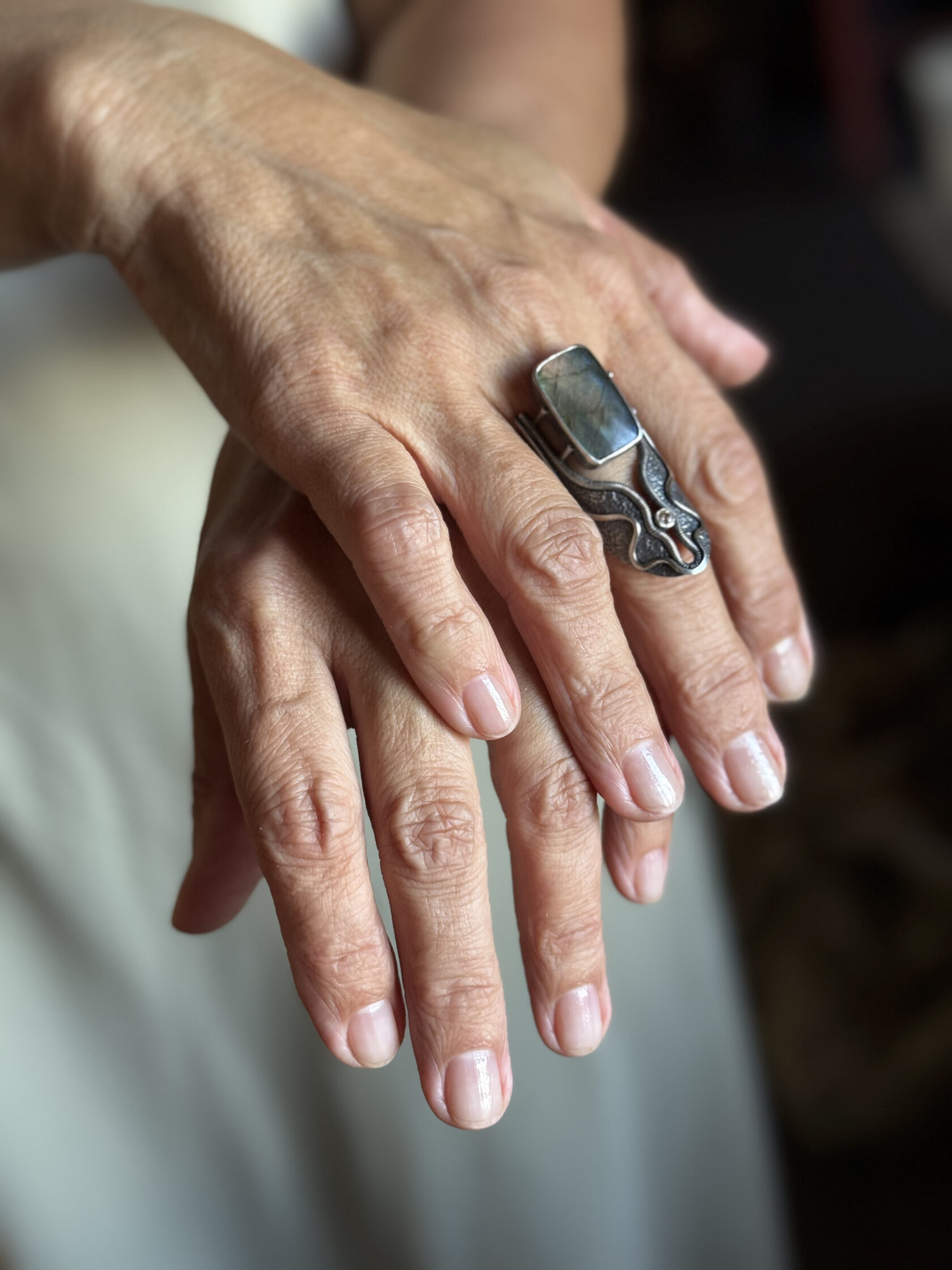
The reference may be a construction idea—a hollow dimensional box and stone-impressed surface—even if a new version changes proportions.
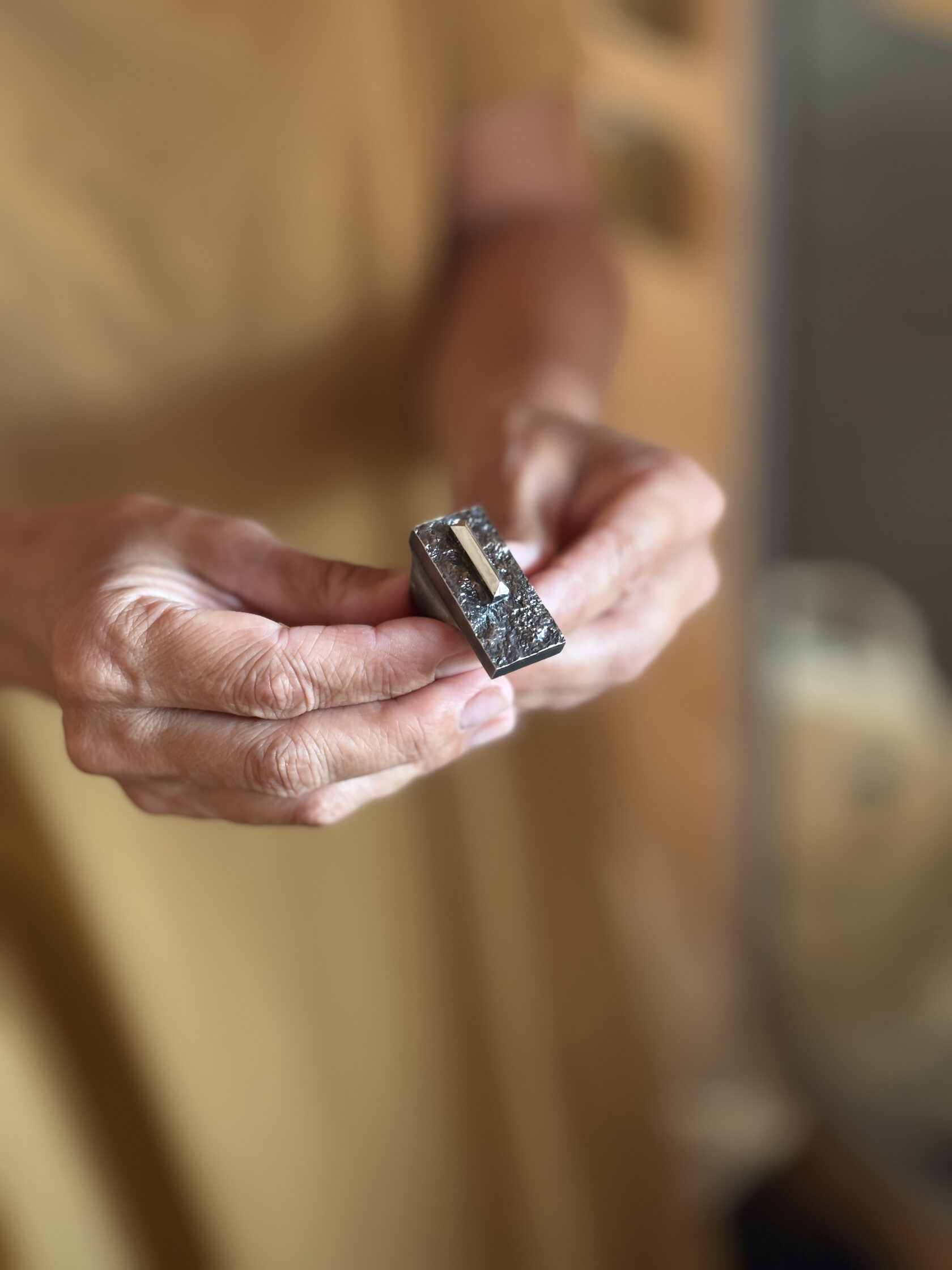
The starting point may be the combination of geometry and a dark stone while the cylinder proportions and stone itself change.
“I relate to this ring: [link]. What matters most is the elongated shape and raised stone. My size is 17.5, but I will verify it. I am attaching a hand photo. I would like labradorite or a similar cool-toned stone. My comfortable budget is around 20,000 ₽. I do not have a hard deadline. The long silhouette matters most; the surface details can change.”
That is already enough for the jeweler to ask the next, more specific questions.
A jeweler does not need a perfect brief. They need honest starting information.
The best first message explains what to start from; who the ring is for and what size it should be; which stone or material matters; budget and timing constraints; which part of the idea should not be lost.
The clearer the priorities, the less guesswork both sides have to do.
Usually: a reference or direction, ring size, stone/material preference, budget range, deadline if relevant, and a short explanation of your main priority.
No. A sketch can help, but the client does not have to solve the technical design before the first conversation.
An accurate size is important for fabrication. For the first discussion, you can provide an approximate size as long as you clearly say it still needs verification.
For a large or sculptural ring, it helps the maker evaluate proportion and visual scale. It does not replace ring-size measurement.
Not always. You can begin with color, character, shape or a group of possible stones and refine the choice with the jeweler.
A comfortable range is useful because it helps define realistic scale, materials, stone and complexity.
Send the link and explain what you want to preserve: form, stone, surface, proportion or overall direction.
No. Clear ordinary language is more useful than a technical term you are unsure about.
Mention the date in the first message so the jeweler can judge whether the schedule is realistic.
Say so. Uncertainty is normal at the beginning of a custom project; the important thing is to separate confirmed information from estimates.
